Rain barrels vs rain gardens for community runoff
A standard rain barrel holds roughly 40–60 gallons, usually about 55. That sounds substantial until the catchment area is calculated: a 55-gallon barrel connected to a downspout serving only 300…
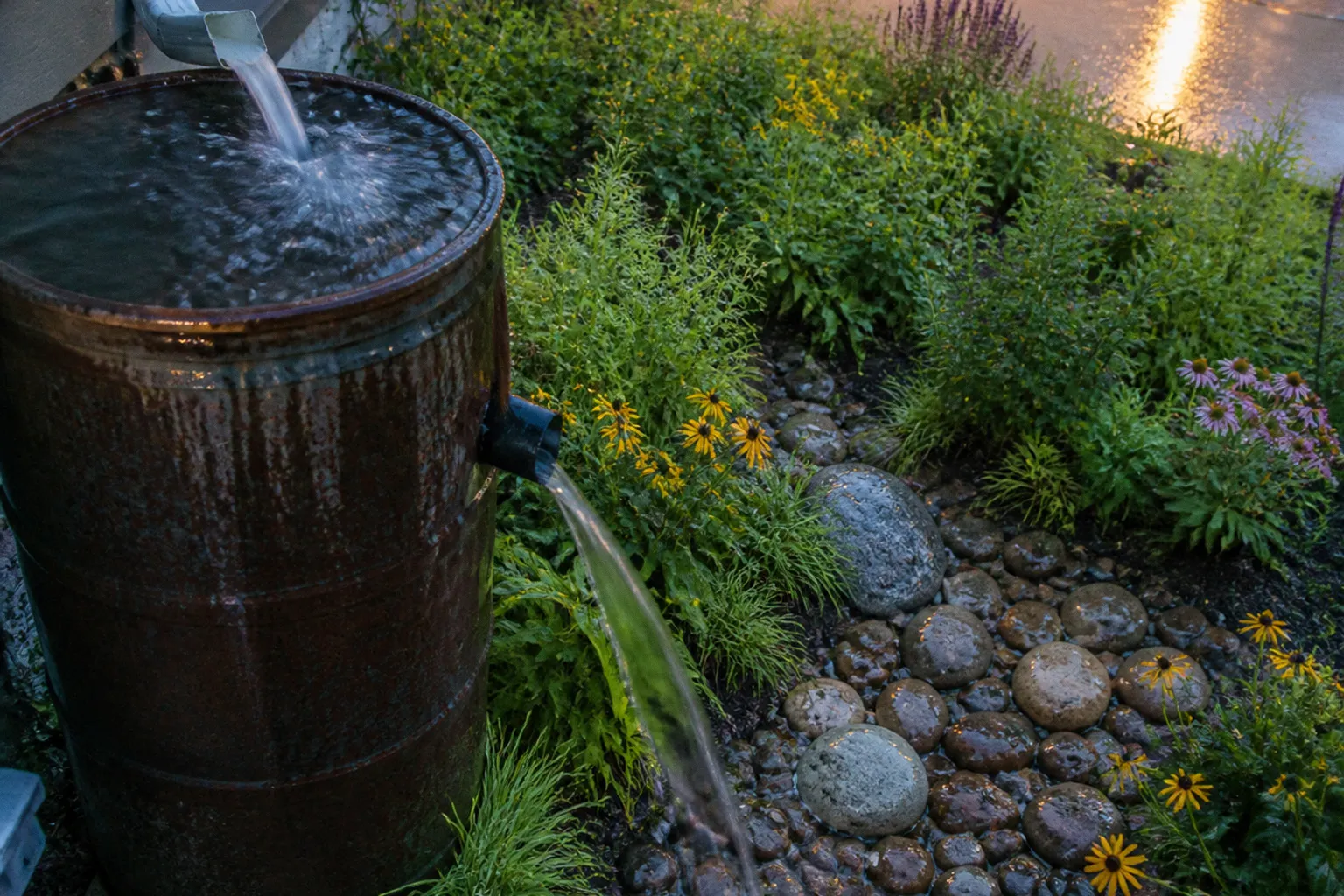
A standard rain barrel holds roughly 40–60 gallons, usually about 55. That sounds substantial until the catchment area is calculated: a 55-gallon barrel connected to a downspout serving only 300 square feet of roof can fill after approximately 0.3 inches of rain. After that point, the barrel is no longer managing runoff unless its contents are actively drained or its overflow is directed into another control measure.
Compare car rental deals in United Kingdom
See available offersPartner link — DiscoverCars comparisonRain gardens operate on a different logic. They do not store a fixed volume for later use; they receive runoff, filter it through soil, sand, and plant roots, and allow much of it to infiltrate into the ground. For community gardens, schools, rural campuses, and neighborhood facilities, the comparison is therefore not simply between two green products. It is a decision between temporary storage and passive infiltration, with different capacity limits, labor requirements, costs, and compliance implications.
The practical question is not which system is universally better. It is where each system should sit in the runoff chain, and whether the project has the operational capacity to keep the system functioning after installation.
Storage and infiltration solve different problems
Rain barrels are collection devices. They intercept water at a downspout, retain it in a sealed or screened container, and make it available for non-potable uses such as landscape irrigation. Their principal value is timing: they remove a portion of runoff from the immediate drainage event and hold it until the water can be used.
Rain gardens are bioretention landscapes. Their function is hydraulic rather than primarily consumptive. A shallow depression receives water from a roof, path, parking area, or other impervious surface. Engineered layers of soil, sand, mulch, and vegetation slow the flow, remove sediment, and promote infiltration.
That distinction matters for environmental projects driven by community groups. A school campus may benefit from both systems, but they produce different impact metrics:
- A rain barrel can be measured by gallons captured, gallons reused, and the number of irrigation events supported.
- A rain garden can be measured by its contributing drainage area, infiltration performance, planted surface area, and reduction in uncontrolled discharge.
- A barrel requires recurring operational intervention; a rain garden requires suitable design, soil preparation, and periodic landscape maintenance.
- A barrel creates a visible water resource for teaching and gardening, while a rain garden provides a broader stormwater-management function with less direct water reuse.
- A barrel has a hard storage ceiling. A rain garden has no single fixed capacity, although soil permeability, available footprint, saturation, and overflow design impose practical limits.
For community gardens, the strongest case for rain barrels is usually water substitution. The system can reduce demand for treated municipal water during dry periods, particularly when irrigation is scheduled and the barrel is drained between storms. The strongest case for rain gardens is runoff routing: they continue to receive and process water without requiring a volunteer to empty a tank first.
A rain barrel is a water-saving asset; a rain garden is a drainage asset. Confusing those functions produces weak designs and inflated impact claims.
Capacity limits are visible in the rainfall math
The basic water-volume calculation makes the difference between the two systems difficult to ignore. The EPA WaterSense formula estimates collected roof runoff as:
Roof area in square feet × rainfall in inches × 0.623 × 0.85
The 0.623 factor converts rainfall over a square-foot area into gallons, while the 0.85 efficiency factor allows for losses from wetting, evaporation, and conveyance. On a 1,000-square-foot roof, one inch of rain produces approximately 530 gallons of runoff under this calculation.
A single 55-gallon barrel can therefore capture only a small fraction of a substantial roof event. Even a smaller roof section can fill it quickly. If a downspout drains 300 square feet, approximately 0.3 inches of rainfall is enough to fill the barrel completely. Any additional water must pass through an overflow route.
This is not a design flaw. It is the expected behavior of a small storage vessel. The problem begins when a project counts the barrel’s nominal capacity as though it were a continuous runoff reduction figure. A barrel installed in early spring may capture 55 gallons during one storm and remain full during the next several events, contributing little additional control until the stored water is used.
A rain garden shifts the calculation from container volume to receiving capacity. Its performance depends on:
- The surface area and depth of the depression.
- The permeability of the soil and any engineered growing medium.
- The volume of water entering from the contributing roof or paved area.
- The time available for infiltration before the next storm.
- The presence of native or well-adapted plants with root systems suited to alternating wet and dry conditions.
- The location of the overflow route when the garden is saturated.
The absence of a hard capacity ceiling does not mean a rain garden can accept unlimited water. A compact garden built on slow-draining soil will not manage the same inflow as a larger installation with a suitable soil profile. The practical advantage is that its capacity is distributed through the landscape rather than concentrated in one tank.
A direct comparison
| Parameter | Rain barrels | Rain gardens |
|---|---|---|
| Primary function | Capture and store water for later non-potable use | Filter, slow, and infiltrate runoff |
| Typical capacity | 40–60 gallons per standard barrel | Determined by footprint, soil, depth, and infiltration rate |
| Response to repeated storms | Performance declines when the barrel remains full | Can continue receiving runoff if designed with adequate drainage and overflow |
| Water reuse | Directly supports irrigation and similar non-potable uses | Water is primarily returned to the soil and groundwater system |
| Labor requirement | Regular draining, inspection, and overflow management | Seasonal planting and maintenance, plus inspection after major storms |
| Educational value | Demonstrates water harvesting and household demand reduction | Demonstrates watershed processes, soil filtration, and habitat value |
| Main failure mode | Full barrel with unmanaged overflow | Saturated or poorly located garden causing ponding or erosion |
| Typical project fit | Small roof sections, gardens, schools, community workshops | Larger drainage areas, campus edges, downspout corridors, public landscapes |
The correct capacity model is cumulative, not symbolic. A project should estimate how often a barrel can be emptied, how much water is likely to be reused, and where the next storm will go if the tank is full. For a rain garden, the equivalent analysis is the contributing area, infiltration rate, and overflow path.
Economic considerations for community-led projects
Rain barrels often have a lower entry cost and a simpler installation pathway. Commercial models average roughly $120–$160, while basic units may cost around $60–$80. Community workshops using food-grade drums can bring the material cost closer to $50, although the lower price depends on local access to safe containers, fittings, screens, stands, and tools.
The apparent affordability can be useful for environmental education programs. A school or neighborhood group can install multiple units, label them, and track the volume captured and reused. The project creates a clear relationship between rainfall and resource allocation: water that would have entered a drain is redirected to planting beds, tree establishment, or campus landscaping.
However, the financial comparison changes when labor is included. A low-cost barrel still needs:
1. A stable base capable of supporting the filled container.
2. A secure connection to the downspout.
3. A screened inlet or lid to reduce debris and mosquito access.
4. A spigot or pump suitable for the intended users.
5. An overflow route that does not undermine a foundation, path, or planting bed.
6. A drainage routine after rainfall so the barrel has available capacity for the next event.
7. Seasonal preparation in regions where freezing can damage fittings or the vessel.
The cost of a rain garden is less standardized because excavation, soil amendment, grading, edging, plant selection, and site access vary significantly. It may require more capital at the beginning, especially where compacted urban soil must be removed or replaced. Yet the system can provide multiple outputs beyond runoff control: pollinator habitat, shade-compatible planting, improved campus appearance, and a visible environmental education site.
For an NGO, the relevant question is sustainable yield rather than purchase price alone. A barrel program may show strong initial participation but weak long-term performance if volunteers cannot maintain the drainage schedule. A rain garden may require a larger launch budget but deliver more consistent passive control once the landscape is established.
A simple project budget should separate the following categories:
- Capital materials: containers, fittings, soil media, plants, edging, and signage.
- Installation labor: excavation, grading, downspout conversion, and safety work.
- Maintenance labor: watering during plant establishment, weeding, sediment removal, and repairs.
- Monitoring: rain gauges, volume logs, infiltration observations, or student data collection.
- Contingency: overflow correction, replacement plants, damaged fittings, and access repairs.
This separation prevents a common accounting error: treating volunteer labor as free capacity. Volunteer time is a resource allocation decision. If the same people are responsible for school repairs, tree planting, waste collection, and community education, a system with high manual demands may underperform even when its equipment cost is low.
Regulatory hurdles are not optional details
Rain barrels are often perceived as low-risk because they are small and familiar. In practice, their installation still affects drainage behavior around buildings. An improperly secured barrel can tip, an unsealed container can become a vector-control concern, and an unmanaged overflow can direct water toward foundations or erode soil.
More importantly, municipal building and stormwater codes generally do not treat rain barrels as direct substitutes for rain gardens or other bioretention measures. A barrel may reduce the volume discharged during selected events, but it does not provide the same continuous infiltration function. A compliance plan that requires a bioretention area cannot normally be satisfied by replacing that area with a row of storage containers without formal approval.
For community projects, this creates a distinction between supplementary control and approved control:
- Supplementary control improves local water use and reduces some runoff.
- Approved control is designed and documented to meet the requirements of the relevant authority.
- Educational infrastructure can support both, but public messaging must not imply regulatory equivalence where none exists.
The regulatory review should begin before materials are purchased. At minimum, the project team needs to establish whether local rules address:
- Rainwater harvesting and non-potable reuse.
- Downspout disconnection.
- Setbacks from building foundations and property boundaries.
- Overflow discharge and erosion protection.
- Mosquito prevention and container screening.
- Excavation near utilities.
- Accessibility and public safety on school or community grounds.
- Stormwater obligations for institutional or commercial sites.
A school campus may also have internal facilities requirements that are more restrictive than a residential installation. Insurance, child safety, maintenance access, and responsibility for water quality all become relevant when students or volunteers use the system.
The most robust approach is to document the system as a drainage assembly, not as a decorative garden feature. Drawings do not need to be elaborate, but they should identify the source area, conveyance route, storage or infiltration component, overflow direction, and maintenance owner. This creates accountability and reduces the risk that a project will fail when the original volunteer coordinator leaves.
Integrating both systems across a campus or neighborhood
The rain barrels versus rain gardens comparison becomes more productive when treated as a network-design question. A large community site rarely has one uniform runoff problem. Roofs, paths, compacted courtyards, gardens, and sloped road edges generate different flows. Applying one intervention everywhere is usually less efficient than assigning each intervention to the location where it performs best.
A practical integration model uses barrels near active irrigation demand and rain gardens where runoff needs to be slowed or infiltrated. For example, barrels may be positioned beside a school kitchen garden or tree nursery, while overflow is routed into a planted bioretention area. In that arrangement, the barrel captures the first portion of the runoff for reuse; the rain garden receives overflow and manages the remaining flow.
This configuration creates redundancy. If the barrel is full, the overflow system still has a destination. If the garden is temporarily saturated, the barrel may still provide a controlled storage volume once it is drained. The two components are not interchangeable, but they can be complementary.
A staged framework for project planning
1. Map the contributing surfaces.
Identify roof sections, paved areas, slopes, drains, and existing low points. A barrel attached to a small roof section may be appropriate, while a large paved area may require a broader infiltration or conveyance solution.
2. Quantify the inflow.
Use roof area and expected rainfall events to estimate the volume generated. The EPA formula provides a consistent starting point, but local rainfall patterns and roof efficiency will determine actual performance.
3. Assign the functional objective.
If the objective is irrigation substitution, storage is relevant. If the objective is reducing uncontrolled discharge or supporting groundwater recharge, infiltration is the more appropriate metric.
4. Design the overflow before installing the primary device.
A full barrel without a safe overflow route is an incomplete system. The same applies to a rain garden without a defined exceedance path during saturated conditions.
5. Match maintenance to ownership.
Name the person, school department, NGO team, or community committee responsible for inspection and seasonal work. Avoid assigning a system to an undefined group.
6. Track performance with modest but consistent metrics.
Useful measures include gallons reused, number of irrigation cycles supported, days of standing water, visible erosion, plant survival, and maintenance hours. These metrics are more defensible than broad claims about saving the watershed.
7. Review the design after one wet season.
The first season reveals whether the system receives the expected flow, whether the soil drains within an acceptable period, and whether users can maintain the equipment. Adaptation is part of responsible infrastructure management.
For organizations working across rural schools, standardization can reduce procurement and training costs. A repeatable barrel kit may include the same screened lid, overflow fitting, stand, signage, and maintenance instructions at each site. Rain gardens cannot be identical in every location, but their design process can be standardized through site surveys, planting palettes, and inspection forms.
The scalable unit is not the barrel or the garden. It is the operating model that connects design, ownership, monitoring, and funding.
Measuring impact without overstating it
Environmental initiatives often lose credibility when they report the easiest number rather than the most meaningful one. Counting installed barrels or planted square feet demonstrates activity, not necessarily function.
A stronger reporting structure separates outputs from outcomes:
| Reporting level | Example metric | What it demonstrates |
|---|---|---|
| Installation output | Number of barrels, gardens, or downspout connections completed | Deployment scale |
| Operational output | Gallons captured and reused; maintenance visits completed | Whether the infrastructure is being used |
| Environmental outcome | Reduced uncontrolled discharge, functioning infiltration areas, improved soil cover | Local performance |
| Institutional outcome | Students trained, volunteers retained, maintenance ownership documented | Program durability |
| Financial outcome | Cost per functioning site and annual maintenance requirement | Scalability and funding efficiency |
Rain barrels are particularly suitable for direct volume accounting. Their capacity is known, and water use can be logged by event or by irrigation cycle. The reported number should distinguish between theoretical capacity and actual turnover. A 55-gallon container that is emptied repeatedly may support meaningful reuse; five full containers that remain unused may provide little additional value after the first storm.
Rain gardens require a different evidence base. The project can document the area receiving runoff, the condition of the planting and soil layers, the duration of ponding after rain, and whether overflow reaches intended drainage points. It should not claim a universal citywide flood reduction percentage without site-specific hydrological data. Soil types, rainfall intensity, urban density, and maintenance conditions vary too widely for a single figure to apply across all communities.
The same discipline applies to financial return. Rain barrels may reduce municipal water demand for outdoor irrigation, with an estimated average saving of about 1,300 gallons during peak summer months for homeowners under suitable conditions. That figure should not be transferred automatically to a public campus or community garden. Usage patterns, rainfall, irrigation schedules, and local water tariffs determine the actual result.
A project dashboard can remain compact:
- Water reuse: gallons used for non-potable irrigation.
- Runoff routing: percentage of connected downspouts with a verified overflow path.
- Infiltration performance: observed drainage time and recurring ponding locations.
- Maintenance reliability: scheduled inspections completed versus planned.
- Asset condition: damaged fittings, blocked inlets, dead plants, or erosion.
- Community participation: trained operators and active site stewards.
These indicators support funding decisions because they reveal bottlenecks. If installation targets are met but maintenance completion is low, additional capital purchases are unlikely to solve the problem. If barrels fill quickly and remain full, the constraint is not collection capacity but water demand or drainage design. If rain gardens fail to drain, the project needs soil or siting corrections rather than more plants.
The strategic choice for local sustainability campaigns
For a single household or small garden, a rain barrel may be the simplest way to begin harvesting roof runoff. Its cost is comparatively accessible, its educational value is high, and its benefit is easy to explain. But its performance depends on active management, and its storage volume is modest relative to the runoff generated by even ordinary roof areas.
For a school, community center, or NGO-managed campus, the decision should be made at the drainage-network level. Barrels are well suited to locations with predictable irrigation demand and responsible operators. Rain gardens are better suited to areas where water must be slowed, filtered, and infiltrated without depending on daily volunteer action. In many cases, the best design is a controlled sequence: barrel storage first, then a properly designed overflow route into a rain garden or other approved landscape feature.
The project should not present the two systems as competing symbols of environmental commitment. They are infrastructure components with different performance envelopes. A barrel cannot replace a rain garden where passive infiltration or regulatory compliance is required. A rain garden cannot provide the same direct, measurable supply of water for a nursery or vegetable plot.
For organizations expanding environmental awareness programs across multiple schools, the funding priority should be operational continuity. Finance the overflow paths, site assessments, training, inspections, and replacement materials alongside the visible installations. Policy teams should treat small-scale harvesting as a supplement to, not a substitute for, broader stormwater planning.
The most defensible conclusion is straightforward: use rain barrels where stored water will be consumed, use rain gardens where runoff needs to be processed, and connect the two when the site can support a safe, maintainable sequence. That approach produces clearer impact metrics, fewer compliance conflicts, and a higher sustainable yield from every dollar invested in community runoff control.