School campus greening: a roadmap from plan to planting
A greening project dies before the first shovel hits soil. We have watched it happen: a burst of weekend energy, a truckload of saplings, a photographer from the local paper. Then summer break arrives. Nobody is assigned to water. The sprinkler valve seizes.
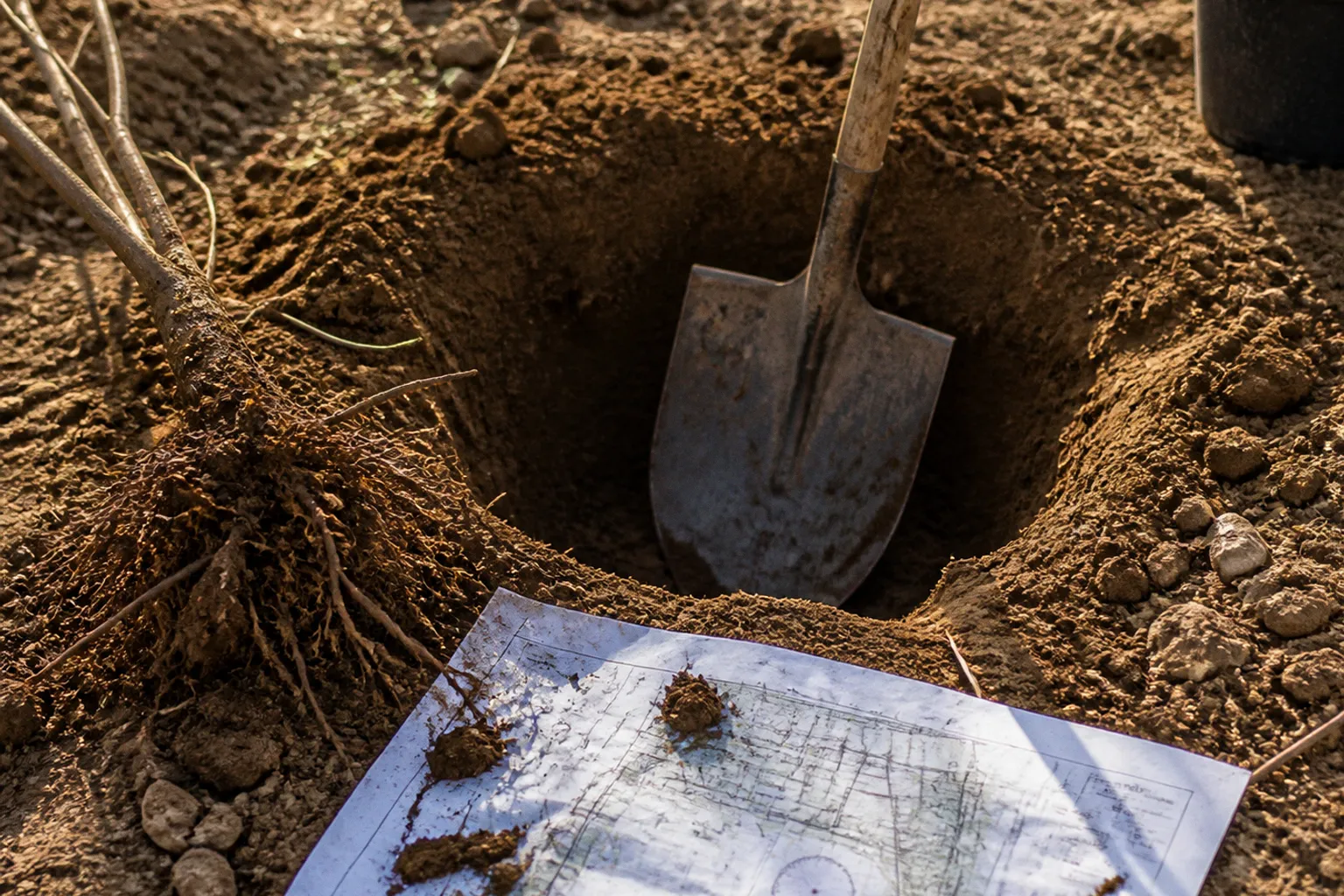
By September, half the stock is dead, the rest stunted, and the principal wants the whole mess cleared so it does not look like neglect during the next inspection.
The failure point is almost never the planting. It is the absence of a load-bearing plan — a structure that holds the project upright through dry weeks, administrative reshuffling, and the turnover of student volunteers. A successful school campus greening project is less about one impressive planting day than about a sequence of decisions made in the right order: who owns the work, what the site can support, how water will move, how plants will be spaced, and who will still be responsible when the original volunteers have moved on.
What follows is the field-tested sequence we use when a school commits to re-greening its grounds: from building the team that owns the work, through the dirt-level site audit, to the planting details and maintenance arrangements that allow the project to survive a holiday, an exam period, or a monsoon.
Building the Foundation: Governance and Committee Structure
Before you specify a single tree, anchor the project to a committee. This is not a formality — it is the chassis. Without it, the initiative scatters the moment the driving teacher or parent coordinator moves on.
A functional campus greening committee needs four seats at minimum:
1. Facilities lead — the person who controls the keys, water mains, site access, and maintenance budget. This may be a groundskeeper, vice-principal, administrative officer, or another member of staff with practical authority.
2. Curriculum link — a teacher willing to connect planting beds, tree surveys, composting, and rain gardens to actual lesson plans. Biology, geography, design, and mathematics can all find legitimate points of contact. If the project remains extracurricular only, it loses institutional priority during exam season.
3. Student captain — not a token position. This person coordinates the volunteer rota, flags broken equipment, and reports on plant health. Give them a clipboard, a watering schedule, and the authority to call the facilities lead when a pipe leaks.
4. External operations contact — the liaison with whichever NGO, volunteer network, municipal horticulture department, nursery, or community group is providing materials, transport, or technical advice. We have hauled compost across three districts on a Sunday morning because this link was secure. Without it, supplies sit in a warehouse while the planting window closes.
The committee does not need to be large. It needs to be legible. Everyone should know who can approve spending, who can authorize work near utilities, who holds the site plan, and who makes the call when the weather changes. A committee of twelve people that cannot make a decision is weaker than a committee of four with defined responsibilities.
The An Taisce Green-Campus Programme offers a useful example of how formal recognition can be organized. A school does not complete the full methodology before it registers. Registration comes first; the school then works through the programme’s required stages during an active implementation period. Those stages include forming a committee, conducting an environmental review, preparing an action plan, monitoring progress, connecting the work to learning, engaging the wider community, and developing a Green Charter. The order matters because registration establishes the framework within which the school records and demonstrates its work.
Schools that skip straight to a planting event often discover that they have no baseline, no agreed targets, and no evidence of what changed. The saplings may be real, but the project becomes difficult to manage and even harder to evaluate.
A committee without a facilities lead is a club. A committee without a student captain is a lecture. Both break under load.
Set a cadence early. Biweekly meetings of fifteen or twenty minutes are enough if the agenda is standing and practical: what got done, what broke, what needs hauling, what decision is blocked. No speeches. Keep minutes on a shared document rather than in a message thread that scrolls into oblivion.
The committee should also agree on what success means before anyone buys plants. That might include a functioning rain garden, shade along a particularly exposed walkway, a food-growing area used by several classes, reduced bare soil, or a maintenance system that students can operate safely. The point is not to collect the largest number of objectives. It is to choose outcomes that can be observed, maintained, and explained.
Site Analysis: Assessing Sunlight, Soil, and Spatial Constraints
Walk the grounds before you sketch a single bed. We carry a compass, a tape measure, and a soil auger — and we use all three in the first hour.
A campus is not an empty canvas. It is a working site with play areas, service roads, drainage channels, underground utilities, security requirements, shade patterns, and groups of children moving quickly through it. A planting plan that ignores those realities will eventually be cut back, fenced off, or removed.
Sunlight Mapping
Every edible garden bed, native flowering strip, and outdoor classroom needs enough direct sunlight for the plants selected. Six hours a day is a useful floor for many sun-loving crops, but the actual requirement depends on the species and the purpose of the bed. A shaded seating area does not need the same exposure as a vegetable plot.
Walk the site at several times of day during the growing season. A simple survey at 9 a.m., noon, and 3 p.m. will reveal more than a single visit. Mark shadow lines from buildings, boundary walls, covered walkways, and mature canopy trees. Plot them on a rough site plan and repeat the exercise when seasonal conditions change.
A bed that looks perfect in February can sit in full shade by May when a deciduous tree leafs out overhead. The reverse also happens: an apparently exposed corner may become uncomfortably hot once reflected heat from a wall or paved surface is taken into account. Note wind exposure as well. Young plants lose water quickly in corridors between buildings, while a sheltered corner may remain damp long after rain.
Soil and Drainage
The auger tells the truth. Pull cores at several points across any proposed planting zone rather than testing only the easiest patch to dig. Compare the surface layer with the soil below it. Construction spoil, compacted fill, and imported topsoil can sit within the same bed.
You are looking for:
- Compaction depth — if you hit a hard pan at shallow depth, roots will not penetrate normally. You may need to break that layer mechanically, improve the soil gradually, or build raised beds.
- Drainage behavior — a simple infiltration test can reveal whether water disappears quickly, remains for several hours, or sits at the surface. Poor drainage is a problem for many trees and vegetables, although a rain garden is deliberately designed to hold stormwater temporarily.
- Soil texture and structure — sandy soils drain quickly and may need organic matter; heavy clay can retain water but become airless when compacted. Neither condition is solved by adding a thin layer of compost and walking away.
- Existing vegetation — couch grass, lantana, and other aggressive species can indicate a site that will need sustained clearing and mulching. They will not politely make room for new plantings.
- Contamination risks — old painted structures, treated timber, dumping areas, and runoff from vehicle zones deserve particular caution before food crops are planted.
Drainage should be considered across the whole site, not only inside the future garden. Where does roof water go? Which paved areas send runoff toward a doorway? Where does sediment collect after a heavy storm? A school can spend money on a rain garden and still fail if the inlet is too small, the overflow has nowhere to go, or the basin is placed where children will compact its edges every day.
Spatial Budget
This is where people get generous and then get burned. Measure the total available ground, then subtract:
- Fire-lane and emergency-access clearances, according to local requirements.
- Utility corridors — buried water lines, electrical conduits, sewer runs, and inspection access points.
- Play-area buffer zones, where thorny species and low-hanging branches create avoidable hazards.
- Sightline requirements near gates, crossings, corners, and vehicle access.
- Space needed to move wheelbarrows, hoses, tools, and maintenance equipment.
- Areas that must remain open for assemblies, sports, deliveries, or future construction.
Call the relevant municipal or facilities office before digging. One spade through a clay sewer lateral can cost more than the entire planting budget. Mark known lines on the ground, but treat old site drawings with caution; school campuses change, and undocumented repairs are common.
What remains is the usable footprint. It is often substantially smaller than the mental picture everyone carried into the first meeting. That is not a reason to abandon the project. It is a reason to divide the site into phases. One well-maintained courtyard is more valuable than five neglected planting zones spread across the campus.
Designing for Resilience: From Rain Gardens to Tree Spacing
Design is where ambition meets physics. We design for neglect — because the project will be neglected at some point. The sprinkler will fail during a holiday. The volunteer rota will collapse during exam preparation. A storm will wash mulch onto a path. The design must survive those gaps without becoming dangerous or expensive to repair.
Tree Planting: The Hard Numbers
Trees anchor a campus green. They shade buildings, reduce the heat of hard surfaces, and create the visual canopy that makes the whole project feel real to students and administrators. But plant them wrong and you create a decade of maintenance headaches.
Spacing depends on mature canopy, root behavior, soil depth, wind exposure, and the amount of pruning the school can realistically afford. As a starting point, shrub-form species may need around two meters between plants, while canopy trees commonly require four to six meters. Those are planning ranges, not universal laws. A species label that says “small tree” is not a substitute for understanding its mature form.
Setbacks matter just as much. Large, fast-growing trees should not be placed close to classroom walls, underground services, drains, or narrow walkways simply because the young sapling looks harmless. A banyan or rain tree planted a few meters from a building can eventually lift paving, interfere with plumbing, or create a canopy that blocks gutters and windows. The cheapest planting location is not necessarily the cheapest long-term location.
The planting hole also deserves more care than it usually receives. A square or loosened-sided hole encourages roots to move outward into surrounding soil rather than circling a smooth, compacted cavity. Hole dimensions should match the size and condition of the root ball; a small sapling does not need an oversized pit filled with a different soil that roots may refuse to leave. The top of the root flare should remain at the correct level rather than being buried under a mound of mulch.
Before buying, record the intended mature height, canopy spread, water requirement, root behavior, and tolerance of heat or temporary flooding for every tree. A campus should not be planted as if every corner has the same climate. Native and well-adapted species are often the better choice, but “native” alone does not guarantee that a tree is suitable beside a playground or water line.
Rain Gardens: Engineered Drainage
A rain garden is not a decorative pond. It is a shallow, landscaped depression — often around 15 to 30 centimeters deep, depending on the site — that captures runoff from roofs and paved surfaces, slows it, filters it through an engineered soil profile, and allows it to infiltrate or move safely toward an overflow.
The soil mix matters more than the plants. A broadly sandy, free-draining mix may be appropriate for some rain-garden designs, while compost and finer material must be used carefully so that the basin does not seal over time. The precise specification should follow local soil conditions and the drainage test rather than being copied blindly from another campus.
| Component | Planning role | What to watch |
|---|---|---|
| Coarse sand or other free-draining material | Helps water move through the basin | Too much can leave the bed dry and nutrient-poor |
| Compost or mature organic matter | Supports plant growth and improves structure | Excessive amounts can reduce infiltration and release nutrients |
| Existing site soil | Provides local structure and affects infiltration | Heavy clay may require amendment, excavation, or a different design |
| Mulch | Protects the surface and reduces weeds | Keep it away from inlets and do not allow it to block overflow paths |
Plant the rain garden with species that can tolerate both saturated periods and dry intervals. Vetiver grass, canna lily, and local sedges may work in suitable climates, but the final list should come from local growing knowledge. Avoid ornamentals that require consistent moisture; the point is to accommodate a boom-and-bust water cycle, not to create a permanent wet border.
The inlet and overflow are as important as the basin itself. Protect the inlet from erosion with stone or another suitable surface. Make the overflow obvious and safe. If the garden is near a walkway, provide a clear edge or low barrier that prevents accidental falls without turning the site into a fenced-off exhibit. A rain garden should teach students how water moves, not merely hide the drainage problem behind ornamental plants.
Outdoor Classrooms and Garden Beds
Raised beds solve the compaction problem but introduce a material cost and a maintenance edge. Use untreated hardwood, durable local materials, or stone borders rather than railway sleepers or other treated timber that may leach unwanted compounds into soil. Make the beds accessible from both sides where possible; if students cannot reach the center without stepping into the bed, compaction will return immediately.
A shallow-rooted greens bed may work at around 30 centimeters high, while deeper-rooted crops need more soil volume. Do not treat those dimensions as a universal prescription. The right depth depends on the crop, the existing ground, and whether the bed is intended for short-term lessons or continuous production.
Orient beds north-south where possible to distribute sunlight more evenly across both sides. In hot climates, however, shade structures and afternoon exposure may matter more than orientation. Leave enough space between beds for a student group, a wheelchair, and a wheelbarrow to pass without crushing the planting edge.
An outdoor classroom also needs a relationship to the rest of the campus. Place seating where students can observe without crossing drainage channels or fragile beds. Provide a tool point, a hand-washing arrangement, and a place for harvested material or plant labels. These details turn a garden from scenery into infrastructure for learning.
Design for the gap week — the holiday, the exam break, the monsoon flood. If the system cannot survive two weeks without active human input, it will not survive year one.
Operationalizing Sustainability: Maintenance and Community Engagement
The planting day is a sprint. Maintenance is the marathon that nobody photographs. The first year should be planned as a sequence of changing responsibilities rather than one permanent volunteer rota.
Months 1–3: Establishment
New plants need close observation because their root systems are small and their tolerance for missed watering is limited.
- Water according to weather, soil, species, and plant condition. Daily watering may be necessary in hot, exposed conditions, but a fixed schedule can also encourage shallow roots or waste water after rain.
- Mulch beds and tree bases with roughly five to eight centimeters of suitable organic material. Keep mulch away from trunks, stems, drains, and rain-garden inlets.
- Inspect stakes, ties, guards, and hoses after storms. A loose tie can girdle a trunk; a displaced guard can become a trip hazard.
- Replace failed stock only after identifying why it failed. If the cause was waterlogging, reflected heat, poor handling, or a damaged root ball, simply installing an identical plant repeats the mistake.
- Record the nursery’s replacement policy in the purchase agreement before the stock arrives.
Months 4–6: Filling In
Once plants are established, the task changes from rescue to observation.
- Reduce watering where the plants and soil allow it, but do not confuse a less frequent schedule with abandoning the site.
- Watch for pest pressure, leaf-eating caterpillars, fungal spots, erosion, and weed competition after heavy rain.
- Check whether water is reaching the intended root zone rather than running off compacted soil.
- Rotate student teams weekly so knowledge does not concentrate in one group that graduates or leaves the school.
- Use simple records: date, area checked, condition observed, action taken. A few consistent notes are more useful than an elaborate monitoring system no one maintains.
Months 7–12: Ownership Transfer
By this stage, the facilities lead should assume responsibility for long-term maintenance budgeting. This means a line item, not a hopeful gesture. Mulch replenishment, hose replacement, seasonal pruning, tool maintenance, replacement plants, and occasional soil work all cost money.
Student captains can conduct a quarterly plant-health census: count surviving stock, flag dead or diseased specimens, measure canopy spread on trees, and note which areas are receiving too much or too little water. The purpose is not to turn students into unpaid grounds staff. It is to give them a meaningful role in observing the consequences of design decisions while ensuring that adults retain responsibility for safety and infrastructure.
The community-engagement piece runs parallel, not on top. Involve local residents and parent bodies from the beginning, with specific asks rather than inspirational speeches at the inauguration:
- donate clean mulch or suitable yard waste;
- provide access to tools or transport;
- help monitor the site during school holidays;
- share local knowledge about species that tolerate the climate;
- support a planting or repair day with a defined task and finish time.
Concrete work attracts more reliable participation than a general appeal to “support sustainability.” People show up for a job; they drift away from a vibe.
This is also where student-led greening initiatives can become durable rather than symbolic. Let students choose some of the questions they want the site to answer: Which corner is hottest? How quickly does water leave the rain garden? Which species attract pollinators? Which beds produce food through the longest part of the year? Give them a method, a boundary, and a way to present the findings. Ownership grows when students can see that their observations change the next decision.
Aligning with Global Standards: The Path to Green Certification
Formal recognition can help a school secure grants, municipal support, and administrative continuity. It can also become a distraction if the school starts collecting certificates before it has solved water access and maintenance.
The useful frameworks are not substitutes for a functioning site. They are ways to organize evidence, expose gaps, and show that the work extends beyond a single event.
The Green-Campus Programme: Registration Before Implementation
The An Taisce Green-Campus model is useful precisely because it treats greening as an ongoing institutional process. The school registers for the programme and then works through the required stages during an active period of implementation. The committee, environmental review, action plan, monitoring, curriculum connection, community engagement, and Green Charter are not paperwork to complete in private before anything happens on campus. They are parts of a cycle that the school must put into practice and document.
The programme requires a sustained implementation period before the school can apply for the Green Flag Award. That period is intended to show that the work has survived ordinary institutional pressures: a full summer, student turnover, budget scrutiny, and the inevitable failure of at least one hose or planting area.
The practical lesson is straightforward. Register when the school is ready to commit to the process, then build the evidence as the project runs. Keep environmental-review notes, meeting records, action-plan updates, photographs of work in progress, maintenance logs, and examples of student learning. A polished planting-day photograph is not evidence of sustainability on its own.
UNESCO’s Green School Quality Approach
The UNESCO Green School Quality Standard organizes school sustainability around four broad areas:
1. School governance — sustainability is embedded in management decisions and school policy rather than assigned to one enthusiastic teacher.
2. Facilities and operations — the campus addresses waste, water, energy, biodiversity, and the condition of its physical infrastructure.
3. Teaching and learning — sustainability is connected to meaningful learning across the school’s educational work, in ways appropriate to age, curriculum, and local context.
4. Community engagement — the school documents partnerships, participation, and effects that extend beyond the boundary fence.
There is no need to invent a rigid subject-count threshold to make this framework useful. A project can connect with science, mathematics, language, art, social studies, vocational learning, or practical maintenance without treating every connection as a box to tick. The stronger test is whether students are doing real intellectual or practical work with the site: collecting observations, interpreting results, making design decisions, communicating findings, and revising plans.
The Greening Education Partnership’s global ambition is to green at least half of schools in every country by 2030. In 2026, 2030 is roughly four years away, not five. That compressed horizon makes the gap between global ambition and ground-level capacity impossible to ignore. Many schools still lack reliable water, maintenance staff, shade, or secure storage for tools. The standard should therefore be used as a reference architecture and a source of direction, not as evidence that every campus can immediately meet the same level of performance.
The Biker Network Advantage
Here is where our operational model plugs in. Volunteer biker networks — the same crews that haul desks, paint walls, and rebuild roofs for rural schools — can bring a logistical backbone that many campus greening projects lack. We can transport bulk compost, saplings, tools, and gravel across districts in a coordinated run. We can organize planting days across several schools in a weekend circuit and move surplus stock from one site to the next when a school over-orders.
This is not charity tourism. It is supply-chain work with motorcycles instead of trucks. The same principles apply: route planning, load balancing, timing around weather windows, and a crew chief who knows which road washes out after heavy rain.
The network is most useful when it is integrated into the plan rather than called in for spectacle. Confirm the load, delivery point, unloading equipment, planting sequence, and storage arrangements in advance. A convoy that arrives before the beds are prepared creates a new problem: living stock sitting in the sun while volunteers search for tools. Logistics should remove friction from the project, not add a more photogenic version of it.
Before the first volunteer arrives, the committee should be able to answer a few unglamorous questions without debate. Who is present on planting day? Where are the utilities marked? What happens if rain interrupts the work? Where will mulch be stored? Who waters during the first holiday? Which budget covers replacement plants? Who records what was planted and where?
Those answers are the real pre-launch document. They can live in a site plan, a meeting note, a purchase order, and a maintenance rota rather than in a ceremonial binder. The critical point is that they exist, that named people can find them, and that the plan includes a backup for every task likely to fail.
A school campus greening project is not complete when the last sapling goes into the ground. It becomes real when the school can maintain it without the original organizer, explain it without the planting-day speech, and improve it using evidence from the site. Start with governance, measure the ground, design for the weeks when nobody is watching, and make the next planting cycle depend on what the first one taught you. That is how a green campus moves from plan to planting — and stays planted.