Rainwater harvesting vs greywater reuse for community projects
For partnership directors staging the next school convoy into a parched district, the question is rarely philosophical.
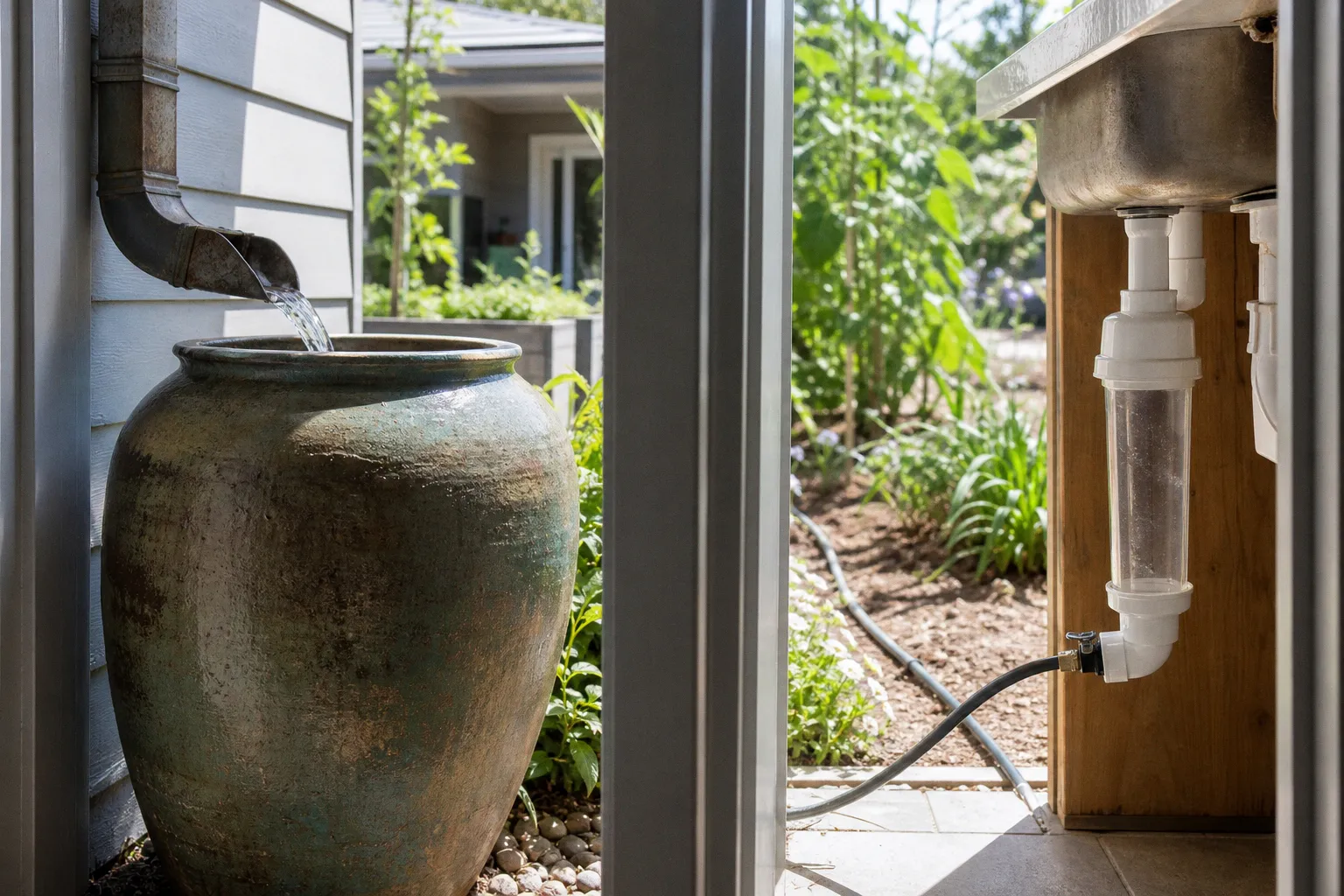
It arrives as a resource-allocation problem with measurable inputs: a 1,000-square-foot school roof receiving roughly 15 inches of annual rainfall can yield approximately 8,410 gallons of harvestable water per year, applying the conservative 90 percent efficiency factor that the University of Arizona Cooperative Extension recommends to account for first-flush diversion, splash loss, filter backwash, and overflow. That figure sets the scale of the conversation. Whether a community project should invest capital in rainwater harvesting infrastructure or in greywater reuse depends on supply-side arithmetic, regulatory thresholds, and the specific end use the budget is funding.
Compare car rental deals in United Kingdom
See available offersPartner link — DiscoverCars comparisonThis comparison is built for non-profit directors, partnership leads, and volunteer coordinators who need a decision framework, not a thesis. Two systems will be evaluated on yield reliability, source eligibility, treatment requirements, regulatory friction, operational overhead, and end-use alignment. The objective is to give each project team the metrics it needs to deploy scarce capital toward the option that actually matches local conditions and project goals—rather than toward the option that sounds most sustainable.
Calculating Potential Yields and Supply Reliability
Rainwater harvesting produces a calculable, weather-dependent supply. The standard formula—catchment area in square feet, multiplied by rainfall in inches, multiplied by the conversion factor of 0.623 gallons per square-foot-inch—yields theoretical annual collection. From there, standard engineering practice deducts a loss factor; 90 percent is the conservative benchmark published by extension services, leaving room for first-flush diversion, filter backwash, and overflow during high-intensity storm events.
A worked example clarifies the scale: 1,000 square feet of roof × 15 inches of annual rainfall × 0.623 × 0.90 = 8,410 gallons per year. That figure represents a single structure in a low-rainfall regime. In higher-rainfall districts, the same catchment can deliver two to three times that volume. Critically, the supply profile is seasonal and storm-driven—collection is concentrated in monsoon months in much of India, and storage capacity becomes the binding constraint rather than catchment yield. A project that calculates 8,410 gallons of theoretical annual supply but sizes its cistern for two months of monsoon runoff has sized it incorrectly.
Greywater reuse produces a fundamentally different supply profile. The volume scales with building occupancy, fixture inventory, and water-use behavior rather than with meteorological input. The 2024 Plumbing Code Essentials describes light greywater as wastewater from bathing and laundry drainage, and explicitly excludes water-closet, kitchen-sink, dishwasher, water-softener, and reverse-osmosis discharge from that category. The practical implication for a community facility: a school or hostel with reliable occupancy generates a roughly predictable daily greywater volume tied to fixture counts and user behavior, independent of the weather.
Rainwater is a stochastic supply that must be captured and stored; greywater is a deterministic supply that must be intercepted and treated. These are not interchangeable resources.
The two systems answer different questions. Rainwater answers: how much precipitation can the built environment intercept? Greywater answers: how much already-used water can the built environment recycle before it leaves the site? Project teams that conflate the two typically end up with infrastructure that does not match demand.
Defining Eligible Sources and Treatment Standards
The source definition matters because treatment requirements scale with it.
For rainwater, the source is roof catchment. The 2024 Plumbing Code Essentials indicates that non-potable rainwater typically requires filtration, protection of storage from direct sunlight to prevent biological growth, and circulation to prevent stagnation—but this baseline applies only to non-potable applications. For potable end uses, the standard is materially higher and includes the cross-connection testing provisions of CSA B805-22/ICC 805-2022, which covers rainwater-harvesting system design, materials, installation, and operation for both potable and non-potable applications, with roof-surface rainwater and stormwater as eligible source waters.
For greywater, the source is restricted to bathing and laundry drainage under the cited 2024 framework. Kitchen-sink and dishwasher discharge, despite sometimes being treated informally as "light greywater" in informal literature, are not eligible under that definition. Toilet and bodily-waste streams are categorically excluded from light greywater classification. Project teams that route kitchen drainage into a greywater reuse system have misclassified their source water and will face compliance issues.
Treatment standards attach to end use rather than to source alone. The 2021 International Green Construction Code requires listing and labeling in accordance with NSF 350 for greywater or wastewater treatment systems producing non-potable water for water-closet and urinal flushing, surface irrigation, and similar applications. This is a specific requirement tied to specific end uses—not a blanket national mandate. Applicability depends on the adopted code edition in the governing jurisdiction. The U.S. EPA's broader position is that treatment requirements vary by source water and intended end use, and gives rainwater used for irrigation as an example that may need less stringent treatment than municipal wastewater reused for potable purposes. The principle translates across jurisdictions even where the specific regulations do not.
Navigating the Regulatory Landscape and Local Oversight
There is no single federal-level water-reuse regulation in the United States, and the same regulatory fragmentation applies in most national contexts where state, provincial, or municipal authorities retain primacy over water quality and plumbing codes. The EPA's REUSExplorer framework acknowledges that states develop reuse regulations to supplement baseline clean-water and drinking-water statutes, and that local authorities may impose additional plumbing and health-code requirements on top of those. In India, similar primacy patterns apply: the Bureau of Indian Standards, the Central Public Health and Environmental Engineering Organisation, and state-level public health engineering departments each play a role, with municipal authorities retaining final approval authority on most retrofit applications.
For a community project, this means the regulatory answer is location-specific. A school retrofit in one district may face a different approval pathway, a different inspection cadence, and a different set of allowed end uses than an identical project one district over. Permits, treatment thresholds, monitoring requirements, and operator qualifications are not standardized nationally or, in many cases, statewide. Project teams that assume a uniform regulatory environment will under-budget for compliance.
The 2024 code guidance cited in this comparison requires operation-and-maintenance documentation for onsite non-potable reuse and rainwater systems, and specifies that the documentation must include detailed procedures, schematics, and a list of components with manufacturers and model numbers. Whether this requirement applies in a given project depends on the code edition adopted in the governing jurisdiction; project teams should verify local applicability rather than assume it. Where the requirement is in force, it represents a recurring compliance obligation rather than a one-time submission, and it is the documentation an inspector will request first.
| Regulatory and Technical Domain | Rainwater Harvesting | Greywater Reuse |
|---|---|---|
| Eligible source water | Roof catchment (stormwater permitted under CSA B805-22/ICC 805-2022) | Bathing and laundry drainage only (per cited code guidance) |
| Excluded sources | None from the roof catchment itself | Kitchen sink, dishwasher, water closet, water softener, RO reject |
| Typical non-potable treatment | Filtration, sunlight protection, circulation | NSF 350-listed treatment required for specified end uses under IgCC 2021 |
| Governing authority | State, provincial, municipal plumbing and health codes | Same; often more prescriptive due to human-contact source |
| Cross-connection testing | Required under CSA B805-22/ICC 805-2022 where adopted | Required for non-potable distribution systems per cited 2024 code guidance, where adopted |
| O&M documentation | Required per cited 2024 code guidance, where adopted | Required per cited 2024 code guidance, where adopted |
| Capital cost driver | Cistern sizing, gutter/conductor sizing, first-flush diverter | Treatment system, dual plumbing, monitoring instrumentation |
| Supply profile | Seasonal, storm-dependent, capturable at the source | Occupancy-dependent, continuous, requires plumbing separation |
Operational Requirements and Cross-Connection Safety
Both systems introduce non-potable water into a building or site that also contains potable plumbing. The safety implications are non-trivial and the liability is direct.
The 2024 code guidance cited here requires labeling of non-potable outlets and tanks, and protection of potable backup connections against backflow. CSA B805-22/ICC 805-2022 includes cross-connection testing for the distribution system as part of its scope, where the standard is adopted by the governing jurisdiction. These are not advisory measures; they are the minimum engineering controls that prevent accidental potable contamination. A project that funds the capital infrastructure without funding the cross-connection controls has built a liability, not an asset.
For community projects, the operational burden falls into three distinct categories:
1. Routine inspection and maintenance of filters, tanks, ultraviolet components where present, and treatment-system consumables. Frequency depends on source water quality and end use.
2. Documentation updates whenever components are replaced, modified, or re-rated. The cited 2024 code guidance specifies that the O&M manual must list components with manufacturers and model numbers; any substitution triggers a documentation revision.
3. Periodic verification that cross-connection protection remains intact, particularly after any plumbing work on the potable side. A new tap added upstream of a backflow preventer defeats the protection.
The resource allocation question for non-profits is whether the project can sustain this operational overhead over a multi-year horizon. A rainwater system with simple filtration and minimal treatment has a lower ongoing compliance cost than a greywater system with NSF 350-listed treatment and recurring monitoring—but that cost differential depends on end use and jurisdiction, not on the technology category alone.
Matching System Capabilities to Community End-Use Goals
The U.S. EPA's list of potential onsite non-potable reuse applications is instructive and largely jurisdiction-neutral: toilet flushing, dust control, soil compaction, fire protection, commercial laundries, vehicle washing, street cleaning, and snowmaking. For community projects in rural school settings, the realistic end uses narrow considerably: toilet flushing, garden and campus irrigation, and—where appropriate—vehicle washing for fleet operations.
Rainwater harvesting is well-suited to irrigation end uses with relatively low treatment requirements, particularly subsurface drip irrigation where human contact with the water is minimized. Greywater is well-suited to toilet flushing and subsurface irrigation where NSF 350-listed treatment is in place. The two systems serve overlapping but distinct demand profiles, and conflating them produces either over-treatment (expensive greywater treatment for an irrigation end use) or under-treatment (rainwater routed to a flushing end use without adequate controls).
A community project with a dominant irrigation demand for a school garden, kitchen garden, or campus greening initiative will typically find rainwater harvesting the more straightforward path, because the treatment threshold is lower, the supply is captured at the source before it interacts with building plumbing, and the regulatory friction tends to be less prescriptive. A project with a dominant year-round non-potable demand for toilet flushing in a high-occupancy hostel or school block will find greywater reuse more supply-reliable, because the source is building-dependent rather than weather-dependent and the demand is continuous.
Non-potable water is safe only insofar as the cross-connection controls, labeling, and operational discipline are maintained. Funding the capital without funding the operations creates liability, not infrastructure.
The honest assessment: many well-designed community projects deploy both systems, each sized to its respective demand segment. Treating rainwater and greywater as mutually exclusive choices is a framing error; treating them as parallel investments with distinct cost and regulatory profiles is closer to the engineering reality. Where the budget supports only one system, the dominant end use and the dominant supply constraint should drive the selection.
Resource Allocation Framework for Non-Profit Decision-Makers
For partnership directors and fleet logisticians evaluating either system, the decision matrix reduces to a small number of variables. Each must be quantified before capital is committed.
- Supply reliability: rainfall regime versus occupancy profile. Quantify each with actual data, not estimates.
- End-use demand profile: irrigation-heavy versus flushing-heavy versus mixed. Match the system to the dominant demand.
- Regulatory friction: jurisdiction-specific permitting and inspection cadence. Budget for the approval timeline explicitly.
- Treatment and monitoring cost: capital plus recurring compliance. The O&M line item is not optional.
- Operational sustainability: in-house technical capacity versus contracted service. A system without an operator is not a system.
Capital allocation should be weighted toward whichever system matches the dominant end-use demand and falls within the operational capacity of the implementing organization. Where both systems are viable, the project team should run the yield calculation for rainwater using local rainfall and actual catchment area, and run the occupancy-based volume estimate for greywater using actual fixture counts and user behavior. Comparing the two numbers against the demand profile produces a defensible budget allocation.
There is no universal answer. The project location, the governing jurisdiction's adopted plumbing code, the local rainfall record, the roof area and material, the building occupancy and fixture inventory, and the demand profile for non-potable water all determine the right answer. Without that site-specific data, no responsible recommendation can be issued—only a structured framework for generating one. The unknowns in any generalized comparison are precisely the inputs that determine the decision.
For non-profit project teams mobilizing resources across rural school networks, the actionable next step is straightforward: collect the site-specific inputs, run the yield calculation on both sides, identify the governing code edition for the relevant state and municipality, and budget for the operational overhead before committing capital. The infrastructure will follow the framework. The framework is the deliverable, and it is what funders, district officials, and engineering partners should be reviewing at the planning stage—not the equipment list.