School greening models: which path suits your campus?
Thirty-six inches. That is the minimum continuous clear width the ADA Standards require for an accessible route through outdoor learning spaces, narrowable to 32 inches for a maximum 24-inch stretch at doorways.
For most volunteer-driven school greening projects, this single measurable constraint is the difference between a build that gets used and a build that sits behind a locked gate. The gap between "we planted a tree" and "we delivered a measurable campus asset" is, almost always, a gap in site analysis.
Compare car rental deals in United Kingdom
See available offersPartner link — DiscoverCars comparisonThe EPA's guidance is unambiguous: there is no one-size-fits-all solution for green stormwater infrastructure on school grounds, and the same logic extends across the entire portfolio of campus greening options. Rain gardens, tree-canopy expansion, edible gardens, outdoor classrooms, and waste-reduction systems are not interchangeable menu items. They are engineering choices that must be matched to local soils, slope, drainage, contamination profile, accessibility pathways, and the specific environmental or learning problem the campus is actually trying to solve. This guide maps the verified options against the constraints that determine whether they succeed. It is written for partnership directors, facility planners, and CSR teams who need to evaluate a school greening project before committing capital, volunteer hours, or political capital.
Site Analysis as the First Deliverable
The most common failure mode in campus greening is not bad planting or weak fundraising. It is skipping the site assessment. Green Schoolyards America treats this as a design prerequisite — emergency access routes, ADA compliance, traffic flows, and microclimate all have to be mapped before any species list or layout is approved. EPA's rainwater-specific guidance extends the same logic to soil type, slope, and current land use.
A useful site assessment captures four measurable inputs:
- Soil profile and contamination risk. In-ground planting for edible gardens triggers a separate obligation: USDA guidance directs schools to test for chemicals, pesticides, and heavy metals such as lead, particularly near high-traffic corridors or industrial zones. The same data applies to infiltration projects, since EPA explicitly warns against routing large volumes of stormwater into contamination hot spots or onto steep slopes.
- Slope and drainage paths. Running slope along an accessible route cannot exceed 1:20 (5%), and cross slope cannot exceed 1:48. Both figures are hard constraints that dictate how a garden, pathway, or outdoor classroom can be laid out.
- Existing impervious surface and heat exposure. Asphalt play areas absorb and re-radiate heat; the U.S. Forest Service's schoolyard research ties canopy cover directly to measurable temperature reduction. A site with a large exposed asphalt footprint is a different project than a shaded, semi-permeable campus.
- Maintenance capacity and operational ownership. EPA's waste-reduction materials name facilities staff, custodians, cafeteria managers, administrators, and green teams as the operational roles that keep a program running. A student-led compost program that lacks a custodian owner is not a program; it is a pilot waiting to collapse.
The output of this assessment is a short list of project types that are physically and legally buildable on the site. Everything else is a wish list.
A rain garden is a depressed planted landscape that collects runoff from a roof, drive, or street and lets it soak into the ground. The same vocabulary applied to a system with engineered drainage and amended soils is called bioretention. Both terms refer to the same family of green infrastructure, but they operate at different scales of complexity, cost, and regulatory review.
Stormwater Management: Rain Gardens vs. Bioretention
The two are commonly conflated, but they operate at different scales of complexity and cost. The decision is rarely about aesthetics; it is about volume, soil infiltration capacity, and what the campus can maintain.
| Parameter | Rain garden | Bioretention |
|---|---|---|
| Typical catchment | Downspout, sidewalk, small parking area | Larger parking lot, multiple roofs, combined drainage |
| Soil treatment | Native or amended topsoil, modest depth | Engineered soil media with underdrain and overflow |
| Maintenance profile | Periodic weeding, replanting, sediment removal | Same, plus drainage inspection and media lifecycle |
| Permitting profile | Often permitted as landscaping | Typically requires stormwater engineering review |
| Standard exclusion | EPA warns against siting at contamination hot spots or steep slopes | Same constraint, plus stricter design review |
EPA's Storm Smart Schools guidance is explicit that priorities depend on local soils, slope, and current land use. For campuses with unknown subsurface conditions, the conservative path is a smaller rain garden tied to a defined catchment, with a phased upgrade to bioretention only if monitoring data justifies the additional engineering cost.
Thermal Mitigation: Tree-Canopy Strategy for Asphalt
Impervious surfaces are not a background condition; they are the primary heat budget on most school campuses. The U.S. Forest Service's research on schoolyard trees ties canopy cover directly to surface temperature reduction. Shade is not a comfort feature; it is a measurable thermal-mitigation asset.
For exposed asphalt areas, the strategic priorities are:
1. Map the hottest surfaces first. Identify which playground or assembly zones sit in direct sun during school hours. Those are the priority planting zones.
2. Match species to microclimate and root-zone constraints. A campus with buried utilities, septic lines, or shallow bedrock requires a narrower species list than a flat, open site.
3. Plan for survival, not just installation. Tree survival rates depend on watering regime, soil volume, and protection from foot traffic. A maintenance plan is part of the project, not a follow-up.
4. Coordinate with ADA accessible routes. A tree planted in the middle of an accessible path is a removal order waiting to be issued. Pathway clear width and tree placement must be designed together.
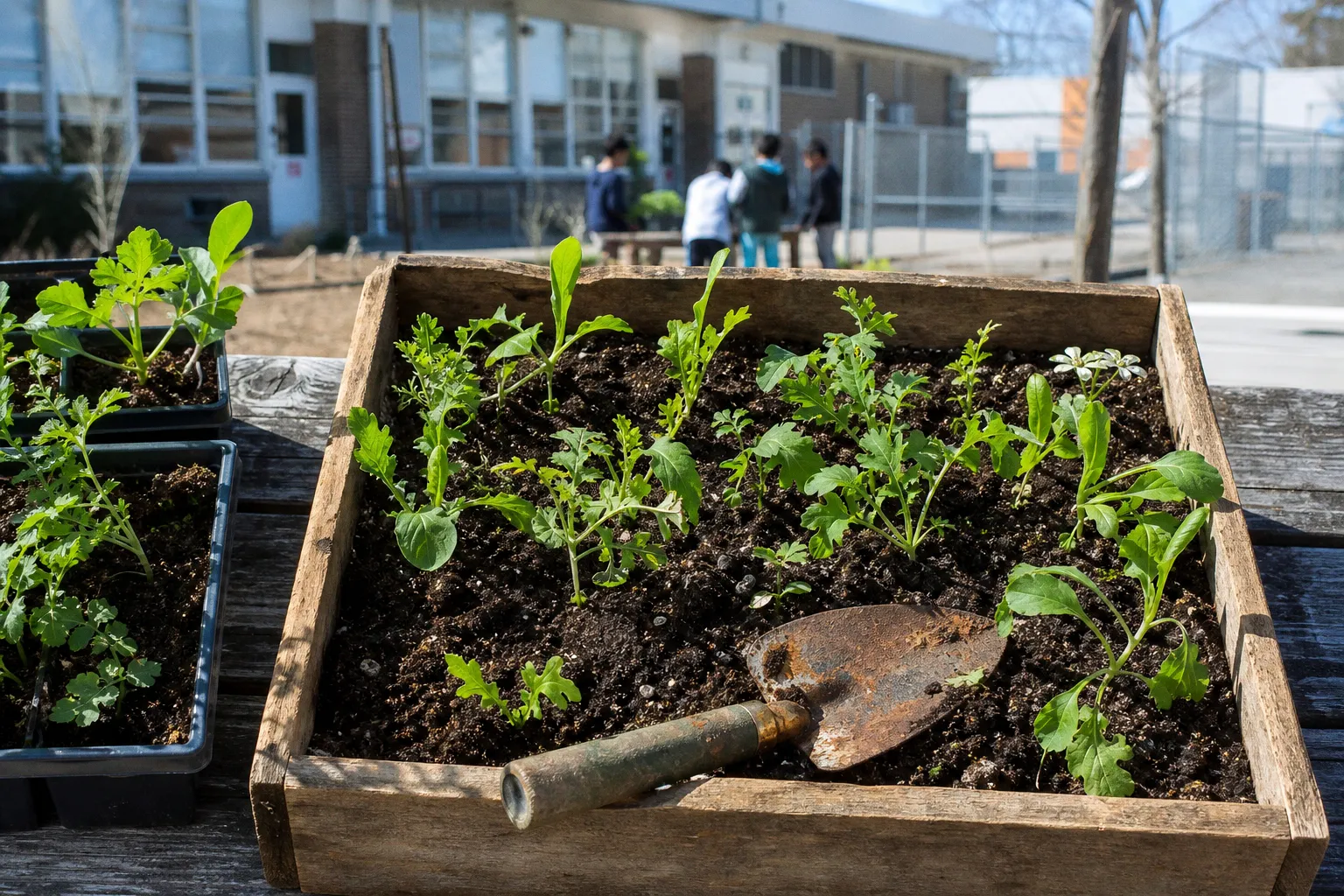
Edible Gardens: Soil Testing and Regulatory Compliance
The fastest way to convert a goodwill project into a district-level liability is to serve school-grown produce without verified soil safety. USDA does not prohibit using school-garden produce in school meals, but it does place the responsibility on the school nutrition director, and local health departments or school districts may add additional requirements.
The non-negotiable preconditions are:
- In-ground soil testing for chemicals, pesticides, and heavy metals, especially near high-traffic or industrial areas. Detected residues trigger site-specific food-safety decisions: depending on the levels found, raised beds with imported, tested soil or other mitigation measures may be warranted, subject to local requirements.
- Non-toxic, non-leaching materials for raised beds, containers, stakes, and trellises. Treated lumber, certain recycled plastics, and some sealants can transfer contaminants into the soil.
- Clear ownership of food safety. The school's nutrition director must formally accept the produce, and the chain of custody from harvest to serving must be documented.
- Local compliance check. Municipal health, district facility, and dietary rules vary. A garden that passes USDA guidance can still fail local inspection.
For campuses where in-ground testing raises concerns, raised beds with imported, tested soil are a common mitigation approach. They add material cost and substantially reduce, though they do not fully eliminate, the contamination variable from the project.
Waste Reduction: Beyond the Recycling Bin
EPA's school waste-reduction toolkit covers a wider portfolio than most volunteer programs attempt: recycling, composting, anaerobic digestion, reuse, repair, and source reduction. Recycling alone is the entry point, not the ceiling.
A typical implementation ladder looks like this:
- Source reduction. Menu engineering, tray-less service, and portion control. The lowest-cost ton of waste is the one not generated.
- Food-waste audit. EPA, USDA, and the University of Arkansas jointly produced a guide for student-led cafeteria audits. The output is a quantitative baseline: what is being thrown away, where, and in what volumes. Without this data, intervention design is guesswork.
- Composting or anaerobic digestion. Operational, not symbolic. EPA materials flag facilities staff, custodians, and cafeteria managers as the operational roles; a student green team is an advocate, not the operator.
- Contamination control. Recycling streams degrade when sorting is sloppy. EPA's program goals include reducing contamination, which is a training and signage problem, not a bin problem.
The audit step is the highest-leverage investment. It converts waste reduction from a feel-good initiative into a measurable program with a baseline, a target, and a verification path.
Inclusive Access: ADA Standards as a Design Constraint
ADA compliance is not a permit-stage checkbox; it is a layout constraint that has to be present in the earliest site sketches. The hard numbers from the U.S. Access Board are:
- Accessible route continuous clear width: at least 36 inches.
- Permitted narrowing: 32 inches minimum, for a maximum distance of 24 inches, at points such as doorways.
- Walking surface running slope: maximum 1:20, or 5%.
- Cross slope: maximum 1:48.
A path that runs 38 inches wide but slopes 7% along its length is not an accessible route. A garden entrance that narrows to 30 inches at a gate is not an accessible entrance. Outdoor classrooms, raised beds, sensory gardens, and rain gardens all have to be designed to these numbers, and the connections between them have to be designed as a network, not as isolated compliant spots.
Two practical implications for project planners:
- Accessible routes are continuous, not punctate. The route must connect accessible site spaces and elements. A compliant rain garden with a non-compliant path to it is still a non-compliant build.
- Surface matters as much as width. Loose gravel, soft mulch, and uneven flagstone can fail accessibility tests even when the route is wide enough. Surface specification is part of the design, not a finishing detail.
Project Type Comparison: Matching the Menu to the Site
The site assessment produces a constraint set. The project portfolio produces a menu of options. The matching step is where most projects succeed or fail, and it depends on matching the primary problem to the right intervention.
| Project type | Primary problem it solves | Hardest site constraint | Operational dependency |
|---|---|---|---|
| Rain garden / bioretention | Stormwater runoff, pollutant filtering | Soil infiltration, slope, contamination history | Facilities staff for media and drainage upkeep |
| Tree-canopy planting | Heat mitigation on impervious surfaces | Underground utilities, root zone volume, available soil | Watering through establishment period |
| Edible garden | Food literacy, hands-on learning | Soil contamination, food-safety chain of custody | School nutrition director sign-off |
| Outdoor classroom | Instructional capacity, microclimate | ADA route geometry, shade, surface stability | Custodial and facilities scheduling |
| Waste reduction program | Material diversion, contamination control | Cafeteria workflow, haul-off contracts | Custodial and cafeteria operations |
A workable decision sequence:
1. Define the primary problem. Heat mitigation, stormwater runoff, food literacy, waste diversion, and biodiversity each point to a different optimal project.
2. Filter the menu against site constraints. Soil contamination rules out in-ground food gardens. Steep slopes rule out large infiltration. Buried utilities restrict tree placement. ADA geometry rules out narrow pathways.
3. Score the survivors against maintenance capacity. A bioretention system with no operator is a future retrofit. A tree planting with no watering plan is a future replant.
4. Phase the build. A pilot that can be monitored and expanded on data is more credible to funders than a one-shot full build.
Funding and Policy Implications
The verifiable levers for accelerating campus greening at scale are not in the garden bed; they are in budget lines and district policy.
- Direct capital allocation. State and district facility budgets can be earmarked for green infrastructure, with EPA's Storm Smart Schools guide as a reference specification.
- Utility and watershed partnerships. Stormwater fees in many jurisdictions can be offset by documented infiltration, which makes rain gardens and bioretention financially as well as ecologically attractive.
- Procurement reform. Specifications for non-toxic raised-bed materials, permeable pavers, and ADA-compliant surfaces can be standardized at the district level, lowering per-project cost across a portfolio of schools.
- Maintenance line items. EPA's materials are explicit that operational ownership lies with paid staff roles. Grants that fund a build without funding three years of maintenance are writing the project's failure into the budget.
For partnership directors and CSR leads, the right conversation with a district is not "we will plant trees." It is "we will fund the site assessment, the design, the build, and the first three years of maintenance, with measurable outcomes at each stage." That is the structure funders and district boards can approve, and it is the structure that survives contact with the next school year.