Is Rainwater Safe for Community Garden Crops?
In a community garden, the question is rarely as simple as whether rainwater is “clean.” The real question is what the water has touched before it reaches the barrel, where it will be applied, and…
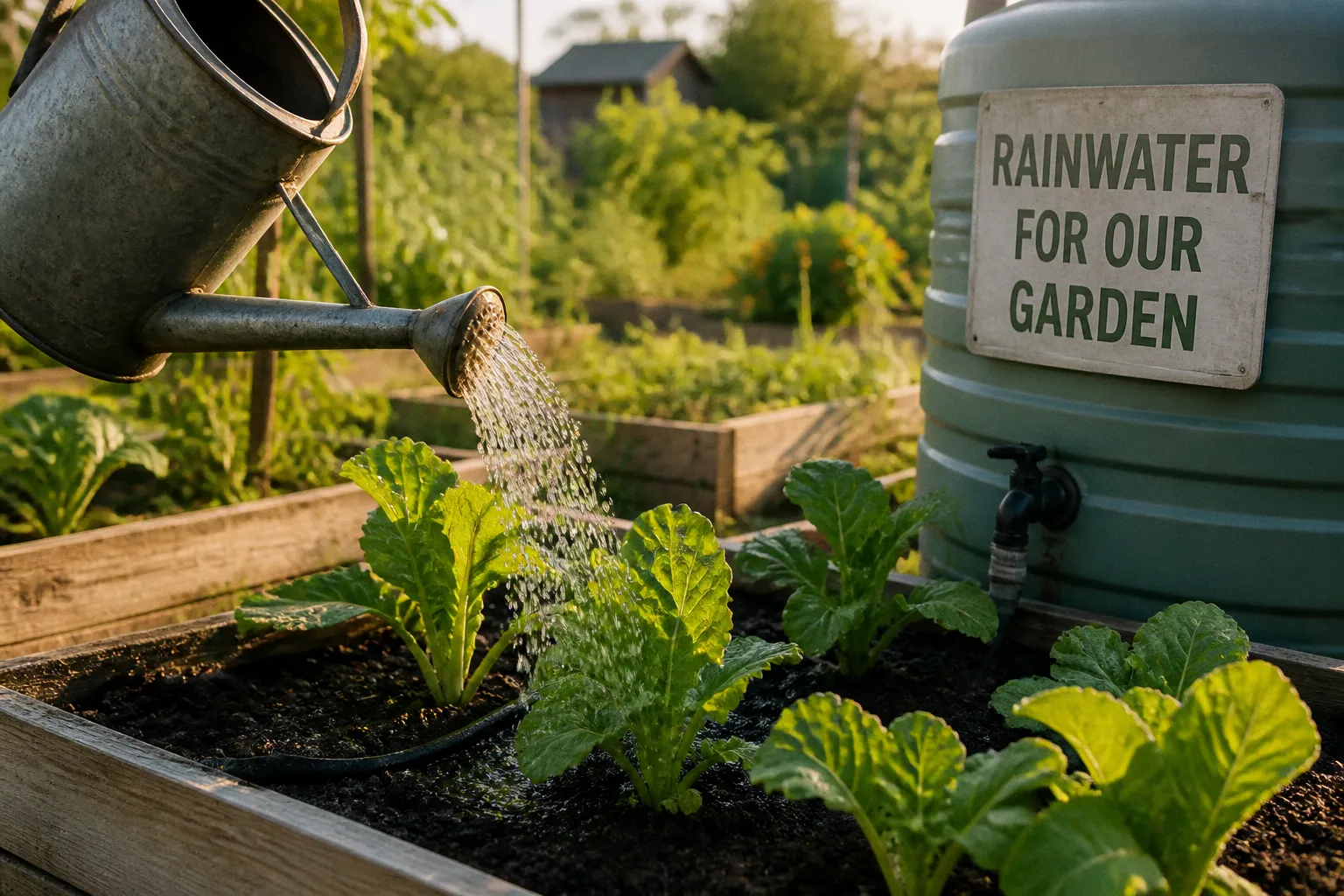
In a community garden, the question is rarely as simple as whether rainwater is “clean.” The real question is what the water has touched before it reaches the barrel, where it will be applied, and how much responsibility a garden group can realistically carry from one growing season to the next.
I have seen this question arise wherever a school garden, village growing plot, or neighbourhood planting project is built around shared stewardship rather than private convenience. Rain arrives freely, but the collection system is never neutral: a roof can contribute dust, bird droppings, industrial residues, paint particles, or dissolved metals, while a carefully designed system can provide soft, temperate water that plants often respond to better than chlorinated municipal supplies. Rainwater safety for community gardens is therefore a matter of design, observation, and collective agreement.
For most edible crops, harvested rainwater can be a useful and generally safe irrigation source when it is collected from a suitable surface, stored properly, and delivered to the soil rather than sprayed across leaves and vegetables. It is not automatically sterile, and it should not be treated as drinking water without advanced filtration and disinfection. But neither should it be dismissed simply because it has passed through a roof.
The water itself is not the whole story
Fresh rainwater is naturally soft. It contains little of the chlorine and dissolved salts found in many municipal or groundwater supplies, and it usually arrives close to the surrounding air temperature. For a garden, these qualities can be valuable. Repeated irrigation with salty water can gradually affect soil structure and plant growth, while very cold or heavily treated water may create a less favourable environment for sensitive seedlings.
In a school or community plot, this difference becomes visible in the small, practical details of cultivation. Seedlings recover more easily when watering is gentle and consistent. Soil does not receive an unnecessary load of salts. Children can learn that water is not simply something that comes from a tap, but part of a local cycle that includes roofs, tanks, soil, plants, evaporation, and care.
Yet the softness of rainwater should not be confused with purity. Rainwater may collect microorganisms from the atmosphere, and the greater contamination risk commonly enters during the journey from roof to storage tank. Birds and small animals may leave faecal material on collection surfaces. Dust can accumulate between storms. Old paint, treated wood, copper, or certain metal roofing materials may introduce substances that are unsuitable for food-growing areas.
A useful distinction is this:
- The rain itself is usually not the main concern.
- The collection surface determines many chemical risks.
- The tank and fittings determine whether contamination is stored and multiplied.
- The irrigation method determines whether water reaches the edible part of the plant.
- The garden’s management routine determines whether small risks remain small.
This is why the same answer cannot be given for every rain barrel. A clean tank connected to a suitable roof in a low-pollution setting is not equivalent to an open container beneath a deteriorating painted roof.
Rainwater becomes a safe garden resource not through optimism, but through the ordinary discipline of knowing where it came from and where it goes.
Why rainwater can be particularly useful in shared gardens
Community gardens often operate under constraints that private gardens can avoid: irregular water access, limited budgets, long dry spells, and several people sharing responsibility for the same growing beds. During summer droughts, as much as 40 percent of water use may take place outdoors, so even a modest harvesting system can ease pressure on mains supplies or groundwater.
The social value is just as important as the volume collected. When residents, students, teachers, and local volunteers maintain a rainwater system together, the tank becomes part of the garden’s educational and organisational infrastructure. Someone notices when the lid is damaged. Someone clears the gutter. Someone records when the first flush of a storm has been diverted. That shared observation creates agency: people are not merely receiving an environmental intervention but learning how to govern one.
This matters particularly in rural school projects, where a garden may be expected to support lessons in biology, nutrition, climate awareness, and practical responsibility at the same time. A rain barrel can connect those subjects without turning the garden into an abstract demonstration. The children can see the relationship between a building and its watershed; elders can contribute knowledge about seasonal rain; the biker crew or volunteer group can help install a system that local residents are able to repair after the initial project has ended.
The strongest systems are rarely the most elaborate. They are the ones that fit the capacity of the community maintaining them.
Harvesting surface and garden use
| Collection situation | Main concern | Sensible garden response |
|---|---|---|
| Clean, well-maintained roof made from a suitable material | Dust, bird droppings, and first-flush contamination | Divert the first runoff after a dry period, keep the tank covered, and apply water to the soil |
| Copper roof or copper fittings in the collection path | Potential copper contamination | Avoid using this water for edible crops unless its safety has been professionally assessed |
| Untreated or deteriorating metal roof, including some galvanized steel | Leaching of metals such as zinc and other contaminants | Choose another collection surface or use the water only after appropriate testing and expert advice |
| Roof with lead-based paint or unknown old coatings | Heavy-metal contamination | Do not harvest for food gardens |
| Treated wood roof or collection surface | Chemical residues entering runoff | Do not use for edible crops |
| Open barrel or uncovered tank | Mosquitoes, debris, animal access, and microbial contamination | Fit a secure lid and screen openings; clean the system as part of the garden calendar |
| Water with an unusual odour, colour, or visible film | Possible chemical or biological contamination | Stop using it on food crops until the cause is understood |
The table is not a substitute for local assessment, but it helps a group make decisions before enthusiasm outruns infrastructure. A low-cost system can still be a careful system.
Roof runoff is where the important questions begin
When people ask, “Is rain barrel water safe for vegetables?”, they often focus on the barrel. In practice, the roof deserves at least as much attention.
A collection surface should be known, intact, and free from coatings that may release harmful substances. Copper roofs and fittings are unsuitable choices for edible-crop irrigation because copper can enter the collected water. Untreated metals, including some galvanized steel surfaces, may leach metals such as zinc. Treated wood and roofs covered with lead-based paint present a more serious concern and should not be used to collect water for a community food garden.
This is one reason that an older school building or community hall should not be connected to a tank immediately simply because its roof is large. The history of the structure matters. Was the roof repainted? Are the gutters original? Are there old storage sheds or treated timber sections connected to the same drainage line? Has dust from a nearby road or industrial activity accumulated on the surface? These questions do not require academic language, but they do require dialogue between the people who know the building and the people installing the system.
The first runoff after a dry period is usually the dirtiest. It can carry accumulated dust, leaves, bird droppings, and residues from the roof into the downpipe. A first-flush diverter, even a simple one appropriate to the local system, can reduce the amount entering the main tank. It should be inspected rather than installed and forgotten, because a device that fills with sediment is no longer performing its intended function.
The tank itself should remain covered. An open vessel invites debris, insects, and animals, while stagnant water can become a source of odour and maintenance problems. Gutters and screens need periodic cleaning, and a shared schedule is more reliable than an assumption that “someone will notice.”
In my experience, this is where the physical work and the social work meet. A system fails less often when its maintenance is visible and assigned. The person who waters the beds is not necessarily the person who understands the gutter. Elders may know when the first major rains arrive, while students may be willing to keep a simple observation chart. Integration means making those forms of knowledge work together.
Applying the water safely to crops
Even water of uncertain microbiological quality can be used more safely when it is delivered to the soil at the base of the plant rather than sprayed over leaves, fruit, or edible roots that will be harvested soon.
Drip irrigation is particularly useful because it limits splashing and places water where the plant needs it. A watering can fitted with a low-flow rose can also work when the person watering takes care not to wash soil onto lettuce, herbs, or low-growing vegetables. Flooding foliage from above is less desirable, especially when the garden is harvesting crops for a school kitchen or community meal.
Timing matters as well. Early-morning watering allows plant surfaces to dry relatively quickly, and daylight provides natural ultraviolet exposure that can help reduce some surface pathogens. This does not disinfect contaminated water, and it does not replace safe handling, but it is a sensible part of a wider routine.
A practical irrigation pattern looks like this:
1. Water the soil, not the edible surface. Direct the flow to the base of the plant or use a simple drip line.
2. Avoid splashing. Mulch can reduce the movement of contaminated soil onto leaves and fruit.
3. Water early when possible. Plants have time to dry during the day, and the garden is easier to inspect.
4. Separate irrigation from washing. Do not use harvested rainwater to rinse vegetables before serving unless it has been treated appropriately.
5. Allow a short gap before harvest when conditions are uncertain. The exact interval depends on the crop and local guidance, but avoiding overhead irrigation close to harvest is a prudent practice.
6. Keep hands, tools, and containers clean. Safe water cannot compensate for dirty harvest equipment or careless food handling.
For root crops, the question is slightly different because the edible portion is in contact with soil. Direct-to-soil irrigation remains preferable, but the final safety of carrots, radishes, potatoes, and similar crops also depends on thorough washing with potable water before eating. Harvested produce should not be served directly from the garden simply because the irrigation water looked clear.
What to do when the water quality is questionable
Not every community garden has the budget for frequent laboratory testing, and routine testing is often impractical for a volunteer-run plot. That reality should lead to proportionate safeguards, not to indifference.
The first response to questionable water is to identify the source of the concern. Has an animal entered the tank? Was there a chemical spill near the roof? Has the water developed a strange smell? Is the roof material unknown? Has the tank remained uncovered through a long dry period? Different concerns require different responses, and “disinfect everything” is not a solution to heavy-metal contamination.
Chlorination can be considered when microbial contamination is suspected and the water is otherwise collected from a suitable surface. A commonly cited treatment for questionable harvested water is unscented household bleach containing 5 to 6 percent chlorine, added at a rate of 1/8 teaspoon per gallon, or 1 ounce per 55 gallons, followed by 24 hours of standing time before use.
This is a treatment for a specific concern, not a universal recipe. The bleach must be unscented and free from added cleaners or fragrances. It should never be mixed with other chemicals. The group should also recognise that chlorine treatment does not remove metals, PFAS, pesticides, or other chemical contaminants. If the roof is made from an unsuitable material, adding bleach does not make the water appropriate for edible crops.
The treatment also needs to be discussed openly within the community. A volunteer may know the dose but not the tank’s capacity. A teacher may understand the educational value but not want children handling bleach. A local elder may have practical knowledge of water storage that prevents contamination in the first place. Good stewardship means combining these forms of agency rather than assuming that technical knowledge belongs to one person.
Where laboratory testing is available and affordable, it can help resolve uncertainty. For irrigation water, an individual sample with fewer than 235 E. coli counts per 100 millilitres is considered within a safe range in the research used for this guidance. But a single test is a snapshot, not a permanent guarantee. It does not remove the need to keep the roof, tank, and irrigation equipment in sound condition.
The PFAS question: a difficult reality without a simple slogan
“Forever chemicals,” or PFAS, have become part of the rainwater conversation because they are widely present in the global water cycle. This can make gardeners feel that collecting rain is pointless, particularly when they hear that rainwater is not entirely free from modern pollutants.
The more honest conclusion is less dramatic. In some circumstances, harvested rainwater may still be preferable to groundwater already affected by PFAS, especially when it is used with soil-management practices that can reduce plant uptake. Compost and other appropriate soil amendments may help limit the movement of some contaminants into plants, although they should not be presented as a complete solution or as a guarantee of safety.
There is still uncertainty about the exact safe threshold for PFAS in homegrown or commercially grown produce and about the long-term health effects of low-level exposure through garden vegetables. That uncertainty deserves respect. It should not be converted into either false reassurance or fatalism.
For a community project, the practical response is to map the local context. Is the garden near a known industrial source, airport, fire-training site, or area with a history of contaminated groundwater? Are there public health advisories? Is the harvested rainwater being used for ornamental beds, fruiting vegetables, leafy greens, or crops eaten by young children? Those distinctions may affect the level of caution required.
Where local authorities have issued specific advice, that advice should take precedence over general gardening guidance. Where no such information exists, a group can still reduce avoidable risks by choosing appropriate roofs, keeping tanks clean, using soil-directed irrigation, and avoiding claims that the water is completely free of contaminants.
Designing a rainwater system that people can sustain
The best environmental project is not the one with the most impressive installation photograph. It is the one that remains intelligible and repairable after the visiting team has gone.
Before installing a tank at a school or community garden, I would want the group to agree on a few practical matters:
- Who will inspect the roof and gutters after storms?
- Who will empty the first-flush section?
- Who has authority to stop using the water if the source becomes questionable?
- Where will the tank overflow during heavy rain?
- Is the tank secure around children?
- How will the group record cleaning, repairs, and unusual observations?
- Which crops may be watered from the tank, and which require greater caution?
- What is the plan during a prolonged dry period when stored water becomes stagnant or scarce?
These are not bureaucratic additions to a green project. They are the structure that protects the project’s dignity. A community should not be asked to maintain a system whose risks and responsibilities were never explained.
There is also a question of scale. A small tank may be enough for seedling beds and a teaching plot but not for a large vegetable field. If expectations are too high, the system can be judged a failure when it was simply designed for a narrower purpose. Conversely, if a tank is treated as an unlimited source, people may overwater, neglect roof maintenance, or assume that collection alone solves water scarcity.
A clear division of use can help:
| Garden use | Suitability of harvested rainwater | Good practice |
|---|---|---|
| Trees, shrubs, and ornamental planting | Usually suitable when the tank and roof are appropriate | Apply at the soil line and keep storage covered |
| Established vegetable plants | Often suitable with source and storage safeguards | Prefer drip or soil-level watering |
| Leafy greens harvested raw | Requires greater caution | Avoid overhead application; wash produce with potable water |
| Root vegetables | Possible with careful irrigation and harvest hygiene | Prevent soil splash and wash thoroughly before eating |
| Seedlings and nursery trays | Often suitable if water is clean and gently applied | Avoid damping foliage and monitor for contamination |
| Drinking or washing vegetables | Not suitable without appropriate treatment | Use potable water instead |
This approach allows a garden to gain the benefits of harvested water without pretending that every use has the same risk profile.
Rainwater safety is also a question of trust
In grassroots environmental work, technical recommendations are only effective when people trust the process behind them. A community may accept a tank quickly but remain uncertain about whether the water is safe for children’s vegetables. Another group may have used roof water for years and feel that outside warnings ignore local knowledge. Both positions contain information, and neither should be treated with contempt.
Dialogue is therefore part of contamination control. Explain why one roof is suitable and another is not. Show how the first flush works. Let people see the inside of the tank before it is sealed. Mark the tap clearly if the water is for irrigation only. Keep the instructions near the garden rather than in a document that no one revisits. If a treatment is used, record what was added and when the water can be used again.
The language matters. We should not describe local residents as careless because a tank was not maintained, just as we should not describe them as helpless recipients of a donated system. Maintenance is a shared practice, and shared practices improve when knowledge is accessible, roles are recognised, and concerns can be raised without embarrassment.
That is the difference between installing infrastructure and building stewardship. One delivers an object. The other leaves behind a relationship between people, land, water, and responsibility.
The answer, in practical terms
So, is rainwater safe for community garden crops?
Generally, yes—when it is collected from a suitable roof, stored in a covered and maintained tank, and applied directly to the soil. It is often a beneficial irrigation source because it is soft, low in salts, and close to ambient temperature.
But harvested rainwater should not be assumed safe in every situation. Avoid water collected from copper, treated wood, lead-painted, or unsuitable metal surfaces. Divert the first runoff after dry periods. Keep storage protected from animals and debris. Use drip or soil-level irrigation rather than spraying edible parts. Water early in the day where possible. If microbial contamination is suspected, carefully consider appropriate chlorination; remember that chlorine does not remove chemical pollutants. Treat PFAS concerns as a matter for local information and proportionate caution, not as a reason for unsupported certainty.
A community garden is an environmental project in miniature. Its success is measured not only in litres collected or vegetables harvested, but in whether the people caring for it understand the system well enough to make decisions together. Rainwater can support that work, provided the collection is designed with the same respect as the garden itself: attentive to place, honest about uncertainty, and rooted in the agency of the community that will carry it forward.