Community seed libraries: when are they sustainable?
A community seed library becomes sustainable when it is treated not as a box of packets, but as a relationship between people, land, and the institutions already trusted by the community.
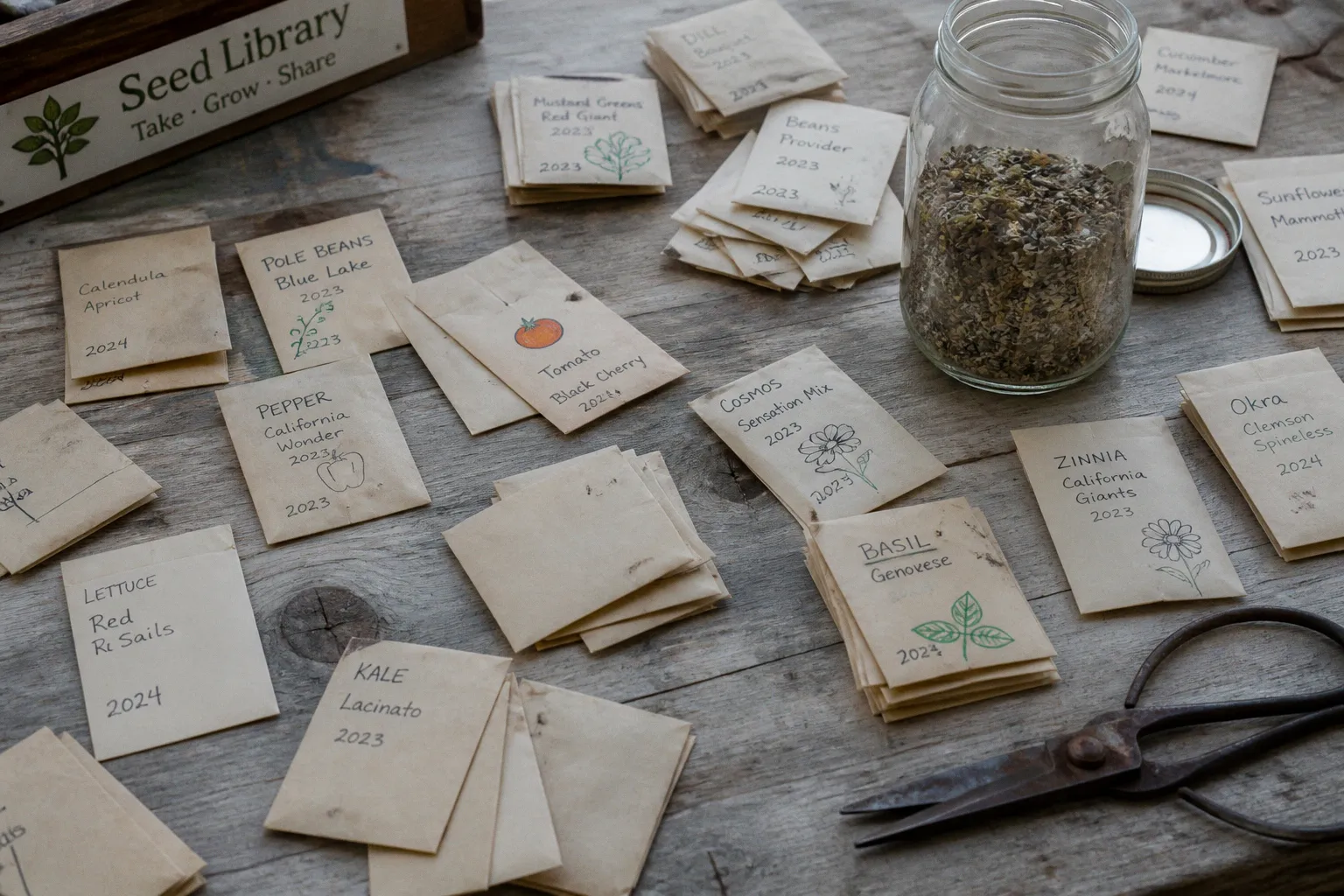
The shelves matter, and so do the envelopes, catalogues, planting notes, and harvest records; but the programme will endure only if people understand why seeds are being shared, who holds responsibility for them, and how participation can remain open without becoming careless.
This distinction is especially important in rural schools and village institutions, where an environmental project is rarely separate from everyday life. A school garden may become a science lesson, a meeting place for elders, a source of locally adapted planting knowledge, and a modest exercise in stewardship. A seed library can support all of those functions, but only if its design respects local agency rather than assuming that a community will sustain an imported model simply because the model appears efficient on paper.
So, when are community seed libraries sustainable? They are sustainable when voluntary participation is matched by clear education, practical record-keeping, institutional support, and a legal structure that does not turn a non-commercial exchange into a regulated commercial activity.
Sustainability begins with the legal shape of the programme
The most consequential design decision is often made before the first seed packet reaches the shelf: whether the programme requires people to return harvested seed.
At first glance, mandatory returns seem sensible. A person borrows beans, grows them, saves the next generation of seed, and brings some back. The library is replenished, and the cycle appears neatly closed. In practice, however, requiring patrons to return seed can create legal complications. In some jurisdictions, a seed library that imposes return obligations may be treated as a commercial seed distributor, even when no money changes hands. That classification can bring state testing, labelling, and other regulatory requirements designed for commercial seed businesses.
This is not a theoretical concern. In 2014, the Pennsylvania Department of Agriculture informed Simpson Public Library that its seed-sharing programme conflicted with commercial seed laws. The dispute helped prompt wider efforts to amend state seed acts and create exemptions for non-commercial seed libraries. The lesson is not that community seed sharing is inherently unlawful. The lesson is that a small local project can cross a regulatory boundary through its operating rules, without its organisers intending to become a seed company.
A resilient community seed library therefore needs a legal conversation at the beginning, not after the programme has grown. The precise rules will depend on the country, state, or province, but organisers should establish:
- whether non-commercial seed exchanges are exempt from commercial seed testing and labelling requirements;
- whether a return request is merely an invitation or could be interpreted as a contractual obligation;
- how seeds should be described when their variety, origin, or germination history is uncertain;
- whether the host institution carries insurance, governance, or record-keeping responsibilities;
- which plants may present particular concerns because of cross-pollination, invasive behaviour, or local agricultural regulation.
Language matters here. A library can invite gardeners to donate saved seed, share knowledge about successful crops, and contribute to future seasons without promising that every packet will be replaced. The programme should not make the community responsible for maintaining an inventory that its members cannot reasonably control.
The sustainable seed library is not the one with the strictest return rule; it is the one whose responsibilities remain clear, voluntary, and legally proportionate.
For schools, this distinction deserves an additional layer of care. Children can participate in cleaning, labelling, planting, observing, and recording germination, while adults oversee any distribution decisions and explain that saved seed is not automatically identical in quality or reliability to commercially tested seed. This is not a reason to exclude children. It is a reason to make the educational purpose visible and the safety boundaries understandable.
Why voluntary returns are stronger than compulsory ones
A voluntary model can sound less disciplined than a mandatory one, particularly to funders or organisers who want measurable outputs. Yet seed saving is shaped by weather, household labour, crop failure, pests, cooking needs, and the simple fact that not every participant will have a successful harvest. A family may plant the seed but be unable to save it. A school may lose its crop during an unusually difficult season. An elder may have valuable knowledge but no spare seed that year. A return obligation treats these realities as non-compliance; a voluntary model recognises them as part of community life.
Voluntary participation also protects the social character of the project. The person who contributes a handful of okra seed, a planting date, or a method for drying gourds is not merely supplying stock. They are contributing knowledge and making a decision about what should remain available locally. That agency is central to community seed sharing programmes, especially where local varieties carry culinary, cultural, or ecological meaning that cannot be captured by a catalogue entry alone.
A useful programme can encourage donations without making them a test of belonging. Signage and conversations might explain that participants are welcome to return seed after harvest, but that failed crops and changing circumstances are normal. The library can also receive other forms of contribution:
- a note about when a crop was planted and how it performed;
- information about taste, drought tolerance, or soil preference;
- a small lesson for children on seed drying or storage;
- help sorting and labelling packets;
- a story about how a variety has been used in local cooking;
- observations about pollinators, pests, rainfall, or soil condition.
This wider understanding of contribution is particularly valuable in rural schools, where the seed library may be maintained by several generations at once. Children bring curiosity, teachers provide continuity, farmers and gardeners bring practical judgement, and elders may hold knowledge about varieties that formal agricultural programmes have overlooked. No single group needs to carry the entire project.
The absence of a universal return-rate figure is not a weakness in the evidence; it is a reminder that community seed libraries do not operate as identical machines. Their results depend on climate, crops, storage conditions, local customs, and the strength of the host institution. A programme should measure what helps it learn rather than use an invented benchmark to make itself appear successful.
A seed library needs a home that can outlast enthusiasm
Many community environmental projects begin with a small group of energetic volunteers. That energy is precious, but it is not the same as continuity. People move, change jobs, become caregivers, lose access to transport, or simply reach the point where another person must take responsibility. Community seed library sustainability depends on embedding the work in an institution that can preserve knowledge when the original organisers are no longer present.
Public libraries are a natural home because they already manage collections, public access, classification, and community programming. Academic libraries can provide similar support, particularly where a college or university has agricultural, environmental, or education departments. Existing infrastructure can reduce overhead: outdated card catalogues may be repurposed for seed storage, and library cataloguing databases can help track varieties, planting information, and availability.
The value of this arrangement is not only financial. A library offers a recognised place where people can ask questions without feeling that they are entering a specialist or commercial service. That matters for participation. Someone who is unsure how to save tomato seed may be more comfortable approaching a librarian, teacher, or community volunteer than attending a formal agricultural workshop.
The basic system does not need to be elaborate, but it should be consistent. Each packet or container should carry enough information for the next person to make a sensible decision:
| Information | Why it helps |
|---|---|
| Common crop name and local name | Connects formal records with community language and memory |
| Approximate variety or source | Shows whether the seed is locally known, donated, or uncertain |
| Harvest year, when known | Helps users judge freshness without pretending to offer laboratory certification |
| Saving notes | Records whether the seed was dried, cleaned, or stored under particular conditions |
| Growing observations | Captures practical knowledge about taste, timing, water needs, or resilience |
| Caution about uncertainty | Prevents a community packet from being mistaken for tested commercial seed |
Storage also requires practical judgement. Seeds should be protected from moisture, heat, insects, and unnecessary handling. The ideal arrangement will vary by climate and budget, but the principle is simple: the storage system must be realistic for the building and the people caring for it. A beautifully designed programme that depends on equipment nobody can maintain is less sustainable than a modest cabinet with clear labels and a dependable volunteer rota.
The same applies to data. A shared spreadsheet may be enough for a small school. A public library may prefer its existing catalogue system. The aim is not technological sophistication; it is institutional memory. If a volunteer leaves, the next person should be able to understand what is available, what needs replenishing, and which entries require a conversation before distribution.
The educational partnership is the living infrastructure
Seed libraries endure when they are used as places of learning rather than treated as passive storage. This is where environmental projects in schools can gain depth. Planting is visible and rewarding, but seed saving asks children and adults to follow a longer cycle: choosing a plant, observing its growth, allowing some produce to mature, collecting seed, drying it, labelling it, and deciding how it might be shared.
That sequence links ecological awareness to patience and responsibility. It also gives practical meaning to ideas that can otherwise remain abstract. Biodiversity is not only a word in a textbook when students compare several local varieties. Stewardship becomes tangible when they protect a plant for future seed. Food systems become less distant when the class understands that a packet on the shelf represents the work of a previous season.
In my role between community organisers and local institutions, I would place dialogue before curriculum design. A school garden should not be built around the assumption that experts arrive with the complete answer. Teachers may know the academic calendar, families may understand the local growing conditions, and elders may know which plants can withstand a difficult season. A biker volunteer network may contribute transport, carpentry, publicity, or labour, but its most respectful contribution is to strengthen the community’s own capacity rather than become the centre of the story.
A school-based seed project can be organised around a repeating set of questions:
1. What already grows here?
Begin with local knowledge and existing cultivation, including plants that may not appear in standard educational materials.
2. What does the school actually have capacity to maintain?
A small number of well-supported crops is more useful than a broad collection that no one can monitor.
3. Which part of the seed cycle can students observe directly?
Children should encounter the full process where possible, not only receive pre-packed seeds for planting.
4. Who will hold responsibility during holidays and staff changes?
The project needs a named institutional home and a realistic plan for periods when the school is closed.
5. How will community knowledge be recognised?
Knowledge-sharing should not extract stories from elders or gardeners without acknowledging their contribution and control over what they wish to share.
6. What will happen when a crop fails?
Failure should be part of the lesson and the planning, not quietly treated as evidence that the community did not participate properly.
This is also where a project can avoid the familiar trap of confusing visibility with impact. A tree-planting day or a newly painted garden bed photographs well. A seed library’s deeper work is slower: building confidence, preserving memory, encouraging observation, and making it easier for people to act in the following season. The physical materials are important, but the social infrastructure is what allows them to remain useful.
Local seed bank challenges require more than local enthusiasm
Community seed projects face challenges that are both technical and relational. The technical problems include poor germination, cross-pollination, mould, weak labelling, and uncertainty about whether a seed will perform in a new location. The relational problems include unequal access to the programme, unclear ownership of knowledge, volunteer fatigue, and the possibility that a project becomes associated with one charismatic organiser rather than with the community.
The response should be proportionate. A local seed library does not need to imitate a national genebank, but it does need to know what it can and cannot promise. It should not describe every packet as guaranteed, certified, or perfectly true to type. It should provide enough information for people to make informed choices and enough space for users to report what happened after planting.
Community seed bank research in Africa and Asia has identified several strategies that support longer-term viability:
- adding value through processing, training, or improved access rather than treating seed as a commodity alone;
- supporting nature-positive agriculture that strengthens soil, biodiversity, and local ecological resilience;
- developing relationships with genebanks and national institutions;
- building networks and using digital tools where they genuinely reduce isolation or improve coordination;
- adopting low-cost methods for checking seed quality.
These strategies are relevant beyond formal seed banks. A school or village library can build a modest network with nearby educators, agricultural advisers, public libraries, farmer groups, or conservation organisations. Such partnerships reduce the risk that a local project must solve every problem alone.
At the same time, networking should not erase local control. A partnership is sustainable when it increases the community’s agency, not when it makes the community dependent on outside visits, outside funding, or outside definitions of success. A volunteer biker crew can be particularly useful in this regard because it may connect dispersed settlements, carry materials, and maintain relationships across distance. But the route should serve the institution, not the other way around. If the project collapses when the visiting team stops coming, integration has not yet been achieved.
Funding follows the same principle. The Greenfield Community College Seed Library launched in 2015 with an initial grant of $500, demonstrating that a programme can begin with limited resources when its ambitions are carefully matched to its capacity. That figure should not be treated as a universal startup budget; local storage, transport, staffing, and legal requirements vary widely. The more important point is that sustainability is often built through modest, repeatable systems rather than a single large investment.
A small budget can support envelopes, labels, storage containers, training materials, and a few local workshops. It cannot compensate for unclear ownership or an absent maintenance plan. Funding should therefore be connected to responsibilities: who opens the library, who updates records, who leads the school session, who checks storage, and who speaks with community contributors when information is uncertain.
Growth should follow trust, not outrun it
The modern seed library movement offers evidence that interest can spread. The number of active seed libraries in the United States grew from 63 in 2013 to approximately 300 within the following fifteen years of the movement’s modern expansion. Growth of that kind can be encouraging, but replication is not the same as sustainability. A programme copied without its social foundations may produce shelves of packets and very little participation.
For a new community seed library, the wiser route is usually gradual:
- begin with a limited collection that can be labelled and stored properly;
- establish a voluntary donation policy from the outset;
- run practical seed-saving sessions before expanding the number of crops;
- invite feedback from people who actually use the collection;
- document decisions in plain language;
- review the arrangement after one growing season;
- expand only when the institution and volunteers can support the additional work.
This approach also allows the programme to notice who is missing. Are women able to participate at times that suit their responsibilities? Can older residents reach the library? Are children invited as learners rather than used as decoration for a launch event? Are local-language names included? Can someone with limited literacy understand the most important information through symbols, demonstrations, or conversation?
Accessibility is not an optional social benefit added after the ecological work. It is part of the ecological work because a seed library depends on many forms of knowledge and participation. A narrow programme may preserve a few packets. An integrated programme can preserve relationships between generations, institutions, and landscapes.
The strongest measures of progress may therefore be qualitative as well as numerical. Organisers can record how many varieties are available, but they should also ask whether people know how to use the library, whether teachers can continue the lessons independently, whether contributors feel respected, and whether the project has become part of ordinary community activity rather than an occasional campaign.
The durable model is a commons with boundaries
A community seed library occupies a careful middle ground. It is more than a collection, but less than a commercial distributor. It belongs to the public in the sense that people can participate in and benefit from it, yet it still requires stewardship, rules, and decisions about quality. Calling it a commons should not mean that nobody is responsible. It should mean that responsibility is shared transparently.
That is why the most durable models combine openness with boundaries:
- open access where the programme can support it;
- voluntary donations rather than mandatory returns;
- clear descriptions of what has and has not been verified;
- education that makes participation more confident;
- institutional support that survives individual turnover;
- partnerships that add capacity without taking away local agency;
- records that remain understandable to the next generation of volunteers.
A seed library can also become a quiet form of environmental awareness work. It makes ecological conservation visible at the scale of a packet and a planting bed. It encourages people to notice which plants thrive, which conditions are changing, and which practices protect the soil. It does not need to claim that one programme can solve food insecurity, climate pressure, or agricultural loss. Its contribution is more grounded: it gives a community a place to practise care together.
The question, then, is not whether every seed will return. Nor is it whether a library can grow as quickly as possible. The better question is whether the project is building the conditions in which knowledge, participation, and responsibility can continue after the launch team has gone.
Community seed library sustainability is achieved when the shelves remain connected to real lives: to the school timetable, the village calendar, the public library, the growing season, and the decisions of the people who use the land. When those connections are tended with patience, a seed library becomes neither a charity display nor a fragile volunteer project. It becomes a small, practical institution of shared stewardship—one capable of carrying local knowledge forward without taking it out of local hands.