Community tool library: a roadmap to launch
A community tool library usually fails before the first checkout. The failure starts with a soft plan: collect whatever people donate, find a corner for storage, open the doors, and solve the paperwork later.
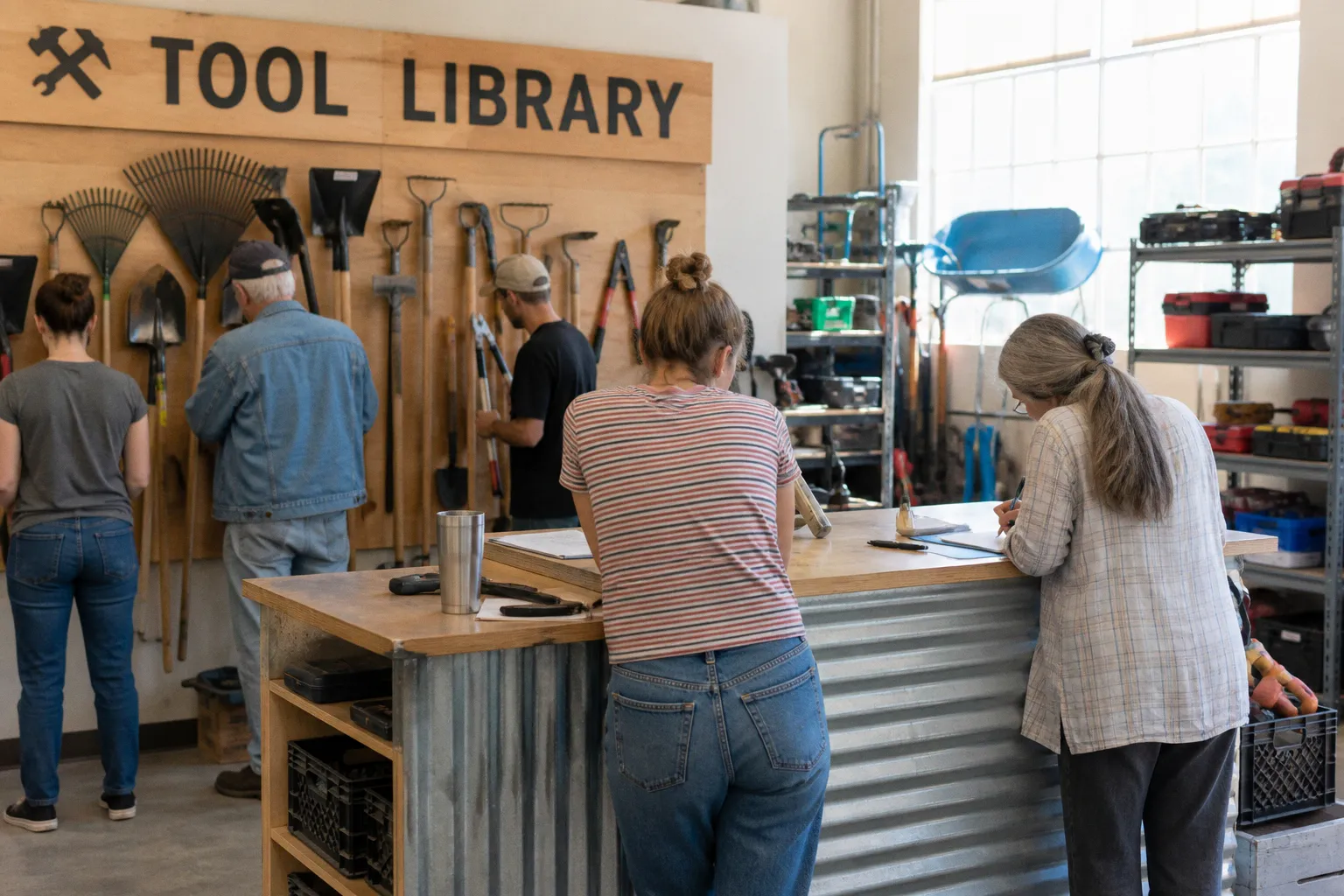
That sequence produces bent shelving, missing drill bits, unclear responsibility, and a stockroom nobody can audit.
We build these systems in the opposite order. Start with the local work people actually need to do. Then define the operating unit, limit the first inventory, anchor the legal structure, and install a tracking method before the public launch. A community tool library is not a pile of shared equipment. It is a lending operation with storage, maintenance, records, risk controls, and a route from request to return.
The setup milestones are straightforward. The friction sits between them.
Start with the work, not the tools
The first task is a needs assessment. Not a survey full of broad questions. We need a map of recurring jobs.
In a rural school network, the demand may sit around campus greening, classroom repairs, garden beds, rainwater handling, waste sorting, or tree-planting drives. A neighborhood program may see requests for pruning, bicycle repair, sewing, home maintenance, event equipment, or cleanup work. Those are different operating loads. They call for different tools, storage methods, borrower rules, and maintenance capacity.
We begin by collecting actual requests from the groups that will use the library:
- school maintenance teams and parent committees;
- local environmental groups;
- community gardens and farming collectives;
- volunteer rider networks;
- housing associations and neighborhood groups;
- repair workers, educators, and event organizers;
- municipal or public-library partners.
We do not ask only what people would like to borrow. We ask what they currently rent, buy, borrow informally, or leave undone because the equipment is unavailable. That distinction determines whether the library solves a real access problem or merely stores donated objects.
The assessment should record four practical points for each proposed tool category:
1. The job. What work does the item support?
2. The frequency. Is the demand weekly, seasonal, or occasional?
3. The user. Can an untrained borrower operate it, or does it require orientation?
4. The burden. How much space, maintenance, cleaning, and inspection does it require?
A hedge trimmer and a set of hand pruners may support the same environmental project. They do not create the same risk or service load. A sewing machine may need less physical space than a wheelbarrow but more instruction and electrical inspection. A pressure washer can move quickly through a queue, but it also brings water access, hose storage, cleaning, and damage questions.
We need the work map before the inventory list.
Form the steering crew and assign the hard jobs
A tool library needs a small operating crew before it needs a logo. The steering committee does not have to be large. It does have to cover the jobs that otherwise fall between chairs.
At minimum, assign responsibility for:
- Operations: opening hours, intake, checkout, returns, and escalation.
- Inventory: item selection, condition grading, tagging, and replacement decisions.
- Maintenance: inspection intervals, cleaning, sharpening, charging, and repair.
- Records: member files, reservations, overdue items, and incident logs.
- Finance: donations, grants, deposits, replacement funds, and recurring costs.
- Risk and compliance: borrower agreements, waivers, insurance, and local requirements.
- Community coordination: schools, environmental groups, volunteer crews, and launch partners.
One person may carry two roles at the beginning. That is normal. One person should not silently carry all of them.
We also need a decision rule for accepting donations. Without one, the library becomes a disposal point. A donated tool still consumes shelf space, staff time, inspection time, and future replacement capacity. If it arrives without a battery, guard, charger, blade, or safe operating condition, its zero purchase price is irrelevant. The operating cost has already started.
A simple intake decision can use three grades:
- Ready: inspected, tagged, and suitable for circulation.
- Repairable: useful after a defined repair, with a named person and a time limit.
- Reject: unsafe, incomplete, obsolete, contaminated, or too costly to support.
Do not create a permanent “we may fix this later” pile. That pile is where usable storage disappears.
The first inventory is not a warehouse. It is a controlled test of whether the community can borrow, use, return, and maintain equipment without losing the chain of custody.
Keep the launch inventory narrow
Established tool-library frameworks commonly recommend launching with roughly 20 to 40 items. That range is not a law. It is a useful load limit for a new crew. We can inspect every item, learn the demand pattern, and correct the system before the stockroom becomes unmanageable.
For an environmental project, a first collection might include:
- hand pruners and loppers;
- spades, shovels, hoes, and rakes;
- wheelbarrows or garden carts;
- watering equipment;
- tarpaulins and reusable collection sacks;
- soil screens or simple garden tools;
- hand saws and clamps;
- basic bicycle-repair equipment;
- sewing or repair equipment where local demand supports it;
- event supplies used in waste-reduction campaigns.
That does not mean every launch needs every category. The route is set by local demand and the available storage. We should avoid adding powered equipment merely because it attracts attention. A battery platform can create several dependencies at once: compatible chargers, battery health, electrical inspection, replacement packs, and a clear rule for charging and transport.
The same applies to large items. A wheelbarrow may be highly useful for a school campus greening project, but it needs a dry storage position and a return inspection. A set of folding tables may serve several community events, but it occupies volume even when idle. Inventory planning is a physical problem, not just a catalog problem.
A workable first-inventory test
Before an item enters circulation, record:
- asset number;
- tool category and model, where applicable;
- serial number or identifying mark;
- condition at intake;
- included parts;
- safe-use restrictions;
- inspection interval;
- storage position;
- replacement or repair path;
- checkout value for internal tracking.
The internal value does not have to be the retail price. It can be a replacement estimate or a risk tier. The purpose is to distinguish a missing hand trowel from a missing charger, motor assembly, or specialized blade.
We also tag accessories as separate assets when losing them would stop the main tool from working. A drill without its charger is not a complete lending unit. A hedge trimmer without its guard is not a usable lending unit. The record must follow the working assembly, not just the headline item.
| Inventory approach | What it gives us | Where it breaks |
|---|---|---|
| Curated 20–40 item launch | Fast inspection, simple storage, clear demand signals | Some requests wait until the next phase |
| Large donated collection | Broad apparent coverage at low purchase cost | High sorting load, hidden defects, poor tracking |
| Powered-tool-heavy launch | Strong capability for construction and repair jobs | More training, charging, maintenance, and liability exposure |
| Hand-tool and garden launch | Lower operational complexity and good fit for campus greening | Limited reach for heavy repair work |
| Distributed storage | Lower pressure on one site and easier local access | Harder auditing, transport, and responsibility boundaries |
The point is not to build a complete catalog. The point is to establish a lending loop that survives contact with real users.
Build the legal and administrative frame before opening
A waiver is not an insurance policy. A borrower agreement is not a substitute for safe equipment. These documents define responsibilities, but they do not remove the underlying risk.
The administrative package normally needs to cover:
- borrower eligibility and registration;
- permitted use;
- operating instructions and orientation;
- late returns and delinquency;
- loss, theft, and damage;
- prohibited transfers to third parties;
- reporting of faults and incidents;
- deposits or other financial controls, if used;
- data handling for member records;
- maintenance holds and withdrawal from service.
The precise requirements vary by jurisdiction and organizational structure. A stand-alone nonprofit will not have the same paperwork as a program operating inside a municipal library. A school partnership may require additional permissions for volunteers, minors, campus access, and storage. A fiscal sponsor can provide an administrative route for a new project, but the agreement needs to state who holds funds, signs contracts, carries insurance, and owns the equipment.
We should also decide who can borrow. Broad access is useful only when the operating rules remain enforceable. The library may serve individuals, school groups, registered community organizations, or project teams. Each category can require different orientation, sign-off, and supervision.
For powered tools, cutting tools, ladders, and equipment with a foreseeable injury path, a training record is more useful than a generic warning paragraph. The record should show what the borrower was shown, when the orientation happened, and which restrictions apply. If the crew cannot demonstrate the operating condition and user briefing, the tool stays on the shelf.
Insurance requirements and municipal licensing cannot be standardized across all locations. We need local advice on the structure we are using, the premises, and the classes of equipment in circulation. The point is not to bury a small project in paperwork. The point is to close the obvious gaps before an incident forces the issue.
Choose the operating model and storage route
A community tool library can run as a stand-alone nonprofit, a branch of a public library, or a partnership with organizations such as Habitat for Humanity or Rebuilding Together. It can also operate through distributed or mobile storage. We do not need a dedicated commercial building to begin.
The operating model changes the workload.
A fixed library site gives us one intake point, one inspection bench, and one place to maintain the catalog. It also creates rent, access-hour, security, and utility requirements. A distributed model places tools with partner schools, gardens, or community groups. That can shorten travel for borrowers, but it multiplies the number of storage points we must audit.
A mobile library can move equipment to a school campus, cleanup site, or environmental campaign. That improves reach when distance is the main barrier. It also creates transport wear, loading risk, weather exposure, and a harder return process. The vehicle becomes part of the inventory system.
Before selecting a site, we measure the actual route of the equipment:
- where donations arrive;
- where they are inspected;
- where clean items are stored;
- where damaged items are quarantined;
- where borrowers sign out tools;
- where returned equipment is checked;
- where charging and drying occur;
- where waste and broken parts are handled.
Do not store returned tools directly beside ready-to-lend tools. We need a quarantine position. A returned item may be wet, damaged, incomplete, contaminated with soil, or missing a guard. It needs inspection before it goes back into circulation.
For school campus greening and waste-reduction programs, transport planning is often the weak point. A volunteer crew may have enough tools for a Saturday project but no secure way to move them between campuses. A route plan should specify loading sequence, tie-down points, weather protection, handover records, and the person responsible at each stop.
The principle is simple: every transfer creates a custody event. Record it.
Install the inventory system before the public launch
A spreadsheet can be enough for a small start if the crew uses it consistently. Specialized inventory systems such as myTurn are also used by community tool libraries to manage members, reservations, and checkouts. The software matters less than the fields and discipline behind it.
At minimum, the system should answer five questions immediately:
1. Where is the item?
2. Who has it?
3. When is it due back?
4. What condition was it in before and after the loan?
5. What action is required next?
Each item needs a persistent identifier. Labels must survive dirt, rain, handling, and repeated cleaning. For tools with multiple accessories, use a kit record with a visible contents list. If a borrower returns a drill, charger, battery, case, and bit set in separate pieces, the staff member needs a fast way to confirm the complete kit.
Reservation rules should be conservative at first. If every popular tool is reserved weeks ahead, the system will encourage no-shows and informal side deals. A short booking window, defined pickup period, and clear cancellation rule may work better during the first operating cycle.
We also track the reasons for non-circulation:
- awaiting repair;
- missing accessory;
- overdue;
- safety hold;
- seasonal storage;
- training required;
- unavailable at a distributed partner site.
This information exposes the actual bottleneck. A catalog may show 30 items, but only 18 may be available because the rest are waiting for parts, stuck in late returns, or held at another location.
A weekly operations review should look at:
- overdue items;
- damage reports;
- incomplete kits;
- repeat repair categories;
- demand by tool type;
- unused inventory;
- storage failures;
- cancellations and no-shows.
We do not need a dashboard full of decorative metrics. We need the facts that determine whether to repair, replace, relocate, restrict, or retire an item.
A tool that cannot be found, verified, and returned to service is not an asset in circulation. It is an untracked liability taking up floor space.
Set maintenance intervals that match the material
Maintenance has to follow the tool, not the calendar alone.
Hand tools may need cleaning, drying, sharpening, rust removal, and handle checks. Garden tools used in wet soil need a different routine from indoor repair equipment. Battery tools need charging controls and battery inspection. Sewing machines need lint removal, needle checks, and safe electrical handling. Event equipment needs a count of every component after each return.
The intake inspection should identify:
- cracked handles;
- loose heads;
- bent shafts;
- damaged guards;
- exposed wiring;
- frayed cords;
- swollen or damaged batteries;
- dull or chipped cutting edges;
- missing fasteners;
- contaminated surfaces;
- incomplete accessory kits.
Do not allow borrowers to perform undocumented repairs on loaned tools. They may report a fault, but the library should control the repair record. Otherwise, the next user receives an item whose condition cannot be traced.
We also need a maintenance hold that is visible in the system and on the item. A tool removed from circulation must not remain reservable. This is a common administrative failure: the physical item is on the bench while the software still promises it to a borrower.
Consumables require their own policy. Drill bits, blades, sanding discs, sewing needles, cable ties, and similar items may be supplied, charged separately, or excluded. The rule must be stated before checkout. Otherwise, the library absorbs an unplanned replacement stream.
For community waste reduction projects, reuse is the main objective, but reuse does not mean keeping every worn object alive. A tool that repeatedly fails, requires unavailable parts, or creates an injury risk has reached the end of its service route. Retire it, salvage usable components where safe, and record the decision.
Launch through one controlled route
The public launch should be a field test with a defined perimeter. We begin with a small member group or a limited set of partner organizations. Schools, gardens, and volunteer crews can generate real work without flooding the system with unknown demand.
The first launch cycle should test the complete route:
1. Member registration and agreement.
2. Item selection and reservation.
3. Pickup and identity confirmation.
4. Condition check and operating briefing.
5. Handover record.
6. Return appointment.
7. Inspection and cleaning.
8. Damage, loss, or repair decision.
9. Return to inventory or maintenance hold.
If any step takes too long, the process will be bypassed. If the condition check is unclear, disputes will follow. If returns are accepted without inspection, the library will not know when damage occurred.
We should measure time in operational terms:
- minutes to prepare a standard loan;
- minutes to process a return;
- number of missing components per kit;
- number of items waiting for repair;
- number of overdue loans;
- number of borrowers needing additional instruction.
These measurements are not about producing a polished report. They show where the crew is losing torque.
The launch should also establish a communication channel for faults. A borrower must know how to report a broken guard, missing part, unsafe noise, electrical problem, or contamination. The report should stop the item from being reissued until someone clears it.
For environmental awareness programs, the library can connect lending to project routes without turning the equipment into a publicity prop. A school that borrows garden tools can record the maintenance work completed. A waste-reduction group can reserve reusable sacks, sorting tables, and weighing equipment if available. A tree-planting crew can request the tool set, transport support, and return window as one operational unit.
The environmental result comes from repeated use and reduced duplicate purchasing. It does not come from the size of the launch event.
Expand only after the return loop holds
Once the first inventory is circulating without repeated loss, we can add categories. Expansion should follow demand records and maintenance capacity.
A practical sequence is:
Phase one: establish control
Launch with a curated set of approximately 20 to 40 items. Use one storage point where possible. Train the crew on intake, checkout, return, and quarantine. Record every movement.
Phase two: correct the weak points
Review overdue items, damage patterns, failed reservations, missing accessories, and storage problems. Change the process before adding stock. If the crew cannot process returns on time, more tools will increase the failure rate.
Phase three: add high-demand categories
Use actual requests to select the next tools. Add a category only when the library can store it, inspect it, explain its use, and replace its high-wear parts.
Phase four: place tools closer to the work
Add partner sites or a mobile route when travel is blocking use. Keep one central inventory record. Define who is responsible for each local cache and how often it is audited.
Phase five: formalize the partnership network
At this point, municipal libraries, school systems, NGOs, and volunteer biker networks can join under written terms. The agreement should specify access, ownership, maintenance, transport, insurance, and loss handling.
We do not expand because a donation arrived. We expand because the operation can absorb another tool category without breaking its inspection and return chain.
The final route check
Before opening, we walk the route with the equipment in hand. Not on paper. On the floor, through the gate, into the vehicle, across the storage area, and back to the inspection bench.
The operating checklist is short:
- Needs are mapped to actual jobs.
- The steering crew has named owners for operations, inventory, maintenance, records, finance, and risk.
- The first inventory is limited and curated.
- Every asset and essential accessory has an identifier.
- Damaged and returned tools have a quarantine position.
- Borrower agreements and liability controls are in place.
- Insurance and local administrative requirements have been reviewed.
- The inventory system blocks items on maintenance hold.
- Pickup, handover, return, and inspection steps are written down.
- Training rules exist for powered, cutting, electrical, and elevated equipment.
- Storage and transport have been tested with real loads.
- The launch group is small enough to supervise.
- Repair and replacement funds have a defined source.
- A fault-reporting channel is active.
If the answer is no on several of these points, the library is not ready for a public launch. Keep the doors closed, reduce the inventory, and repair the operating system first.
A community tool library can support school campus greening, local repair, waste reduction, and other environmental projects without owning a large stockroom. The working model is smaller and harder than that: a controlled set of tools, a reliable record, a trained borrower, a clean return, and a crew willing to retire equipment when the material says it is finished.
Build that loop. Then add weight.