Indigenous seed bank projects: a route to food sovereignty
An indigenous seed bank project for tribal farmers fails the minute it is treated as a room full of jars.
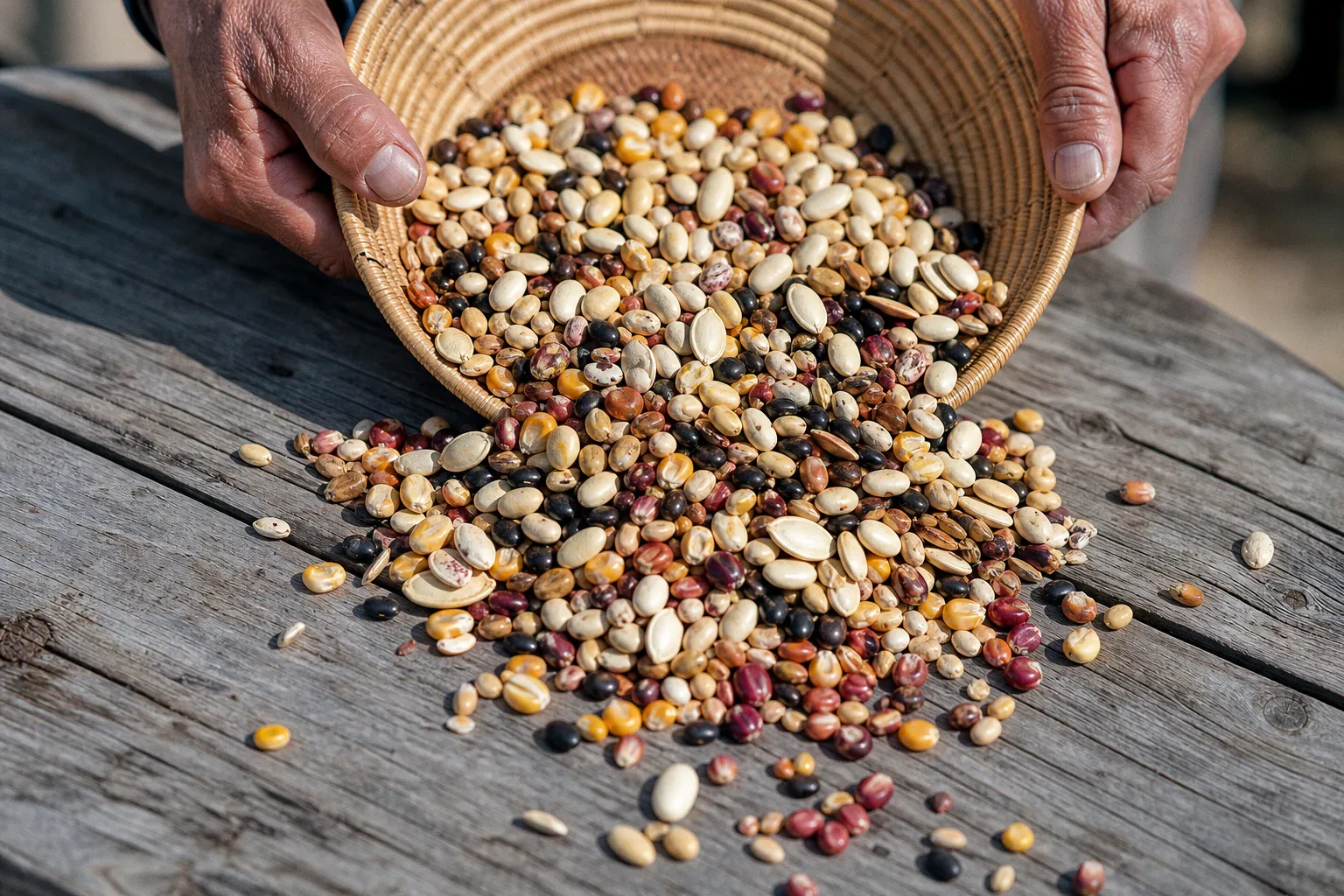
Storage matters. But storage alone does not put seed back in the ground, identify off-types, clean a harvest, settle access rules, or decide what knowledge stays inside the community. A seed bank is working infrastructure. It needs growers, field plots, governance, records, tools, and a clear answer to a hard question: who controls the seed once it leaves the shelf?
That is the route to food sovereignty. Not a ceremonial handoff. Not a catalog of rare varieties. A community-run system that can recover culturally connected crops, multiply them locally, move them to tribal growers, and keep stewardship authority where it belongs.
The work is already moving. In 2024, the USDA reported investment in six regional Indigenous seed-saving hubs through the Native American Food Sovereignty Alliance’s Indigenous Seed Keepers Network. That investment included seed-cleaning fanning mills. Good. A fanning mill is not glamorous. It is also the kind of equipment that turns a mixed, chaff-heavy harvest into seed a grower can actually inspect, store, and plant.
Beyond storage: build a seed hub, not a seed closet
Tribal community seed storage starts with the physical seed. It cannot end there.
Every usable seed program has several moving parts. They need to be bolted together before anyone starts promising distribution. We have seen the same failure point across rural projects: a group secures seed, finds a shelf, takes photos, and then has no field capacity for the next grow-out. The stock ages. Labels drift. Nobody knows which lot went to which grower. The project stalls under its own paperwork.
A working seed hub carries five loads at once:
1. Recovery and rematriation. Some seed is already in community hands. Some may be held by colleges, museums, government collections, or other institutions. Bringing culturally connected seed back into tribal stewardship is not ordinary procurement. It requires consent, relationships, and community-defined terms.
2. Grow-outs and multiplication. One packet does not rebuild a seed system. The seed has to be planted, observed, kept separate where needed, harvested, and increased across seasons. This is where a seed bank either gains capacity or becomes a display case.
3. Cleaning, drying, and lot handling. Seed needs a workbench, screens, containers suited to the crop and local conditions, labels that stay attached, and a method for separating lots. Do not improvise this part after harvest. By then the crew is tired, weather is closing in, and mixed lots become permanent problems.
4. Distribution and return pathways. Seed goes to growers under rules decided by the community. Those rules may cover eligibility, quantities, reporting, return seed, non-sharing boundaries, or ceremonial restrictions. The point is not to impose a universal model. The point is to establish the rules before the first bag leaves the building.
5. Knowledge and data stewardship. A label can contain more than a crop name. It may carry field observations, family connections, traditional uses, or location data. That information can be sensitive. Tribes have specifically raised concerns about public sharing of Indigenous seeds, ecological knowledge, and cultural heritage data. Do not upload it by default. Do not publish it because a grant report asks for color.
Seed is not inventory. It is planting material, cultural responsibility, and governance work packed into the same envelope.
The Mandan, Hidatsa, and Arikara Nation work through Nueta Hidatsa Sahnish College shows the scale of this approach. The college began stewarding traditional crop varieties in 1998. In March 2024, USDA Agricultural Research Service announced a cooperative agreement to expand the traditional varieties held in the college’s seed cache and improve tribal member access.
The project is not built around storage alone. A Tribal Project Advisory Team, with representatives from each of the three tribes, guides seed increases, distribution decisions, program data collection, and the integration of Traditional Ecological Knowledge. That is the right order of operations: governance first, field production next, distribution after that.
The field is where preservation gets tested
Traditional crop preservation methods get real when seed goes back through soil, wind, insects, irrigation limits, and harvest labor.
A banked lot may be culturally vital. It still has to germinate. It still has to produce enough healthy seed. It still has to be kept distinct from other varieties when that matters to the crop and the community’s stewardship goals. There is no way around the fieldwork.
During the first year of the USDA–Nueta Hidatsa Sahnish College collaboration, growers produced:
- Eight corn varieties totaling 28 gallons of seed.
- Seven squash varieties yielding more than 500 squashes.
- Four bean varieties yielding one-half gallon of seed.
- More than 150 watermelons from one variety grown on one-half acre.
Those numbers tell us something useful. Crop increase is uneven. Corn can build volume. Beans may move slowly. Squash may produce substantial food while also supporting the next round of seed selection. A project plan that assigns the same acreage, labor, and distribution target to every crop is not a plan. It is a spreadsheet looking for trouble.
For a field crew, the sequence needs to stay plain:
1. Choose the crop and the purpose. Is this grow-out for seed increase, evaluation, community food, training, or a mix of all four? Write it down. A field intended to make food can be managed differently from one intended to maintain a distinct seed lot.
2. Set the field layout before planting. Mark plots. Record what goes where. Build separation practices appropriate to the crop and local objectives. Do not rely on memory after a storm, a volunteer shift, or a midseason change in crew.
3. Assign observation work. Somebody has to walk the rows and record what happened: emergence, plant vigor, pest damage, flowering timing, fruit traits, and harvest condition. The notes do not need to become a public database. They do need to stay with the community.
4. Separate harvest from handling. Use labeled containers at harvest. Keep lots apart on the truck, at the wash station, and at the drying area. One unlabeled bucket can wipe out months of careful field separation.
5. Decide what returns to storage and what moves out. Some seed may be reserved for future multiplication. Some can go to community growers. Some may need further testing or another season of observation. Do not empty the bank to meet a distribution target.
This is where indigenous agricultural heritage programs earn their keep. They do not freeze a crop in time. They maintain the ability to grow it under current conditions, with present-day growers making decisions on their own land.
The College of Menominee Nation provides another working example. Its USDA-supported Northern Flint Corn project, scheduled from 2024 through 2026, includes reviving Menominee Flint Corn, seed-saving and management training, participatory evaluation of flint-corn varieties, and distribution of increased seed to interested community members. Notice the load-bearing pieces: revival, training, evaluation, and distribution. Remove one, and the system loses torque.
Different crops need different handling plans
There is no universal temperature, moisture level, container, or viability schedule that works for every Indigenous crop and every tribal seed bank. Anyone selling one universal storage formula is bypassing the hard part.
Seed behavior varies by crop. So do local storage conditions, available equipment, harvest timing, and community protocols. Build crop-specific handling plans instead of chasing a generic “best practice” poster.
| Operating question | Corn and other bulk seed crops | Beans and other small-seed lots | Squash and watermelon seed |
|---|---|---|---|
| Main production constraint | Maintaining distinct lots while building enough volume | Slow volume increase from limited starting stock | Cleaning and handling seed from fresh fruit |
| Field priority | Plot records, grower coordination, harvest separation | Careful lot control and patient multiplication | Harvest maturity, seed extraction, washing, drying workflow |
| Storage pressure | Space and container capacity can become a problem quickly | Small lots are easy to mislabel or combine by accident | Seed must be fully processed before it can enter storage |
| Distribution risk | Giving out too much before reserve stock is secure | Exhausting a scarce lot in one season | Confusing food harvest goals with seed-production goals |
The table is not a recipe. It is a way to stop making the same planning error: treating “seed” as one material.
At Nueta Hidatsa Sahnish College, a project-specific guidance point has been that seed in the cache should be regrown at least every 10 years. That is useful for that project. It is not a universal clock for every community or crop. Viability must be checked through local records, testing practices, crop knowledge, and actual storage conditions.
A seed bank also needs a failure log. Not a glossy annual report. A blunt record of what did not hold:
- A lot with weak emergence.
- A field lost to weather or pests.
- A label system that failed.
- A grower who could not return seed because the crop did not produce.
- A distribution rule that created confusion.
- A data request that crossed a cultural boundary.
That log is how the next season gets safer. If we bury mistakes, we haul them into the next planting cycle.
Governance is the axle, not an appendix
The seed room can be locked. That does not mean governance is sound.
The central question is who has authority over seed, information, and access. Community-led seed banking means the tribe or community defines those terms. A university, nonprofit, agency, or funder may supply staff time, equipment, technical support, or money. None of that gives an outside institution automatic control over distribution lists, accession records, photos, traditional knowledge, or public storytelling.
The Mandan, Hidatsa, and Arikara project uses a Tribal Project Advisory Team to guide its key decisions. That structure is not administrative decoration. It prevents the common breakdown where technical staff make cultural decisions because nobody established a decision lane.
A practical governance file should settle the following before the project expands:
- Who approves seed acquisition, rematriation, and increase work? Name the decision body. Do not leave it to whoever answers email fastest.
- Who can access the storage area and handling records? Physical access and data access are separate controls.
- What information is restricted? This can include collection locations, family connections, ceremonial uses, traditional names, photographs, and grower details.
- Who receives seed, and under what terms? The answer may differ for tribal members, school gardens, community farms, research partners, and public events.
- What happens to seed grown by participating farmers? A return-seed expectation may work for some projects. In others, a grower may retain the harvest. The community sets the rule.
- Who can speak publicly about the project? Media requests can strip context fast. Assign the authority before a reporter or donor calls.
If the community does not control the map, the inventory, and the access gate, it does not control the seed system.
This is especially relevant for volunteer networks. Riders, builders, and rural outreach crews can haul tools, repair a storage room, build wash stations, move fencing, or get seed-cleaning equipment to a remote site. That is useful support. It is not a mandate to collect stories or extract data.
Our lane is simple: show up on time, carry the load we were asked to carry, and leave decision-making with the people who hold the responsibility.
Farmers’ rights do not erase local law or local protocol
Seed work sits at the junction of cultural responsibility, agricultural regulation, intellectual property, plant health rules, and tribal law. That junction has potholes.
Article 9 of the International Treaty on Plant Genetic Resources for Food and Agriculture recognizes Farmers’ Rights. It includes protection of traditional knowledge, equitable benefit-sharing, and participation in national decision-making. It also states that the right to save, use, exchange, and sell farm-saved seed is subject to national law and as appropriate.
That final clause matters. It means nobody should sell a tribal seed bank a fantasy of unrestricted global seed exchange. Rules vary by jurisdiction. They may involve seed labeling, plant-health requirements, intellectual property, institutional agreements, tribal regulations, and terms governing material held by outside collections.
Before distributing seed beyond a defined community network, anchor these questions:
1. What law applies to this movement of seed? Tribal, state, federal, and cross-border rules can all enter the picture depending on the crop and destination.
2. Is the seed subject to an agreement with a repository, research institution, or program funder? Read the terms. Do not assume a donation has no strings.
3. Are there plant-health or quarantine concerns? A seed lot may need assessment before it travels, particularly across regions.
4. Does the community want this variety distributed at all? Legal permission is not cultural permission.
5. What benefit-sharing arrangement applies if outside researchers or commercial actors request access? This needs a community decision before interest arrives, not after.
Legal review is not the whole job. A project can be technically lawful and still violate community protocol. The reverse is also true: a community may have a clear cultural mandate but need help navigating an outside regulatory barrier. Get both sides on the table. Do not torque one bolt while the other is loose.
Seed rematriation builds capacity only when the return path is real
Seed rematriation is often flattened into the language of acquisition: locate seed, request seed, receive seed. That misses the point.
The work is about restoring stewardship relationships between a community and culturally connected seed. The seed may come from an institution. The authority and ongoing care must return to the community. That means a real return path: grow-outs, growers, teaching, storage, and governance.
There are global examples at larger scale. Indigenous farmers associated with Peru’s Potato Park established a community-based potato seed bank that conserves 1,136 varieties with support from the International Treaty’s Benefit-sharing Fund. The number is substantial. But the lesson is not that every tribal project needs a four-digit inventory.
A small bank with three viable, well-governed varieties that are grown every season may do more practical work than a large collection nobody can regenerate. Scale should follow field capacity. Start with the crops people are ready to grow, eat, teach, and steward. Add volume only when the handling system can carry it.
USDA reported that hundreds of Mandan, Hidatsa, and Arikara tribal citizens had learned seed saving, received seed to plant, or participated in traditional-food events through the seed-sovereignty collaboration. That is a meaningful measure because it tracks use, not just storage. Still, we should not claim that seed banking alone guarantees household income, nutrition, or food security. It does not. Land access, water, equipment, labor, transportation, local markets, and policy all bear weight.
Food sovereignty is a system load. Seed is one of the main anchors.
Build for the next planting, not the next grant photo
An indigenous seed bank project for tribal farmers should leave a community with more control than it had at the start. More viable seed. More growers who know the crop. Better records under community authority. A clearer distribution process. A storage and handling setup that does not collapse when one staff member leaves.
That is the standard.
Do not measure success by the number of jars on a shelf. Measure it by whether the seed can return to the field without losing its identity, whether growers can access it under community rules, and whether sensitive knowledge stays protected.
Before the season closes, make sure the crew can answer these questions without guessing:
- Which lots are viable enough to plant next?
- Which growers have seed, and what support do they need?
- Which varieties need another increase before wider distribution?
- Where are the harvest, cleaning, and storage bottlenecks?
- Who has authority over records, photos, and public information?
- What happens if a storm, equipment failure, or staff turnover hits tomorrow?
If those answers are solid, the seed bank is carrying load. If they are not, do not expand the catalog. Fix the axle first.