Community recycling models: which setup fits your town?
A community recycling program is not defined by the color of its bins. It is defined by the relationship between participation, material quality, collection logistics, and the value recovered after sorting.
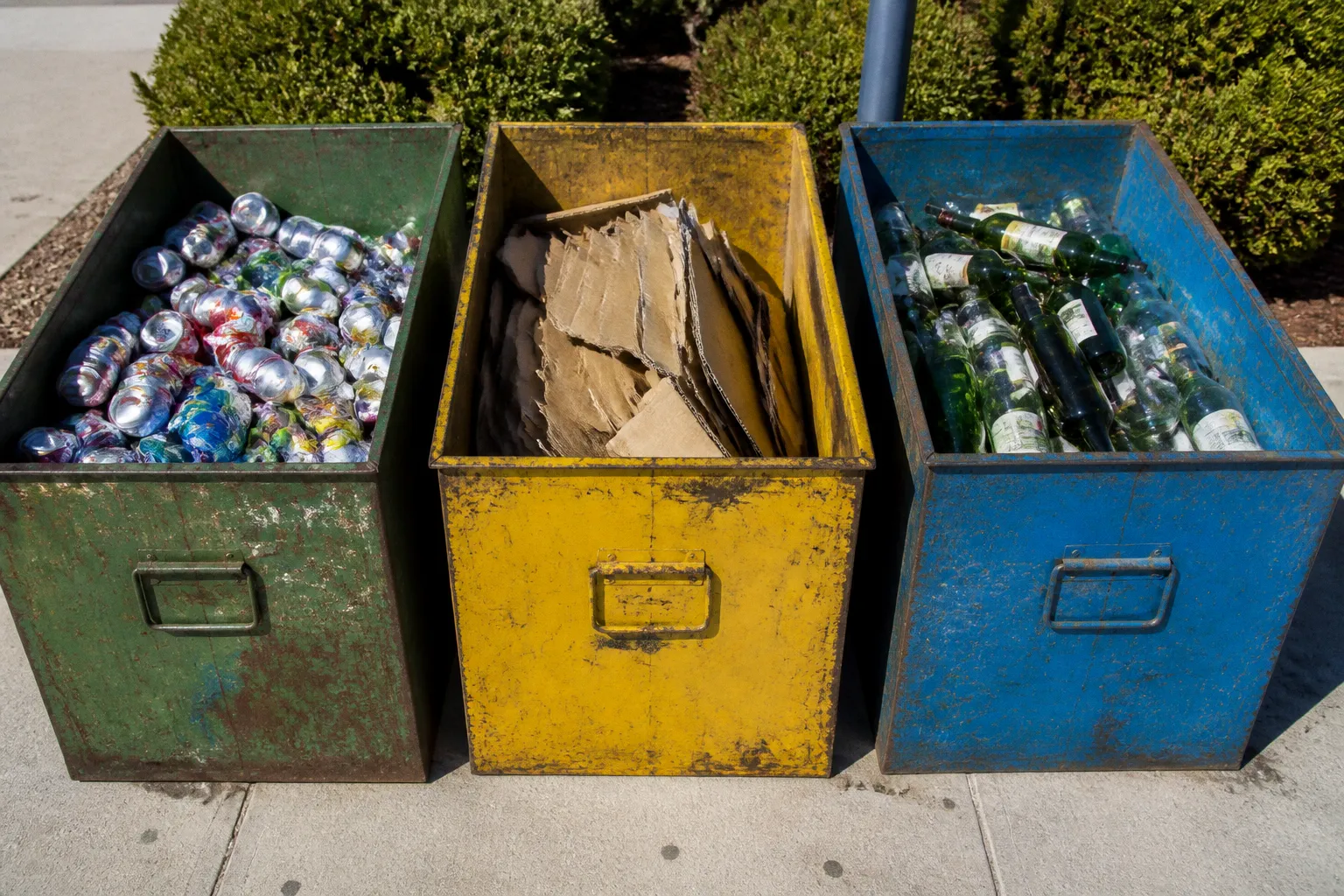
That relationship changes sharply between a dense urban neighborhood, a dispersed rural district, and a volunteer-run network serving schools or small settlements.
Compare car rental deals in United Kingdom
See available offersPartner link — DiscoverCars comparisonThe main community recycling program options fall into four operating models: single-stream curbside collection, dual-stream curbside collection, drop-off centers, and Pay-As-You-Throw systems layered onto waste collection. None is universally superior. Each shifts cost and operational complexity to a different point in the system. Single-stream systems make participation easier but increase contamination. Dual-stream systems require more discipline but generally produce cleaner material. Drop-off centers reduce municipal collection costs but create an access barrier. PAYT can reduce residual waste, although it depends on reliable recycling access and clear enforcement.
For a town deciding among neighborhood recycling hub models, the central question is therefore not which model appears most modern. It is which model can sustain a high-quality material flow with the staff, vehicles, education budget, and processing capacity the town actually controls.
The trade-offs of single-stream and dual-stream collection
Single-stream recycling places paper, cardboard, plastic, metal, and glass in one container. Its operational appeal is straightforward: residents sort less at home, collection crews can move quickly, and a municipality can often increase participation without building a second household storage routine.
That simplicity transfers pressure downstream. The mixed material must be separated at a Materials Recovery Facility, or MRF. When unsuitable items enter the stream, the facility carries the cost through additional sorting, equipment wear, rejected loads, and lower-value recyclates. The town may achieve a strong collection volume while receiving a weaker material yield.
Dual-stream collection divides the material into two categories, typically fibers such as paper and cardboard, and containers such as glass, plastic, and metal. The household sorting requirement is higher, but the processing line receives a more organized input. This generally reduces contamination, lowers sorting costs, and improves the quality of recovered materials.
The choice can be understood as a resource-allocation decision:
| Operating factor | Single-stream | Dual-stream |
|---|---|---|
| Household convenience | Higher; most recyclables enter one bin | Lower; residents separate fibers from containers |
| Collection logistics | Simpler routing and fewer handling distinctions | More complex collection design and container management |
| Participation potential | Strong, because the behavior is easy to understand | More dependent on consistent resident education |
| Contamination exposure | Higher, particularly when all materials are mixed | Lower when residents follow the separation rules |
| Sorting burden | Concentrated at the MRF | Reduced at the processing stage |
| Recyclate quality | More variable | Generally higher |
| Best operational fit | Dense areas with reliable processing capacity | Communities prioritizing material quality and source separation |
This is the first major bottleneck: a town may be able to collect mixed recyclables long before it has the capacity to process them economically. If the downstream facility is not equipped for the volume or contamination profile, the apparent convenience of single-stream collection becomes a liability.
Single-stream moves complexity away from the resident; dual-stream moves more of it into the household. Neither removes complexity from the system.
For towns working through local sustainability campaigns, the decision should be based on the entire chain rather than the collection truck alone. A single-stream model requires confidence in four linked areas:
- The MRF can handle the expected material volume without excessive manual intervention.
- The town has a clear contamination communication system, not just a launch-day publicity campaign.
- Collection contracts define how rejected or heavily contaminated loads are treated.
- Revenue assumptions do not depend on a fixed value for recovered materials.
Dual-stream has a different risk profile. Its primary failure point is participation fatigue. If the separation instructions are unclear, residents may place containers in the fiber stream or discard recyclable material altogether. That makes the education program part of the infrastructure, not an optional supplement.
For volunteer-run recycling programs, dual-stream can work particularly well at controlled collection points, schools, community halls, and neighborhood hubs where volunteers can explain the categories directly. It is less straightforward when the program depends on thousands of households sorting independently without regular feedback.
Drop-off centers for low-density municipalities
Drop-off recycling centers are often treated as a compromise, but in low-density areas they can be the most rational deployment model. A municipality avoids sending collection vehicles down every road, concentrates material at a smaller number of sites, and can begin with a manageable footprint.
The limitation is access. A household must store recyclable material, transport it to the site, and understand which materials belong in which container. Every additional step creates attrition. In the studied drop-off setups referenced in the available research, the separation rate for paper and plastics was 7.7%, compared with 9.7% for kerbside collection. The figures are not a universal forecast for every municipality, but they illustrate the participation penalty that can accompany a less convenient system.
A drop-off program should therefore be designed as a network, not as a single fenced compound at the edge of town. The relevant planning variables include:
- Travel distance: A site that is technically available but difficult to reach will produce weak capture rates.
- Operating hours: Limited access can exclude shift workers, students, and households without flexible transport.
- Material acceptance: The narrower the accepted list, the easier contamination control becomes, but the less useful the program appears to residents.
- Site supervision: Unstaffed areas can become informal dumping points unless signage, lighting, and collection schedules are adequate.
- Overflow response: Full containers quickly undermine trust and can contaminate otherwise recoverable material.
- School and community partnerships: Public institutions can serve as predictable collection nodes when household curbside service is not viable.
For rural school networks, a drop-off model may connect environmental education with a practical recovery route. A school can host a collection day, teach material separation, and aggregate paper or containers for scheduled transfer. That does not make the school responsible for municipal waste management; it creates a visible demonstration point and a controlled data source. The program can track kilograms collected, contamination incidents, participating households, and missed pickups without pretending that educational activity alone equals material recovery.
The strongest drop-off systems establish a service rhythm. A monthly event with no reliable onward transport is not a recycling system; it is temporary storage. The collection calendar, vehicle allocation, and processor agreement need to be defined before public participation is promoted.
When a neighborhood hub is the right middle ground
Many communities do not need to select between universal curbside collection and a distant drop-off site. A network of neighborhood hubs can create an intermediate structure: smaller collection points placed near schools, markets, housing clusters, or community offices, with scheduled consolidation into a larger processing route.
This approach is particularly useful where the population is dispersed but social institutions are concentrated. It also creates a practical role for local NGOs and volunteer networks:
1. Map the collection nodes. Use existing public facilities rather than creating new sites wherever possible.
2. Assign a material owner. Each hub needs a person or organization responsible for opening, supervision, reporting, and escalation.
3. Standardize the categories. A hub should not improvise its own rules; inconsistent categories create contamination at the consolidation stage.
4. Schedule transport around actual volume. A fixed route that collects half-empty containers may waste fuel, while an infrequent route can cause overflow.
5. Measure participation and quality separately. High attendance does not prove that the material is recyclable, and clean material does not prove broad access.
A hub model is not automatically cheaper than curbside collection. Its value lies in matching infrastructure intensity to settlement density. It may reduce route costs while increasing the need for supervision, signage, and public engagement.
Pay-As-You-Throw: a pricing mechanism, not a recycling system
Pay-As-You-Throw, or PAYT, charges households according to the volume or weight of residual waste they discard. The economic signal is direct: households that reduce their trash or recycle more can reduce the amount they pay.
PAYT is often discussed as if it were a standalone recycling model. It is not. It is an incentive layer that requires a functioning waste collection system underneath it. If residents face a charge for residual waste but lack convenient access to recycling, composting, or reuse channels, the likely outcome is not necessarily higher recovery. It may be illegal dumping, waste burning, or storage in unsuitable locations.
The available figures show the difference in adoption between basic curbside recycling and PAYT in surveyed US municipalities: about 50% had curbside recycling programs, while 10% had adopted PAYT. The comparison is useful because it demonstrates that a pricing mechanism demands more administrative and political capacity than a standard collection service.
A responsible PAYT rollout requires a sequence rather than a single policy announcement:
- Establish a reliable baseline for household waste generation.
- Provide a convenient recycling route before introducing the charge.
- Define exemptions or adjustments for households with legitimate higher waste needs.
- Make billing and bag or container rules simple enough to administer.
- Monitor residual waste, recycling participation, complaints, and illegal disposal together.
- Review the policy after implementation instead of assuming that the price signal will behave uniformly across neighborhoods.
PAYT can be combined with either single-stream or dual-stream collection. The combination changes the risk calculation. PAYT plus single-stream may produce a strong participation incentive but can also channel more poorly sorted material into the recycling stream. PAYT plus dual-stream may produce cleaner outputs, but only where residents can follow the separation rules and the collection schedule is dependable.
The policy objective should be waste reduction first, with recycling as one component. A household that avoids unnecessary packaging, repairs an item, or reuses a container has reduced the need for collection and processing before the material reaches any recycling bin. That is a more sustainable yield than measuring success only by the tonnage transported to a facility.
Economic realities: net costs and market volatility
Recycling budgets are exposed to two different cost structures. The first is local and relatively controllable: vehicles, labor, containers, site supervision, education, transfer stations, and administrative systems. The second is external: the value of recovered paper, plastics, metals, and glass in secondary material markets.
Historical US figures show how sharply net kerbside recycling costs can vary. Annual net costs were reported at around $3 per household in 2011 and between $34 and $42 per household during 2018–2020. These figures are not a universal price card for every town; they show the degree to which market conditions can alter the budget position.
A municipality that builds its business case around material revenue is therefore carrying commodity risk. When market values weaken, the collection obligation remains while the income assumption contracts. The more robust approach treats recovered-material revenue as variable and plans the core service around predictable funding.
For a town or nonprofit partnership, the budget should distinguish between these categories:
Fixed operating capacity
This covers the minimum system needed to function even when markets are unfavorable:
- Collection labor and vehicle availability
- Container purchase and replacement
- MRF or processor access
- Drop-off site maintenance
- Public communication and contamination education
- Data collection and program administration
Variable recovery economics
This includes revenue or avoided costs that depend on material quality and market conditions:
- Payments for sorted commodities
- Processing charges or rebates
- Disposal costs avoided through recovery
- Rejected-load penalties
- Transport costs linked to changing shipment destinations
Contingency and expansion
This is the funding required to absorb operational shocks or scale the system:
- Emergency hauling after site overflow
- Replacement of damaged containers
- Additional sorting or inspection
- New collection nodes
- Training for volunteers and school coordinators
The distinction matters for environmental projects driven by community action. A volunteer network can lower coordination costs and improve participation, but it cannot eliminate the cost of transport, processing, or safe storage. Volunteer labor should be allocated to functions where local presence creates measurable value: education, hub supervision, contamination feedback, event coordination, and data recording. It should not be used as a substitute for licensed or technically qualified handling where the material stream requires it.
A recycling program is financially durable when its essential service can survive a weak commodity market.
Aligning local initiatives with 2030 sustainability targets
Global targets can provide direction, but they do not replace local performance metrics. The United States has targeted a 50% national recycling rate by 2030, while the EU Circular Economy Action Plan set a 60% recycling target for 2030. These benchmarks are useful as policy signals, but a town should not claim alignment merely because it has distributed bins or planted signage around a collection site.
A local program needs a measurement architecture that connects activity to outcomes. At minimum, the reporting system should separate:
- Access: the share of households, institutions, or neighborhoods with a practical collection route.
- Participation: the number of households or users who actually contribute material.
- Capture: the amount of recyclable material removed from the residual waste stream.
- Quality: the proportion of collected material that can proceed through processing without rejection.
- Cost: expenditure per household, per collection route, or per recovered unit of material.
- Equity: whether low-income, remote, elderly, or transport-limited households can use the system.
- Behavioral change: reductions in residual waste, litter, or disposable consumption where these can be credibly measured.
A school campus greening project can use the same logic. The objective is not simply to hold an environmental awareness program. It is to establish a repeatable operating cycle: identify the material stream, assign responsibility, record the baseline, train participants, collect at a defined interval, and review the outcome. Tree plantation drives and campus gardens may be valuable, but they should not be counted as recycling progress unless the metrics are kept distinct.
For community organizations, the best implementation sequence is usually a controlled pilot followed by measured expansion:
1. Select a representative zone. Avoid choosing only the easiest neighborhood; the pilot should expose access and contamination constraints.
2. Choose one material architecture. Do not launch multiple sorting rules before the first route has stable performance.
3. Set a baseline period. Record residual waste, collection volume, participation, and operational cost before changing the system.
4. Train the local operators. Volunteers, school staff, collection crews, and municipal officers need the same definitions.
5. Publish simple feedback. Residents should know which materials are accepted and what happens when loads are contaminated.
6. Review bottlenecks after each cycle. If the limiting factor is transport, more awareness messaging will not solve it.
7. Scale only after the processor and budget are ready. A larger collection footprint magnifies every weakness in the original route.
This framework also makes partnerships more precise. A nonprofit may provide community mobilization and reporting. A municipality may provide land, vehicles, or regulatory authority. A processor may provide material specifications and quality feedback. A school network may provide trusted collection nodes. Each partner should have a defined output rather than a general commitment to sustainability.
Choosing the model for your town
The final choice should follow the town’s constraints, not the prestige of the model.
Choose single-stream curbside collection when resident convenience is the main participation barrier, the town has dependable MRF capacity, and it can fund contamination control. The model is operationally attractive where collection density is high and downstream sorting is established.
Choose dual-stream collection when material quality is a strategic priority, the processing system benefits from cleaner inputs, and the community can sustain clear household separation. It is often more suitable for controlled neighborhoods, institutions, and programs with strong education or supervision.
Choose drop-off centers when the population is dispersed, curbside routes are financially inefficient, or the town needs a lower-cost entry point. Build a network of accessible sites rather than relying on a single distant location, and fund the transport schedule before opening the containers.
Add PAYT when the municipality can administer a transparent charging system, provide convenient recycling access, and monitor unintended consequences. PAYT should reinforce waste reduction, not force households into a service gap.
For many small towns, the most resilient design will be hybrid: drop-off or neighborhood hubs in low-density areas, curbside collection in concentrated settlements, dual-stream separation at schools or supervised sites, and a gradual PAYT pilot only after access is stable. That arrangement is less elegant on a presentation slide, but infrastructure should be optimized for actual settlement patterns rather than visual uniformity.
Community recycling program options are ultimately choices about where the system can absorb complexity. If residents cannot sort reliably, the MRF must carry more of the burden. If the municipality cannot finance frequent collection, residents must travel to a hub. If the town wants to use PAYT, it must invest in enforcement, access, and monitoring. Every model has a cost center; the task is to place it where the organization has the greatest operational control.
The practical next step is not a nationwide comparison or a new slogan. It is a local resource-allocation review: map the material flow, identify the first bottleneck, price the minimum viable service, and define the impact metrics before expansion. Municipalities and nonprofit partners that fund those fundamentals will produce higher sustainable yield than programs that optimize visibility while leaving collection, sorting, and processing unresolved.