Shower outreach programs: which model fits your community?
Operating costs for shower outreach programs for homeless populations can range from approximately $60–$80 per shower in a municipal mobile program to more than $390 per shower in a periodic contracted rural model.
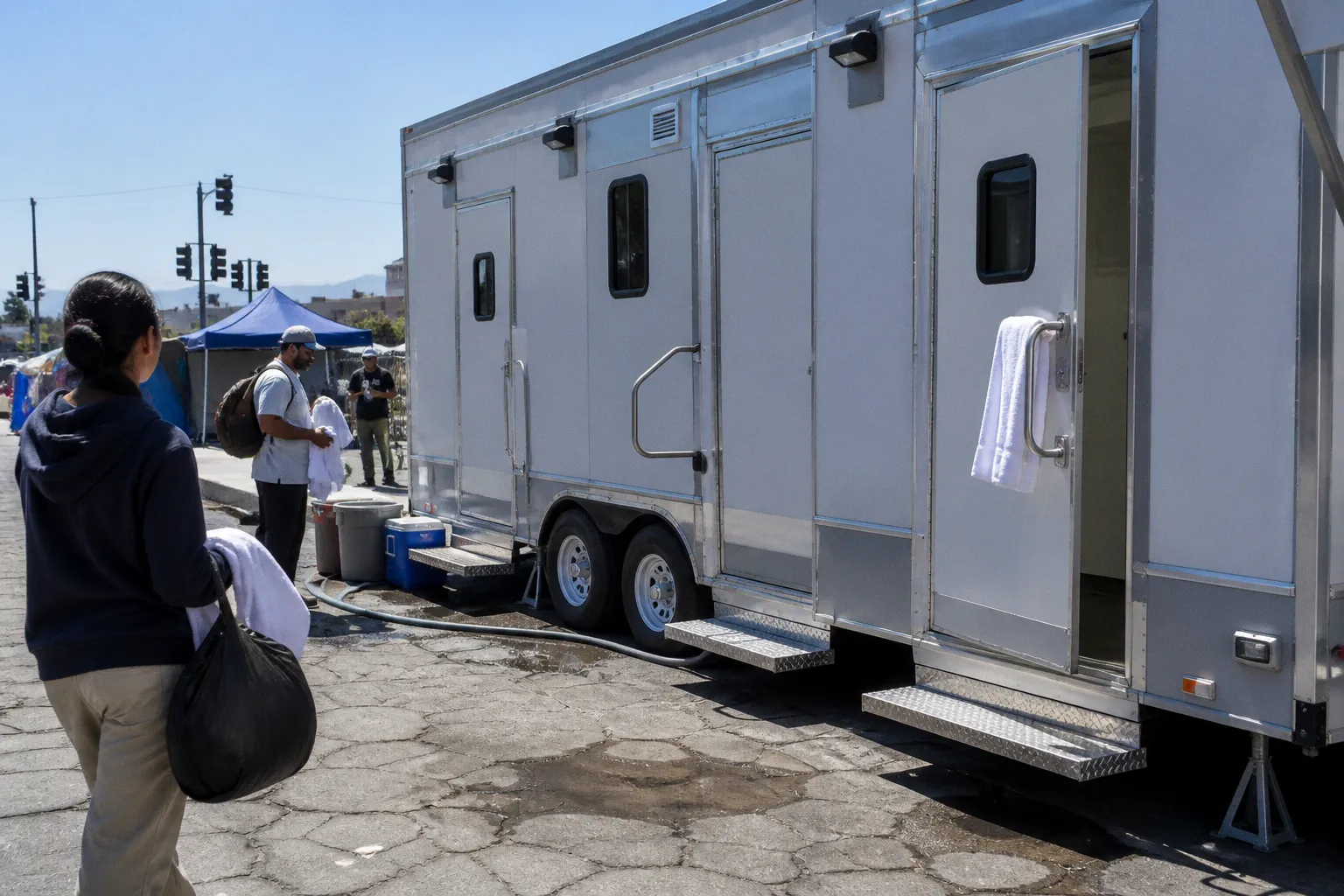
The difference is not explained by the shower fixture itself. It comes from route length, staffing, water supply, wastewater disposal, towing, permitting, and the number of people served during each deployment.
Compare car rental deals in United Kingdom
See available offersPartner link — DiscoverCars comparisonThat cost spread is the central planning fact. A community choosing between a mobile shower trailer, a converted bus, portable indoor stalls, or a fixed facility is not selecting equipment in isolation. It is selecting an operating system with a specific resource-allocation profile.
The correct model depends on site geography, access to utilities, expected demand, available staff, and the municipality’s capacity to manage greywater. Mobility is useful only when the program can sustain the logistics that mobility creates.
The four operating models
Shower outreach programs generally fall into four configurations:
1. Mobile shower trailers that are towed between service locations.
2. Retrofitted buses containing multiple self-contained hygiene stalls.
3. Portable indoor shower kits installed temporarily in shelters, community centers, or emergency facilities.
4. Stationary shower facilities located in a permanent building.
Each model solves a different access problem. A trailer or bus reduces the distance that unhoused people must travel. A portable indoor system uses existing buildings more efficiently. A permanent facility offers the most stable service environment but requires a suitable site, capital investment, and long-term management.
The comparison is best made across the full operating cycle rather than on purchase price alone.
| Parameter | Mobile shower trailer | Retrofitted transit bus | Portable indoor stalls | Fixed facility |
|---|---|---|---|---|
| Primary advantage | Flexible deployment across several sites | Fully contained mobile hygiene service | Low storage footprint and use of existing buildings | Stable, high-control operating environment |
| Typical infrastructure | Water hookup or onboard tank, generator, heater, greywater system | Integrated plumbing, power, water, heating, and vehicle systems | Indoor drain or sink, electrical supply, evacuation pump | Permanent water, sewer, power, ventilation, and accessibility systems |
| Mobility | High | High, but dependent on vehicle access and maintenance | Low to moderate | None |
| Capacity range | Configurations from 2 to 16 shower stations | Determined by bus layout and vehicle size | Usually limited by available indoor space and kit count | Determined by building design |
| Water autonomy | Some units carry up to 1,000 gallons of fresh water | Depends on the conversion and onboard systems | Usually connected to the host building | Continuous utility connection |
| Main bottleneck | Greywater disposal, towing, site access | Vehicle maintenance, route planning, operating complexity | Indoor drainage and host-site coordination | Capital cost, site acquisition, staffing |
| Best fit | Distributed urban or regional outreach | High-visibility urban routes with recurring demand | Shelters and emergency response | Communities able to sustain a permanent service hub |
The table makes one point clear: there is no universally superior model. A mobile hygiene unit for homeless outreach is effective when the service geography requires it. Where a building with usable plumbing already exists, mobility may add cost without adding equivalent value.
Mobile shower trailers: the flexible middle ground
Trailers are often the most adaptable entry point for a community that needs to serve several locations but does not yet have the capital or operational capacity for a bus conversion or permanent center. Available configurations range from two shower stations to 16, allowing organizations to match capacity to demand rather than committing immediately to a large platform.
A trailer can use direct utility hookups or operate with onboard systems. Some configurations carry up to 1,000 gallons of fresh water, supported by mobile generators and propane or tankless water heaters. That autonomy is operationally valuable at encampments, parking areas, disaster sites, and rural locations where utility connections are unreliable or unavailable.
It also introduces a hard limit. Water autonomy does not eliminate the wastewater problem. Every shower produces greywater that must be collected, transported, treated, or discharged through an approved municipal system. In many jurisdictions, this is the most consequential planning constraint.
Where trailers perform well
A trailer is generally a strong fit when:
- Service demand is spread across multiple neighborhoods or towns.
- The program has access to a capable towing vehicle and a qualified driver.
- Sites can accommodate vehicle length, turning radius, queuing, and privacy requirements.
- The operating team can secure water and greywater arrangements before each deployment.
- Demand is substantial enough to justify moving the unit rather than installing several small facilities.
The last point is frequently underestimated. A trailer can reach more people than a fixed site, but each move consumes labor and fuel. Setup, leveling, water connection, heater checks, sanitation, and shutdown all create non-service time. If the route schedule sends a unit to a low-volume site for a short period, the cost per shower rises even if the equipment itself is fully functional.
The trailer versus the stall
The practical comparison between a homeless mobile shower trailer and a portable indoor stall is not really about portability. Both can be moved. The difference is whether the building or the vehicle carries the infrastructure burden.
A trailer carries water, heating, power, and shower spaces to the user. A portable indoor stall carries the shower space to a building that already provides some of the infrastructure. When an emergency shelter has electrical service, an accessible drain, and adequate room, portable stalls can produce a better utilization rate because the program avoids towing and outdoor site preparation.
Mobility is not a benefit by itself. It is a cost-effective benefit only when distance is the primary barrier to service.
Converted buses: maximum visibility, maximum integration burden
The converted-bus model became prominent through organizations such as Lava Mae, founded in 2013. Retired public transit buses were redesigned as mobile shower units capable of taking enclosed hygiene stalls directly to urban encampments and other locations serving people without stable housing.
A bus offers more than a set of shower fixtures. It creates a recognizable, fully contained service environment with room for plumbing, heating, electrical systems, storage, and potentially additional hygiene services. That can support a recurring route model in dense urban areas where the same neighborhoods generate consistent demand.
The operational trade-off is complexity. A bus combines the maintenance profile of a commercial vehicle with the regulatory and sanitation requirements of a public-facing facility. Tires, brakes, engine systems, insurance, inspections, accessibility, water systems, ventilation, and interior sanitation must all be managed as one asset.
When a bus makes strategic sense
A converted bus is most defensible when the organization has:
1. Recurring demand at several high-density locations. A bus is a poor fit for occasional deployment or widely dispersed service points.
2. A dedicated operations function. The program needs more than volunteers arriving for a service day; it needs route control, maintenance scheduling, inventory management, and incident procedures.
3. Stable funding for the full lifecycle. The conversion is only the initial capital requirement. Fuel, repairs, insurance, staffing, sanitation supplies, and wastewater logistics continue after launch.
4. A predictable municipal relationship. Site permissions, parking arrangements, wastewater discharge, and public-health requirements must be coordinated before the vehicle is placed on a route.
5. A service model that benefits from visibility. A branded, recognizable unit can improve outreach coordination, but visibility is not a substitute for reliable scheduling.
A bus may deliver a stronger user experience than a small trailer, but its scale can create an all-or-nothing operating profile. If the vehicle is unavailable, the entire service may be interrupted. A trailer fleet or a combination of portable stalls can provide more redundancy, although often with lower per-unit capacity.
Portable indoor stalls: the underused logistics option
Portable indoor shower kits are designed for emergency and shelter outreach. Some pack flat to less than eight inches in depth, which materially changes storage and deployment requirements. They can be kept in a warehouse, transported to a community facility, and installed when demand increases.
These systems are particularly relevant to organizations that already operate shelters, food distribution sites, disaster-response programs, or community centers. The host building can provide electricity, lighting, privacy partitions, and basic drainage. A custom UL-certified evacuation pump can move wastewater at up to three gallons per minute, directing greywater into existing indoor drains or sinks where the installation is permitted.
This model does not remove infrastructure risk. It relocates it. The critical questions become whether the building’s drains can accept the discharge, whether the electrical supply is adequate, whether the floor can tolerate water exposure, and whether the installation meets local health and safety requirements.
Portable stalls have three strategic advantages.
1. Lower transport overhead
The equipment can be moved in a van or stored on-site rather than towed. That reduces fuel use, vehicle wear, and deployment time. For a program operating inside one shelter or rotating among nearby buildings, this can improve the ratio between staff time and showers delivered.
2. Better weather control
Indoor service avoids many of the operational interruptions associated with outdoor deployments. Heating, privacy, lighting, and queue management are easier to stabilize inside a building. This can be important for older adults, families, people with disabilities, and users who require additional time or support.
3. Incremental scaling
A community can add stalls as demand becomes clearer. It does not need to commit to a large mobile platform at the beginning. That supports a measured expansion strategy in which the organization tracks utilization, staffing demand, and wastewater performance before increasing capacity.
The limitation is obvious: portable stalls cannot reach a distant encampment unless the host building or another suitable indoor site is available. For rural outreach, this may make them a secondary component rather than the primary solution.
Fixed facilities: the highest stability, not always the lowest cost
A permanent shower facility provides the most predictable environment. Water and sewer connections are designed into the building, accessibility can be integrated from the beginning, and staff can establish regular opening hours. A fixed site also supports complementary services such as laundry, case management, mail access, charging stations, or health referrals.
However, a permanent facility is a real-estate and governance project, not simply a sanitation project. The organization must address site selection, construction or renovation, zoning, utilities, staffing, security, cleaning, and long-term maintenance. If the facility is placed too far from the population it intends to serve, users may still face a transportation barrier.
The fixed model therefore performs best in communities with:
- A concentrated population requiring recurring service.
- A suitable public, nonprofit, or donated building.
- Reliable utility infrastructure.
- Funding that can support operations beyond the opening period.
- A service network capable of connecting hygiene access with housing, health, and welfare programs.
For many grassroots organizations, the permanent facility is a later-stage option. A portable or mobile pilot can establish demand and operating data before the organization takes on a building.
The economics of a shower are mostly logistics
The phrase cost per shower can create false confidence. It appears precise, but the underlying calculation may include very different expenses across programs. A municipal mobile program may calculate direct operating costs over a recurring route. A rural contractor may include travel, mobilization, staffing, and limited service volume in a single per-shower figure.
Reported examples illustrate the scale of the difference. A Long Beach municipal mobile outreach model has been associated with operating costs of approximately $60–$80 per shower. In contrast, a periodic contracted program in Siskiyou County reached $390.48 per shower. Neither number should be treated as a universal market rate. They describe different deployment conditions.
A useful internal budget separates at least five cost pools:
1. Capital equipment: trailer or bus acquisition, conversion, fixtures, tanks, generators, heaters, pumps, and accessibility modifications.
2. Deployment logistics: towing, fuel, parking, site preparation, water filling, greywater transport, and disposal fees.
3. Labor: drivers, shower attendants, sanitation staff, supervisors, outreach workers, and maintenance personnel.
4. Consumables: soap, towels, personal-care items, disinfectants, protective equipment, and replacement parts.
5. Compliance and resilience: insurance, permits, inspections, vehicle maintenance, backup equipment, and contingency capacity.
A program that reports only the purchase price will understate its resource requirements. A program that reports only the cost per shower may conceal whether the figure depends on grants, donated labor, free parking, donated water, or unusually high demand.
Capacity utilization is the decisive metric
A 16-station trailer has more theoretical capacity than a two-station unit, but theoretical capacity is not delivered capacity. The relevant measure is the number of completed showers per deployment hour after setup, cleaning, breaks, no-shows, maintenance interruptions, and queue constraints.
The same principle applies to buses and fixed facilities. A large platform with low utilization can have a higher sustainable cost per shower than a smaller unit operating on a dense, reliable schedule.
Organizations should track:
- Showers completed per service day.
- Average service time per user.
- Setup and shutdown time.
- Staff hours per deployment.
- Water consumed per shower.
- Greywater volume and disposal frequency.
- Cancellations caused by weather, vehicle failure, or site access.
- Repeat usage and referral connections.
- Cost per completed shower, separated into fixed and variable components.
These are not administrative extras. They determine whether the service can expand without exhausting its funding base.
Greywater is the principal bottleneck
Many community discussions focus on fresh water because it is visible and easy to quantify. Operators often encounter a more difficult constraint on the other side of the shower: greywater compliance.
A mobile unit must collect wastewater and discharge it through an approved process. Depending on local rules, that can require a dedicated disposal infrastructure, permits, transport to a designated municipal discharge site, or a formal arrangement with a wastewater operator. Rules differ by jurisdiction, and there is no single national framework that resolves the issue for every grassroots program.
This creates several operational risks:
- A site may have enough fresh water but no lawful greywater outlet.
- The unit may need to leave a deployment early because the tank is full.
- Disposal locations may be far from service sites, increasing travel time.
- A program may need additional tanks, pumps, or transport capacity.
- An apparently suitable parking location may fail environmental-health review.
Greywater planning must be completed before equipment procurement. Otherwise, the organization can acquire a functional shower unit that cannot legally operate at its intended locations.
The best practice is to map every proposed service site against four infrastructure questions:
- Where will fresh water come from?
- Where will wastewater go?
- Who owns or controls the connection?
- What approval is required before discharge?
The answers should be documented in the operating plan, not left to the deployment team on the morning of service.
A practical selection framework
A community deciding how to start a mobile shower program should begin with service geography and operating capacity, not with a preferred vehicle type. The following sequence produces a more reliable decision.
1. Define the service area
Map where people without stable housing are located and how far they would need to travel to reach an existing shower. A dense urban route and a dispersed rural region require different deployment economics. In rural areas, a mobile unit may spend more time traveling than serving users, which can move the cost per shower sharply upward.
2. Establish the minimum viable service schedule
A one-time event can demonstrate demand but cannot validate a recurring program. Estimate the weekly or monthly schedule that funding can support, then model staffing and transport requirements against that schedule.
3. Audit existing buildings
Before purchasing a bus or trailer, identify shelters, schools, community centers, faith facilities, and emergency hubs with usable water, drainage, electricity, and accessible space. A portable indoor system may deliver more sustainable yield from existing assets than a fully self-contained vehicle.
4. Confirm wastewater permissions
This is a go/no-go condition. Obtain written confirmation where necessary, identify backup disposal locations, and calculate the time and cost of each discharge trip.
5. Match capacity to demand
Choose the smallest configuration that can meet expected demand with a reasonable queue. Oversizing creates idle capacity and increases capital and maintenance exposure. Undersizing produces long waits, staff fatigue, and poor user retention.
6. Build the partnership structure
A shower outreach program is rarely sustainable as a stand-alone activity. Useful partners may include municipal homelessness teams, shelters, sanitation departments, public-health agencies, towing companies, water suppliers, laundries, and local employers. Each partner should have a defined contribution rather than a general promise of support.
7. Set impact metrics before launch
The program should know what success means beyond the number of showers. Possible measures include completed showers, unique users, repeat access, referrals accepted, operating hours delivered, missed deployments, and cost per completed service. Metrics should support funding decisions and reveal bottlenecks early.
Corporate integration without losing operational discipline
Corporate sponsors can provide vehicles, fuel, maintenance, hygiene supplies, or restricted grants. The most productive sponsorships fund a defined operating component rather than a vague awareness campaign.
A fleet company, for example, may support towing capacity and preventive maintenance. A manufacturer may provide water heaters or pumps. A regional employer may fund a recurring service route in communities where its workforce and customers are located. These arrangements should be measured by their effect on service continuity, not only by branding exposure.
A partnership agreement should specify:
- The asset or cash contribution.
- The period of support.
- Maintenance and replacement responsibility.
- Insurance and liability allocation.
- Reporting metrics.
- Conditions for renewal.
- What happens if demand, regulation, or site access changes.
This structure protects the nonprofit from a common failure mode: receiving a donated asset with no funding for fuel, repairs, insurance, or trained operators.
The sustainable unit of support is not the donated vehicle. It is the funded service cycle that keeps the vehicle legal, staffed, supplied, and moving.
Choosing among the models
For most communities, the decision can be summarized in operational terms.
Choose a mobile trailer when the population is distributed across several accessible sites and the organization can manage towing, water, staffing, and greywater disposal.
Choose a converted bus when demand is concentrated, recurring, and large enough to justify a dedicated vehicle with an integrated service environment.
Choose portable indoor stalls when shelters or community buildings already exist and their utilities can support temporary shower operations.
Choose a fixed facility when the community has a stable site, long-term operating funds, and sufficient demand to justify permanent infrastructure.
A hybrid model may be stronger than any single option. A fixed or indoor facility can serve regular users while a trailer reaches people who cannot travel. Portable kits can provide emergency capacity when a mobile vehicle is under repair. The objective is not to select the most impressive asset; it is to create reliable access with the lowest avoidable friction.
Final position
Shower outreach programs for homeless populations should be evaluated as logistics networks, not equipment purchases. The visible element is the shower stall, but service performance is determined by the less visible system around it: route density, staff time, utility access, wastewater compliance, maintenance, and funding continuity.
For a new grassroots organization, a staged approach is usually the most defensible. Start by auditing existing buildings and service geography. Test demand with a portable or modest mobile configuration. Record utilization, water and greywater volumes, staffing requirements, and true cost per completed shower. Expand only after the operating bottlenecks are documented.
Funders and municipalities should adjust their allocation models accordingly. Capital grants can launch a unit, but sustainable service requires recurring support for the entire deployment cycle. The strongest program is not the one with the largest vehicle. It is the one that can deliver predictable hygiene access month after month, comply with local requirements, and convert each funding dollar into measurable, repeatable community service.