Tribal community power: microgrids vs grid extension
Tribal communities in the United States experience power outages 6.5 times more frequently than the national average, and those outages typically last three times longer. That reliability gap is not a minor service-quality issue.
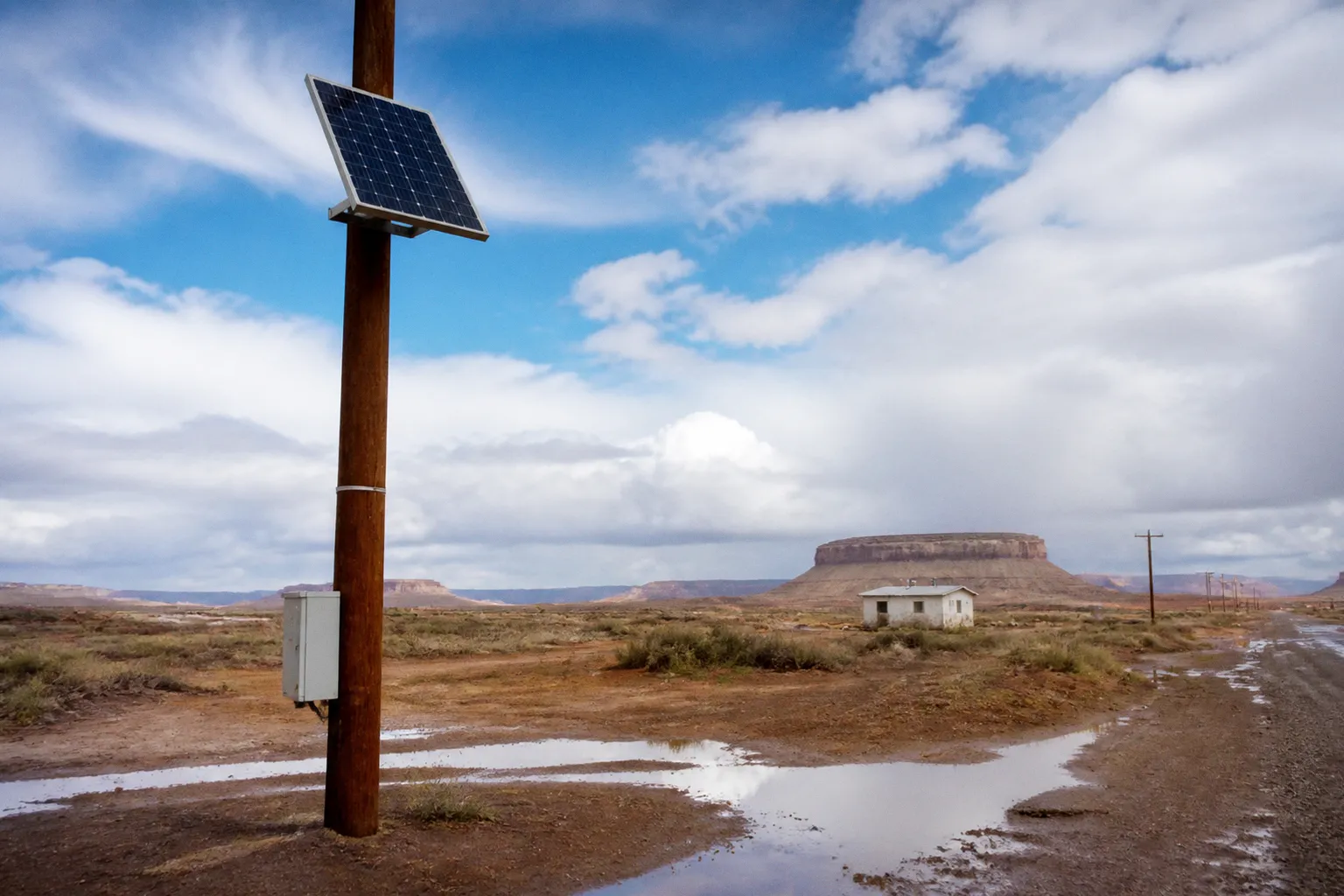
It affects refrigeration, medical equipment, water systems, schools, communications, household finances, and the operating capacity of local enterprises.
Compare car rental deals in United Kingdom
See available offersPartner link — DiscoverCars comparisonThe access problem is equally structural. Around 60,000 residents across the 27,000-square-mile Navajo Nation reservation still lack electricity, while conventional utility extensions connect approximately 400 to 450 homes per year. At that pace, the remaining demand cannot be treated as a routine line-extension project. It is a resource-allocation problem shaped by distance, terrain, low customer density, extreme weather exposure, and the cost of maintaining infrastructure over a very large service area.
The central decision is therefore not whether tribal communities deserve reliable electricity. That point is settled. The decision is whether a particular settlement is better served by extending the central grid, deploying a decentralized microgrid, or combining both approaches through a staged system.
The reliability gap: why traditional infrastructure underperforms on tribal lands
Centralized electricity systems are designed around network density. A substation, feeder, or distribution line becomes more economically productive when it serves many customers within a relatively compact area. Tribal lands often present the opposite conditions: dispersed households, long distances between settlements, rugged or exposed terrain, and limited proximity to existing transmission or distribution assets.
This creates two separate infrastructure challenges.
The first is the cost of reaching households that are far from the grid. A power line extension may require substantial construction across land that serves relatively few customers. Exact cost per mile varies significantly by topography, permitting conditions, utility design, and proximity to substations, so there is no single national figure that can be applied responsibly. The underlying issue, however, is consistent: a long feeder serving a small number of homes produces a weak capital-efficiency profile.
The second is the cost of keeping that infrastructure operational. A centralized line can be vulnerable to wildfire, winter storms, flooding, high winds, ice, and other extreme weather events. On remote land, repairs may also take longer because crews, replacement equipment, and access routes are farther away. A connection that technically reaches a household is not equivalent to a resilient power system if the household loses service repeatedly or for extended periods.
Energy burden compounds the problem. Approximately 10% of on-reservation households spend more than 20% of their income on energy, compared with less than 3% for average U.S. households. This is not simply a question of electricity rates. Energy burden can reflect inefficient housing, fuel costs, unreliable heating systems, expensive backup generation, and the financial consequences of outages.
For tribal development programs, the relevant metric is therefore broader than connection count. A successful project should measure:
- the number of households receiving service;
- average and maximum outage duration;
- critical facilities kept operational during grid failures;
- household energy burden after deployment;
- local operation and maintenance capacity;
- fuel displacement and long-term operating costs;
- the ability to expand service as community demand grows.
A line extension can improve access while leaving reliability and operating costs unresolved. A microgrid can address reliability more directly, but only if its generation, storage, controls, and maintenance model are properly designed.
The question is not whether a community can be connected to the grid on paper. The question is whether the resulting system delivers dependable power at a sustainable cost.
The arithmetic of access: deployment speed, capital, and service density
Grid extension and microgrid deployment allocate capital differently.
A grid extension invests in shared network infrastructure: poles, conductors, transformers, protection equipment, substations, rights-of-way, and interconnection work. Once built, that network can serve multiple customers and may support future growth. Its economic case improves where homes are relatively concentrated and the existing grid is nearby.
A microgrid invests in a localized energy system. A typical configuration may include solar photovoltaic generation, battery storage, inverters, distribution equipment, controls, and backup generation where required. The system can be sized around a household cluster, a school, a health facility, a water system, or an entire small settlement.
The distinction matters because a microgrid can be deployed without waiting for a long distribution corridor to be constructed. It converts distance from a primary constraint into a design variable. The project still requires engineering, land, procurement, installation, maintenance, and community governance, but it does not necessarily depend on extending every line back to a distant substation.
The comparison becomes clearer across operational categories:
| Parameter | Grid extension | Solar-plus-storage microgrid |
|---|---|---|
| Best operating environment | Flat or accessible areas with high customer density and nearby grid infrastructure | Geographically isolated settlements, dispersed homes, and critical facilities far from the grid |
| Primary capital use | Distribution lines, poles, transformers, substations, and interconnection | Solar generation, batteries, controls, local distribution, and backup assets |
| Deployment constraint | Distance, terrain, permitting, construction logistics, and utility schedules | Equipment procurement, system design, installation capacity, and local maintenance |
| Reliability profile | Dependent on the wider network and exposed line infrastructure | Can maintain local service during wider grid outages if adequately sized and maintained |
| Expansion model | Additional customers can be added along an existing network | Modular additions can increase generation, storage, or connected loads |
| Technical requirement | Utility engineering and grid interconnection | Local energy management, battery maintenance, controls, protection, and operator training |
| Main risk | High cost and long timelines for low-density areas | Undersizing, battery degradation, weak maintenance systems, or insufficient governance |
| Energy sovereignty | Community remains dependent on external network operations and fuel flows | Greater local control over generation and priority loads, subject to system ownership and funding |
This table should not be read as a universal ranking. Microgrids are not automatically cheaper, and grid extension is not automatically inefficient. Comparative techno-economic modeling indicates that microgrids are more cost-effective in terrain-constrained and geographically isolated regions, while grid extension remains preferable in flat, accessible areas with high customer density.
The correct unit of analysis is the service area, not the technology label.
Deployment speed is a strategic variable
For a community waiting years for a conventional connection, deployment speed has direct economic value. A school without dependable electricity cannot operate as a modern learning environment. A health post may struggle to maintain refrigeration or communications. A water system may depend on costly fuel-powered equipment. Households may purchase backup solutions that are less efficient and more expensive over time.
This does not mean that a rapidly installed microgrid should be approved without a long-term plan. A poorly designed system can create a second infrastructure problem: unreliable batteries, unavailable replacement parts, unclear ownership, or no budget for maintenance. The speed advantage only becomes meaningful when paired with a sustainable yield model for the asset.
A practical deployment sequence often distinguishes between immediate critical loads and broader household electrification:
1. Map the load base. Identify homes, schools, clinics, water systems, communications infrastructure, and local businesses, then separate essential loads from discretionary demand.
2. Assess the grid boundary. Determine the distance to existing distribution assets, the capacity of nearby substations, and the actual feasibility of an extension.
3. Model the terrain and access route. A short line across difficult terrain may be less practical than a larger local system, while a longer line across accessible land may remain viable.
4. Design for growth. Include expansion capacity for additional homes, productive-use equipment, refrigeration, education technology, or water infrastructure.
5. Assign operational responsibility. Establish who owns the system, who monitors performance, who manages emergency repairs, and how replacement components will be financed.
6. Measure service outcomes. Track uptime, outage duration, household energy burden, and critical-facility continuity rather than reporting installation alone.
This approach prevents a common failure in infrastructure programs: counting physical assets while undercounting service quality.
Terrain and density: when grid extension makes sense
Grid extension has a strong case when three conditions align: the community is near existing infrastructure, customers are sufficiently concentrated, and the terrain permits construction without disproportionate engineering or access costs.
High-density service areas create network value. A single distribution segment can connect many households, public buildings, and enterprises. Maintenance crews can reach the system more easily, and future customer additions may be less expensive because the basic corridor already exists. Where the local utility has adequate capacity and a credible construction schedule, extending the grid may provide the most straightforward long-term arrangement.
Grid connection can also be preferable where electricity demand is high and continuous. Industrial equipment, large agricultural operations, wastewater systems, or future commercial loads may require power levels that are difficult to provide economically through a small standalone system. A microgrid can be designed for substantial demand, but the capital requirement for generation, storage, controls, and backup capacity rises with the load profile.
The central grid is also more suitable when the settlement requires significant seasonal flexibility. Solar generation can be highly productive, but winter demand, heating loads, cloud cover, and prolonged low-generation periods must be modeled carefully. Batteries provide shifting and backup capacity, not unlimited energy. A system designed around average demand can fail when actual peak loads appear during the least favorable generation conditions.
The case for grid extension weakens when the line must travel a long distance to serve a small number of dispersed households. It weakens further when the route crosses steep, flood-prone, fire-prone, or difficult-to-access land. In these conditions, the capital cost is only one concern. The project must also account for maintenance exposure, repair times, vegetation management, replacement logistics, and the consequences of a single line failure.
A decision framework for tribal electrification options
A credible comparison should score each candidate service area against the following factors:
- Customer density: How many households and public facilities can the infrastructure serve within a practical distribution radius?
- Distance to usable grid capacity: The nearest line is not necessarily the nearest connection opportunity if the substation lacks capacity.
- Terrain and construction access: Roads, elevation changes, waterways, protected areas, and extreme weather exposure can materially change project feasibility.
- Critical-load requirements: Clinics, schools, water systems, and communications sites may justify a resilient local system even where households could eventually receive grid service.
- Load growth: The design must reflect expected demand from refrigeration, heating, digital education, small businesses, and community services.
- Ownership and governance: A technically sound system can underperform if no institution has the authority or budget to operate it.
- Financing structure: Grants may fund construction but not necessarily long-term maintenance, battery replacement, training, or insurance.
- Interoperability: A microgrid should be capable of operating independently where appropriate and connecting to the central grid if that becomes viable.
This is where tribal utility authorities and community institutions become decisive. The Navajo Tribal Utility Authority, established in 1959, illustrates the importance of tribal capacity in managing energy infrastructure. Federal funding can accelerate deployment, but local institutions determine whether an asset becomes a functioning service or an isolated installation.
Energy sovereignty: the operational value of decentralized systems
The phrase energy sovereignty can become vague when it is used without an operating definition. In practical terms, it refers to the community’s ability to influence how energy is generated, allocated, maintained, and expanded.
A solar microgrid can increase that influence by placing generation and storage closer to users. It can prioritize a school, clinic, water pump, or communications node during an outage. It can reduce dependence on long external supply chains for routine electricity service. It can also make the energy system more visible to local decision-makers because the assets are physically located within the community.
However, local generation does not automatically create local control. Ownership agreements, tariff design, maintenance contracts, workforce training, data access, and replacement funding determine who actually governs the system. A project funded and operated entirely by an outside entity may provide electricity without building institutional capacity.
For this reason, the technical design should be paired with a governance design. A tribal clean energy project should answer:
- Who owns the generation and battery assets?
- Who controls dispatch during a wider outage?
- Which loads receive priority when storage is limited?
- What is the replacement plan for batteries and power electronics?
- How are residents trained to report faults and manage demand?
- Which entity receives performance data?
- How are future connections approved and financed?
- Can local workers handle routine inspection and first-response maintenance?
A microgrid with a clear answer to these questions can generate more than electricity. It can support local technical employment, community planning, and a stronger platform for future development. A microgrid without those answers may simply transfer technical dependence from a utility to a vendor.
Decentralization is valuable only when the operating authority, maintenance budget, and performance data are decentralized with the equipment.
Solar microgrids are not a single product
The phrase indigenous community off-grid solar covers several different system types, and treating them as interchangeable produces weak planning.
A household-scale system may serve lighting, phone charging, basic appliances, and small refrigeration loads. It can be appropriate for an isolated home or a small cluster where a distribution network would be disproportionately expensive. Its limitations are equally clear: it may not support a clinic, water pumping, electric heating, or productive commercial loads without additional capacity.
A community microgrid serves multiple buildings through a local distribution network. This structure can aggregate demand and make storage more productive, particularly when public facilities and households have different load profiles. The system may also support shared maintenance and centralized monitoring.
A critical-facility microgrid is designed around continuity rather than universal access. It may serve a school, clinic, emergency shelter, water system, or communications site. Such a system can provide high resilience even if household electrification is addressed through another pathway.
A grid-connected microgrid can operate alongside the utility network, importing electricity under normal conditions and isolating local loads during an outage. An off-grid system must balance its own generation, storage, and backup resources continuously. The latter requires more rigorous load management because there is no external network to absorb shortfalls.
The correct design depends on the load hierarchy. For example, a school may need reliable daytime power for digital learning, while a clinic may require uninterrupted refrigeration and communications. A water pumping system may create short, high-power demand peaks. Household loads may be individually modest but collectively significant during evening hours. These profiles should be modeled separately rather than collapsed into a single average.
Storage is the reliability mechanism
Solar panels generate energy; batteries determine when much of that energy is available. This distinction is central to project economics.
A system with insufficient storage may perform well during sunny daytime conditions and fail during evening demand or extended weather events. A system with excessive storage may reserve capital for batteries that remain underutilized. The design must account for daily load shifting, critical-load backup, seasonal variation, battery degradation, and the availability of backup generation where needed.
Reliability metrics should therefore include more than installed solar capacity. Program managers should track:
- critical-load hours supported during grid outages;
- battery state-of-charge performance;
- renewable generation used locally rather than curtailed;
- frequency and duration of system faults;
- response time for maintenance events;
- battery replacement assumptions;
- fuel use by any backup generator;
- actual demand growth compared with the original model.
This is the difference between an equipment procurement exercise and an infrastructure program.
Funding tribal clean energy projects without creating fragmented pilots
Multiple federal assistance programs support tribal microgrid development, including programs managed by the Department of the Interior’s Indian Affairs, the Department of Energy, FEMA, USDA, and the Denali Commission. The Department of Energy’s Energy Improvements in Rural or Remote Areas program received $1 billion under the Infrastructure Investment and Jobs Act to support rural and remote clean energy projects, including microgrids. A 2023 funding opportunity opened $300 million for clean energy projects under the program.
The scale of available support is significant, but the presence of funding does not eliminate the need for project discipline. Federal assistance can be fragmented across agencies, with different eligibility rules, match requirements, reporting structures, technical-assistance pathways, and construction timelines. The Government Accountability Office reported on tribal microgrid federal assistance in 2024, reinforcing the need to examine how programs align rather than evaluating each grant in isolation.
A funding strategy should distinguish between four layers of cost:
1. Planning and technical assessment. Load studies, geospatial analysis, environmental review, interconnection assessment, ownership design, and community engagement.
2. Capital deployment. Solar arrays, batteries, inverters, controls, distribution equipment, meters, backup systems, and civil works.
3. Workforce and commissioning. Installation training, testing, operational procedures, cybersecurity, emergency response, and handover.
4. Lifecycle management. Monitoring, insurance, vegetation control, equipment replacement, battery renewal, software support, and system expansion.
Many projects are strongest in the second layer and weakest in the fourth. A grant that pays for equipment but not long-term operations can leave the community with an asset that deteriorates after the initial funding period. The proposal should therefore identify the sustainable yield of the system: what level of service can be maintained, at what recurring cost, and through which revenue or public funding source?
Build a portfolio, not a collection of disconnected installations
The most scalable approach is to classify communities into infrastructure pathways.
Pathway one: conventional grid expansion. Use this where customer density is high, the existing grid is accessible, and the utility can provide adequate capacity within a reasonable construction schedule.
Pathway two: standalone community microgrid. Use this where terrain, distance, or low density makes central extension inefficient, but clustered demand justifies a shared local system.
Pathway three: critical-facility resilience. Prioritize schools, clinics, water infrastructure, and communications where uninterrupted service produces immediate community value, even before all homes are connected.
Pathway four: hybrid development. Deploy a microgrid now while preserving the technical option to connect with the central network later. This requires compatible equipment, clear interconnection planning, and transparent treatment of stranded-asset risk.
The hybrid pathway is especially relevant where access needs are urgent but long-term demand is likely to grow. It avoids treating the current absence of grid service as a permanent condition while still delivering immediate local capacity.
What corporate and nonprofit partners should measure
Corporate donors, nonprofit organizations, tribal governments, and volunteer networks often approach rural infrastructure with different strengths. A company may provide procurement capacity, fleet logistics, engineering, or financing. A nonprofit may coordinate community relationships and grant compliance. Tribal institutions provide governance, local knowledge, and legitimacy. The program succeeds only when these functions are allocated clearly.
Partnership design should map responsibilities against measurable outputs:
| Program function | Appropriate lead | Evidence of performance |
|---|---|---|
| Community prioritization | Tribal government or local institution | Published selection criteria and community approval |
| Technical feasibility | Qualified engineering partner | Load model, terrain assessment, grid comparison, and resilience plan |
| Procurement | Lead implementing organization | Competitive process, compatible equipment, delivery schedule |
| Installation | Certified contractor with local workforce plan | Commissioning records and safety compliance |
| Operations | Tribal utility, community entity, or contracted operator | Uptime, fault response, maintenance logs, and financial reporting |
| Impact evaluation | Independent or jointly governed evaluator | Verified service, energy-burden, and critical-facility metrics |
| Expansion planning | Tribal leadership and system operator | Capacity roadmap tied to demand growth and funding |
The most useful impact report will not lead with the number of panels installed. It will show whether households received more reliable service, whether public facilities remained functional during outages, whether energy costs became more manageable, and whether the community can operate the system without indefinite external intervention.
For organizations supporting tribal education, the connection between electricity and learning is direct. A rural classroom cannot depend on irregular power for digital instruction, device charging, internet equipment, refrigeration for school meals, or safe lighting. Electrification is therefore not an isolated energy intervention. It is part of the operating infrastructure of education and community welfare.
The decision: match the system to the service problem
The debate over tribal community electricity microgrid vs grid extension is often framed as a contest between old infrastructure and new technology. That framing is inefficient. The actual comparison is between different delivery models under different geographic and institutional conditions.
Grid extension is strongest where density, access, and existing network capacity support efficient expansion. It can provide a durable backbone for communities with substantial demand and future growth. Its weaknesses become pronounced across long, low-density routes exposed to difficult terrain and severe weather.
Solar microgrids are strongest where distance and isolation make the central network costly or slow, and where local generation can be paired with storage, clear load priorities, and credible operations. Their weaknesses emerge when systems are undersized, maintenance is unfunded, ownership is unclear, or project developers treat installation as the final milestone.
The appropriate policy adjustment is not to fund one technology universally. It is to fund comparative planning, allow tribal institutions to choose the delivery model that fits local conditions, and require lifecycle accountability for both infrastructure pathways.
Funding decisions should prioritize projects that can demonstrate:
- a documented comparison with grid extension;
- a realistic demand and terrain model;
- measurable reliability targets;
- ownership and maintenance responsibility;
- replacement and expansion financing;
- local workforce participation;
- transparent reporting on household and community outcomes.
Tribal electrification should be managed as a portfolio of service solutions rather than a single national template. Where the grid is efficient, extend it. Where geography makes extension structurally weak, deploy a properly governed microgrid. Where education, health, and water systems cannot wait, build resilient critical-facility capacity first.
The call to action is straightforward: federal agencies, tribal governments, utilities, nonprofits, and corporate partners should shift funding from equipment counts toward dependable service, lifecycle budgets, and locally governed operations. Reliable power is not the endpoint of tribal development, but without it, the operating base for education, health, and sustainable livelihoods remains incomplete.