Healthcare options for tribes: mobile clinics or health workers
In 1968, the Indian Health Service established the Community Health Representative (CHR) Program to reach American Indian and Alaska Native (AI/AN) households living beyond the catchment of any fixed clinical facility.
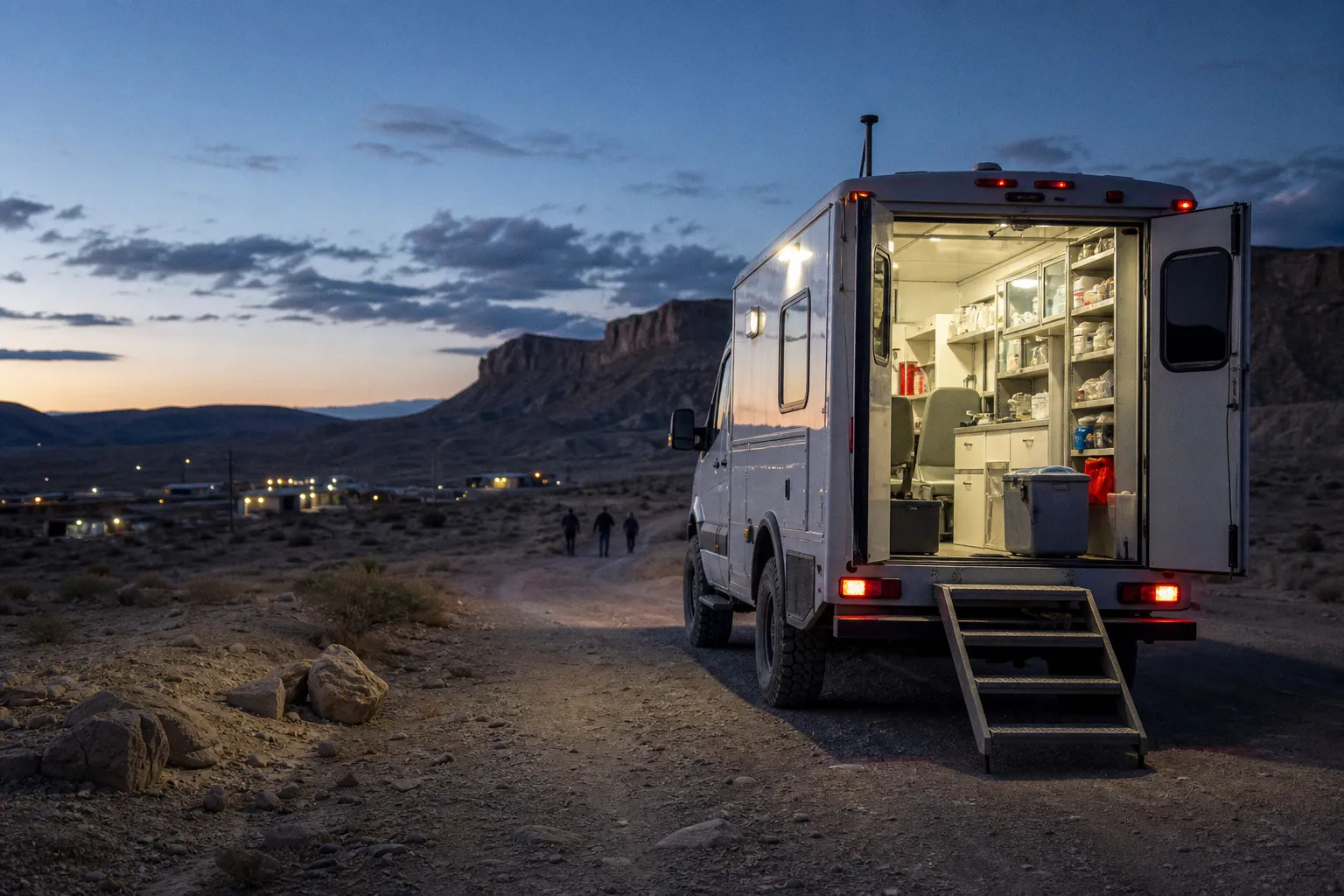
More than 57 years later, the program employs over 1,600 CHRs across 250-plus Tribes in all 12 IHS Areas — and more than 95% of those programs are directly operated by the Tribes themselves under the Indian Self-Determination and Education Assistance Act. The question for funders, health authorities, and Tribal planners is no longer whether the CHR model works in principle, but how it should be sequenced against the rising capital alternative of mobile health units, and where each delivers the highest marginal yield in access, outcomes, and cost.
Compare car rental deals in United Kingdom
See available offersPartner link — DiscoverCars comparisonThe choice is not mobile clinic versus CHR. It is which model — and at what staffing ratio, supervision intensity, and capital footprint — produces the largest measurable access and outcome gain per dollar allocated.
The CHR Program as a 57-Year Operating System
The CHR workforce is not a transport service with a stethoscope. IHS describes CHRs as medically guided, community-based workers embedded in Tribally contracted programs, with a service scope that extends well beyond health education. Authorized CHR functions include case-finding and screening, case management, patient monitoring, referrals, interpretation, patient advocacy, home-safety assessment, basic vital signs, wound and foot care, and transport. A majority of services are delivered in patients' homes — a structural feature, not an operational detail, because it makes the CHR a recurring, supervised, community-based support layer for households whose nearest fixed facility sits beyond realistic same-day travel.
The supervision architecture is what keeps that layer safe. IHS planning guidance requires CHRs to operate within a system of close supervision, with a CHR supervisor who is a licensed health professional or is supervised by one. That requirement is the operating ceiling on what CHRs can lawfully do without a licensed clinician in the loop, and it shapes the entire program design: training scope, documentation, escalation paths, and the line between CHR-delivered support and licensed-clinician-delivered care.
Three operational boundaries matter for any planner comparing this to mobile units:
- Scope ceiling. IHS does not certify CHRs as nurse aides. Planning guidance requires CHRs to operate within a system of close supervision, with a CHR supervisor who is a licensed health professional or is supervised by one.
- Tribal operator dominance. More than 95% of CHR programs are Tribally operated, which means workforce design, hiring, and routing decisions are made at the community level rather than by regional IHS offices.
- Planning reference, not universal mandate. IHS staffing guidance references 1.40 CHR FTE per facility for a user population above 1,320, plus 0.95 FTE for each additional 500 users up to 14,999, with progressively lower incremental ratios at larger population sizes. These are planning criteria, not universal ratios that fit every geography.
The fleet-logistics implication is direct: a CHR program scales by adding supervised workers and routing capacity, not by adding vehicles and fixed routes. That distinction is the backbone of the cost structure, and it is also why a planner reading the CHR budget sees labor, supervision, and mileage as the dominant line items rather than capital depreciation.
Measured Clinical Impact: What the Navajo Data Shows
The strongest outcome signal in the available record comes from a 2019 observational study on the Navajo Nation, which matched 173 diabetes patients receiving a structured CHR outreach intervention against 2,880 comparable nonparticipants. Over the 2010–2014 observation window, the CHR cohort showed a 0.63-percentage-point greater improvement in HbA1c and a 7.40 mg/dL greater reduction in LDL cholesterol than matched controls. Body-mass index did not move significantly in either direction.
The reading I would put on those numbers, as a planner rather than as a clinician:
1. CHRs measurably moved the biomarkers that respond to monitoring and adherence — glycemic control and lipid management — both of which depend on the in-home, repeated-touch follow-up the CHR model is designed to deliver.
2. BMI did not respond to the same intervention, consistent with the broader literature on environmental and food-system drivers of obesity that household-level outreach alone cannot reach.
3. The study was observational and matched, not randomized. The result should be read as "structured CHR outreach was associated with measurable improvement in two specific biomarkers," not "CHR programs outperform any other model."
That distinction matters when the comparison is being made to capital-intensive mobile clinics, where evidence quality in the AI/AN context is still thin. A matched-cohort design reduces — but does not eliminate — selection bias: the comparison group is constructed to look like the intervention group on observed characteristics, but unobserved differences in household motivation, family support, and prior engagement with the health system can still bias the result upward. Planners reading the Navajo signal should hold it as a credible directional finding and a defensible justification for CHR investment, not as a clean causal proof that generalizes to every Tribal context.
Mobile Health Units: Capital-Intensive Reach, Thin Cost Data
The most-cited recent IHS mobile-clinic deployment is the September 2022 announcement of three mobile health units serving seven Tribes across the Mid-Atlantic Service Unit, covering approximately 3,000 AI/AN people. The announced service mix was broad — vaccines, vital signs, COVID-19 screening, oral-health services, mental-health counseling and referrals, and primary, behavioral-health, and dental care — and the units were positioned as a scheduled supplement to fixed-site and outreach services, not a replacement for either.
A 2026 scoping review of rural mobile health clinics analyzed 34 documents and found promising evidence across four dimensions:
- Access expansion in remote geographies
- Preventive-care delivery
- Chronic-disease management
- Patient satisfaction
The same review, however, concluded that evidence quality varied considerably across the included studies, and that stronger longitudinal and economic evaluations are still needed. Two operating realities follow from that gap:
- No reliable national cost benchmark exists for Tribal mobile clinics in the reviewed sources. Startup, vehicle, fuel, staffing, and maintenance figures vary widely by state, Tribe, and provider arrangement.
- Licensure, scope-of-practice, Medicaid reimbursement, and vehicle requirements vary by jurisdiction. A unit that operates cleanly under one state's scope may not transfer to another without redesign.
Operationally, a mobile health unit behaves more like a rolling clinic than a CHR on wheels. Scheduling is the binding constraint: a unit that drives four hours to a community, runs a four-hour clinic, and drives four hours back has consumed a full workday before any patient is seen. Maintenance, fueling, clinical-staff coverage, telemedicine connectivity, vehicle licensing, and cold-chain storage for vaccines and lab specimens all sit on the same operational calendar. When any one of those fails, the unit does not deploy, and a community that was promised a visit that month does not get one. CHR programs distribute that risk across many small household visits; mobile units concentrate it into a small number of high-stakes deployment days.
This is the bottleneck a fleet-logistics lens would flag first: mobile units carry a high capital footprint and a thin evidence base on cost-per-outcome, while CHRs carry a low capital footprint and a measurable outcome record in at least one chronic-disease cohort. Both are subject to supervision, scheduling, and Tribal governance constraints.
A Comparison Framework for Funders and Planners
The honest framing is not "mobile clinic versus CHR" but "where does each marginal dollar of capacity produce the largest access or outcome gain?" The table below maps the two models against the variables a planner actually allocates against.
| Allocation variable | CHR program | Mobile health unit |
|---|---|---|
| Capital outlay | Low — vehicles, supplies, supervisor infrastructure | High — vehicle acquisition, clinical fit-out, telemedicine, licensed staff time |
| Recurring cost driver | Workforce, supervision, mileage | Workforce, fuel, maintenance, scheduling logistics |
| Reach logic | Door-to-door, longitudinal | Scheduled circuit, episodic |
| Outcome evidence (AI/AN) | Observational matched cohort on diabetes biomarkers | Scoping review signals; no head-to-head trial found |
| Scope ceiling | Non-clinical, supervised; IHS does not certify as nurse aides | Clinical scope set by onboard licensed staff |
| Governance locus | >95% Tribally operated under ISDEAA | Variable; IHS-operated example in Mid-Atlantic, Tribal or NGO-operated elsewhere |
| Best fit | Adherence, monitoring, navigation, health literacy, transport | Diagnostics, screenings, procedures requiring licensed staff and equipment |
The Alaska Community Health Aide/Practitioner (CHA/P) network sits adjacent to this comparison and is worth naming, because it answers the question planners quietly ask: "Can the CHR role be upgraded into something more clinical without losing the community-embedded logic?" Alaska's CHA/P model is more clinically structured than the standard CHR — approximately 550 workers serve more than 170 rural villages using assessment and treatment protocols and established referral relationships with regional hospitals and the Alaska Native Medical Center. It is, however, a workforce model with its own training pipeline, supervision architecture, and referral contracts, and it is not a drop-in substitute for the CHR role in lower-48 IHS Areas.
Sequencing is the decision most planners skip. The most defensible allocation pattern in remote Tribal geographies is not "fund one model at the exclusion of the other" but "anchor on the CHR backbone and add mobile capacity where the CHR scope ceiling binds." That means mobile units are best targeted at services CHRs are explicitly not certified to deliver — diagnostic imaging, certain screenings, dental procedures, mental-health intakes that require licensed providers, and any service requiring equipment that does not fit in a CHR's bag. When a Tribal program tries to substitute a mobile unit for the longitudinal household relationship the CHR was built around, both models underperform: the CHR loses the household visits it was funded to make, and the mobile unit inherits a caseload it cannot follow longitudinally.
A capital decision is easy to defend when the cost-per-outcome is known. A capital decision made on access promise alone is the most exposed — because the access question is settled at deployment, while the outcome question is settled only after years of supervised, measured service.
Self-Governance as an Operating Constraint
Under the Indian Self-Determination and Education Assistance Act, Tribes can receive IHS services directly, contract to administer individual IHS programs, or compact to assume control over healthcare programs. IHS policy frames Tribal consultation as the mechanism that ensures Tribal health priorities and goals are a meaningful part of agency decision-making.
The planning consequence is direct: there is no single national staffing ratio that should be treated as correct for every Tribe. IHS figures are planning criteria, not mandates. Local geography, service scope, travel time, workforce availability, and Tribal priorities vary, and the operational design — including the choice, sequencing, or integration of mobile units and CHR programs — is made at the Tribal level. External planners can supply options, financing, and technical assistance; they cannot substitute their allocation logic for Tribal consultation.
In practice, this means a funder or regional IHS office that wants to introduce a mobile unit into a Tribal service area has three viable paths: fund the unit directly and offer it to the Tribe on a schedule, fund the Tribe to design and operate the unit under a Title I contract or Title V compact, or fund the Tribe to operate a hybrid arrangement in which IHS retains vehicle ownership and the Tribe runs the deployment calendar. Each path has different implications for capital recovery, liability, hiring authority, and program design. None of them bypass the requirement that the affected Tribal government be at the table before the unit hits the road.
Allocation logic imposed from outside the consultation process is not capacity building. It is a procurement event.
Where This Leaves Funders and Policy
Three moves follow from the evidence base as it stands today:
1. Treat mobile clinics and CHRs as complements, not substitutes. The Navajo cohort signal is built on longitudinal outreach that mobile units cannot replicate at scale. Mobile units should be evaluated against access gaps and procedure-heavy services — screenings, dental, diagnostics — that CHRs are explicitly not certified to deliver. Funding either model as a replacement for the other erases the structural feature each is built around.
2. Fund outcome measurement inside Tribal programs, not adjacent to them. The 2026 scoping review's central finding — that evidence quality varies considerably — is fixable. Matched-cohort designs, registry work, and longitudinal tracking belong inside program budgets at the planning stage, not as post-hoc evaluations funded by separate grants on separate timelines. The cost of collecting cost-per-outcome data is small compared to the cost of a capital decision made without it.
3. Respect the planning ceiling and know the upgrade path. IHS does not certify CHRs as nurse aides, and any expansion of CHR scope must come with a licensed-supervisor structure and referral contracts. States and Tribes that want a clinically expanded outreach workforce have a working model in Alaska's CHA/P network; copying the role title without the supervision and referral architecture will not reproduce the outcomes.
The systemic question is not which model wins. It is whether funding flows will be allocated against the variables above — capital intensity, reach logic, evidence base, scope ceiling, governance locus — or against the louder short-term metric. The CHR program's 57-year operating record and the Navajo biomarker result argue for protecting the workforce backbone. The mobile-clinic record argues for tighter cost and outcome data before further capital expansion. Both can be funded. Neither should be funded as if it were the other.