Neighborhood tree planting: milestones from planning to canopy
A neighborhood tree planting campaign usually fails before the first shovel hits the ground.
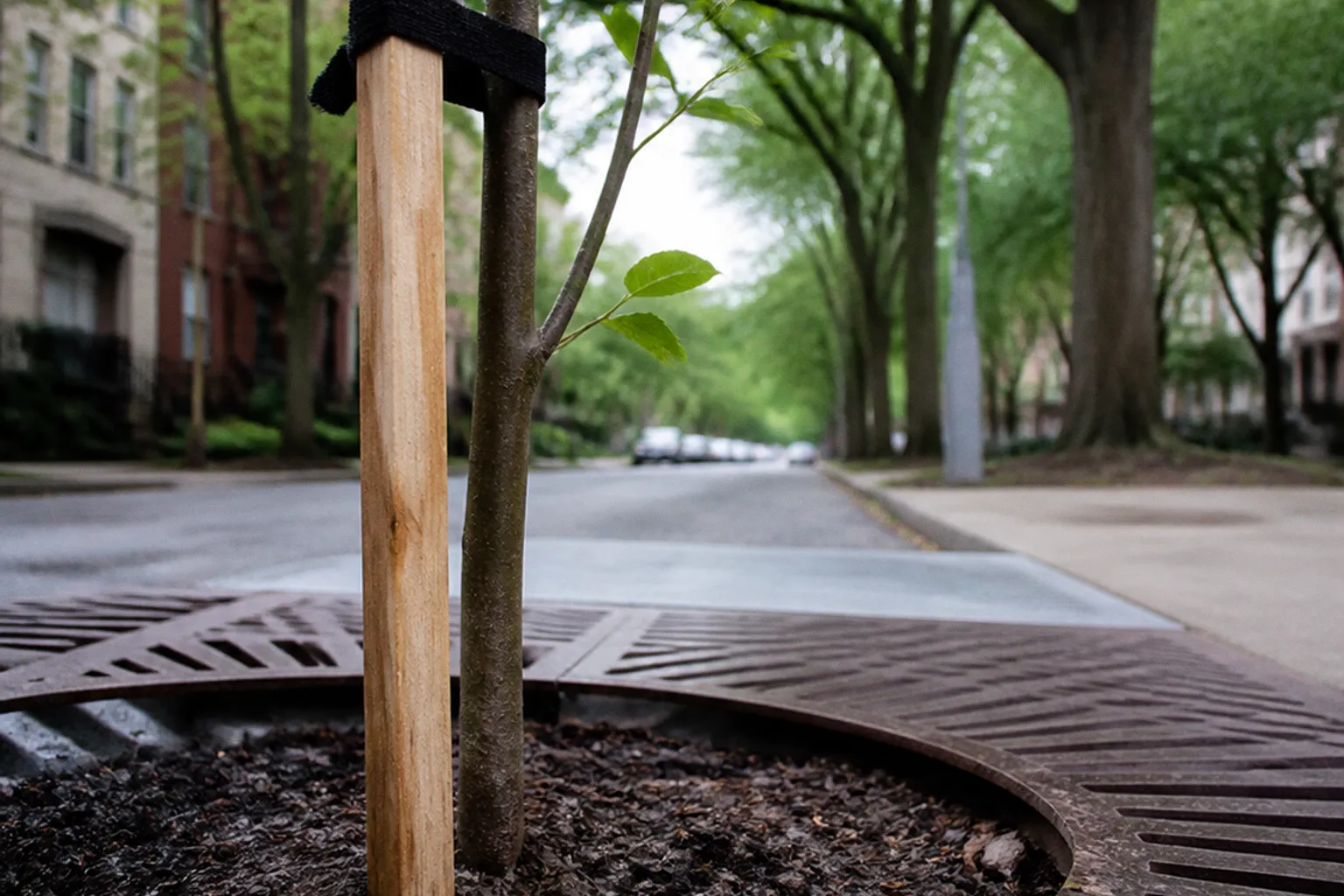
The failure starts with a bad site, a shallow soil volume, a species chosen from a nursery list instead of a planting plan, or a watering roster that exists only in someone’s head.
We do not measure a campaign by the number of saplings unloaded from a truck. We measure it by the number still standing after the first hot season, the first broken branch, and the first change in volunteer attention. A structured campaign should work toward a minimum 75% sapling survival rate. That requires a route from survey to maintenance. Skip one section and the rest of the operation carries the load.
The following neighborhood tree planting campaign steps are built for community groups, school teams, local NGOs, and volunteer rider networks working with limited equipment and uneven ground conditions.
Site analysis comes before species selection
We start with the ground. Not the nursery catalogue. Not the event poster. The ground decides what can survive.
Walk the proposed streets, school edges, vacant lots, drainage margins, and public verges. Mark each candidate location. Record the surface, shade pattern, water access, pedestrian pressure, vehicle clearance, and nearby structures. A site that looks open at 8 a.m. may be under full shade by noon. A verge that appears suitable may contain compacted fill, buried services, or a drainage channel that takes the soil away during the first storm.
For every planting position, record:
- Available soil width and depth, not just the visible patch between pavement and curb.
- Existing canopy and the hours of direct sun.
- Distance from walls, gates, road edges, drains, poles, and building foundations.
- Whether a hose, tanker, water point, or carried container can reach the root zone.
- Soil texture, standing water, rubble, contamination, and signs of compaction.
- The likelihood of vehicles, livestock, pedestrians, or construction equipment damaging the tree.
- Ownership and maintenance responsibility after planting day.
This is field work. We use a tape, a phone map, marking paint where permitted, a digging bar, and a notebook. We do not need a survey crew for every neighborhood. We do need enough information to stop placing a tree where a truck will reverse over it.
Soil volume controls the service life
A tree is not planted into a hole. It is planted into a root system’s future working volume.
Urban forestry guidance advises allocating about 2 cubic feet of loam soil for every 1 square foot of projected tree canopy. The ratio is not a magic switch. It is a planning reference that exposes undersized planting pits. If the expected canopy needs more root volume than the site can provide, we either redesign the site, reduce the tree size, or bypass the location.
Compacted soil creates a second failure point. Roots need air, water, and room to move. A narrow pit surrounded by concrete gives the tree a short operating window. The sapling may establish, then stall when the root system reaches the hard edge of the site.
Do not fill a bad pit with a thin layer of attractive soil and call the work complete. Loam placed over compacted rubble gives us a planted photograph, not a durable tree.
Where the ground is poor, the project team can consider:
1. Expanding the soil trench along a road or school boundary instead of using isolated pits.
2. Linking planting areas so roots have more continuous soil volume.
3. Removing compacted material and replacing it with suitable soil where access and permissions allow.
4. Shifting the planting line away from pavement into a maintained open strip.
5. Selecting a smaller mature form when the site cannot carry a large canopy.
The last option is not a substitute for soil. It is a way to keep the tree and the site within the same load rating.
A sapling does not fail because planting day was badly photographed. It fails because the root zone was too small, too dry, too compacted, or left unattended.
Heat reduction is real, but placement decides the result
Research from the U.S. Forest Service indicates that neighborhoods with abundant tree cover can be 2°C to 5°C cooler than treeless areas. That cooling effect depends on canopy, shade placement, soil moisture, and tree survival. A dead sapling provides none of it.
Map the places where shade has practical value: school approaches, waiting areas, paved courtyards, exposed pedestrian routes, and building edges that trap heat. Then confirm that the same locations have enough root volume and a maintenance route. Do not plant only where the event is easy to stage. Plant where the canopy can eventually do useful work.
For school campus greening, this usually means separating three zones:
- High-traffic zones: paths, gates, assembly areas, and play edges. Use robust protection and maintain clear sight lines.
- Learning zones: demonstration beds, compost areas, native plant sections, and visible waste-reduction stations.
- Low-traffic growth zones: boundary strips and open ground where trees can establish with less damage.
Each zone needs a different layout and protection plan. A single planting specification across the entire campus is a shortcut. Shortcuts are where roots meet concrete.
Species diversity is a structural requirement
Species selection is not a popularity contest. It is a risk-control decision.
A neighborhood canopy built from one widely available species can look uniform and efficient. It is also vulnerable. A pest, disease, drought pattern, or soil condition that affects that species can remove a large portion of the planting inventory at once.
Urban forestry guidelines recommend that no single species exceed 5% of the total planting inventory and no single genus exceed 10%. Those limits are useful when building a long-term neighborhood canopy, but they must be applied to the full local program, not just one Saturday’s delivery.
If a community group plants 20 trees, strict diversity percentages may be difficult to apply without creating a nursery procurement problem. That does not justify ordering 20 copies of one tree. It means we should coordinate with nearby campaigns, schools, municipal planting programs, or other local sustainability projects and track the combined inventory.
Build the planting list from the site backward
Start with the conditions:
- Full sun or partial shade.
- Dry soil, seasonal waterlogging, or reliable irrigation.
- Narrow verge or open campus ground.
- Overhead wires or no overhead obstruction.
- High risk of vehicle impact.
- Need for pedestrian clearance.
- Local soil reaction and drainage.
- Expected mature size.
Then match species to those conditions using local forestry, horticultural, or municipal guidance. We should not declare one native species suitable for every curb, schoolyard, or compacted roadside. Native status does not cancel poor drainage, restricted roots, salt exposure, or lack of water.
The nursery stock also needs inspection. We look for a stable root ball, a straight main stem where the site requires it, no severe girdling roots, no major wounds, and no signs of active pest or disease pressure. A taller sapling is not automatically better. Transport damage and root disturbance can erase the advantage of extra height.
A practical planting inventory should show more than species names:
| Field | What we record | Why it affects the operation |
|---|---|---|
| Species and genus | Full botanical identification where possible | Prevents accidental overconcentration and substitution |
| Mature size | Height and canopy spread under local conditions | Sets clearance and soil-volume requirements |
| Water demand | Establishment needs and dry-season tolerance | Determines the maintenance route |
| Root behavior | Surface rooting, depth, spread, and conflict risk | Protects pavement, drains, and structures |
| Stock type | Containerized or balled-and-burlapped material | Changes handling, crew size, and planting method |
| Site assignment | Exact mapped location | Stops unsuitable substitutions at the truck |
| Protection requirement | Guard, stake, barrier, or no added protection | Controls damage from traffic and public use |
Keep reserve stock only if the maintenance team can support it. Extra trees create extra obligations. They are not free capacity.
Utility clearance and permissions are not paperwork afterthoughts
Before digging, contact the relevant utility-locate service or local authority responsible for underground lines. In the United States, that system may be reached through 811 or a state service such as Miss Utility. Other regions use different agencies and notice procedures. The operating rule stays the same: locate the services before excavation.
A painted mark on the ground is not permission to ignore clearance. It is an input to the excavation plan. If the proposed hole conflicts with a water line, electrical cable, gas service, communications conduit, or drainage structure, we move the tree or change the method. We do not gamble with a digging bar.
Municipal approval timelines vary by city and council. We should not publish a universal number of days for permits. Instead, build the schedule around the local authority’s actual process and keep the planting date provisional until permissions are confirmed.
The route through compliance usually includes:
1. Confirming who controls the land: municipality, school, housing association, private owner, or another body.
2. Obtaining written approval where required.
3. Checking local rules for verge excavation, road clearance, tree guards, species restrictions, and irrigation.
4. Requesting underground utility locations before marking final pits.
5. Confirming disposal or reuse arrangements for excavated rubble and unsuitable soil.
6. Assigning one person to retain permits, maps, contacts, and site photographs.
7. Briefing every crew leader on no-dig zones and stop-work conditions.
The field crew needs a clear abort rule. If markings are missing, permissions are unclear, or the ground differs from the survey, we stop that location. We can bypass a pit. We cannot bypass a severed service.
Planting day is a handling operation
Planting day fails through small delays. The trees arrive late. The guards are at another site. The water is stored in an unmarked tank. Volunteers gather around one hole while the rest of the route sits idle. Root balls dry in the sun. By noon, the schedule has lost torque.
We organize the operation into stations and assign a crew lead to each section:
- Delivery and inspection.
- Temporary shade and root-ball protection.
- Pit preparation.
- Tree placement and alignment.
- Backfilling and soil settlement.
- Watering and mulch placement.
- Guard installation.
- Mapping and handover.
Practical event guidance recommends 2 to 3 adult volunteers per tree on planting day, particularly when handling containerized or balled-and-burlapped stock. That ratio gives us enough hands for lifting, alignment, soil handling, watering, and protection without crowding the pit.
The crew does not bury the trunk flare. We set the tree so the root flare remains at the correct level relative to the finished soil surface. Backfill should not leave large air pockets, but it should not be compacted into a dense plug. Water settles the soil. A stake or guard stabilizes the tree where wind, traffic, or public use demands it. Neither fixes a badly placed root ball.
Sequence the work instead of racing the clock
A reliable planting sequence looks like this:
1. Reconfirm the marked location and check that the site still matches the survey.
2. Inspect the stock before moving it into the planting lane.
3. Prepare the pit and remove rubble, wire, plastic, and unsuitable material.
4. Move the tree by the container or root ball, never by the trunk.
5. Set the tree upright with the root flare at the correct height.
6. Backfill with suitable soil and settle it with water.
7. Form a watering basin where the site can retain water without creating a public hazard.
8. Apply mulch without piling it against the trunk.
9. Install protection and check that it does not cut into the stem.
10. Water thoroughly, record the location, and assign the maintenance owner.
Do not leave root balls exposed while the crew handles unrelated tasks. If delivery and planting cannot happen in the same operating window, hold the stock under shade and keep the roots from drying. A tree is living cargo. Treating it like fence posts creates a delayed failure.
For community groups using motorcycles or small utility vehicles, transport routes need the same planning as planting routes. Tie down the load. Protect stems from abrasion. Avoid stacking containers so the lower stock carries the weight. Keep a separate run for tools, guards, and water if the vehicle cannot safely carry all three.
Watering turns an event into a project
The first watering is not the maintenance plan. It is the opening entry in the maintenance log.
Young trees need repeated attention during establishment, with frequency determined by species, soil, rainfall, heat, and local conditions. We should not issue one universal watering interval for every climate. Instead, assign each tree to a route and define who checks it, how water is delivered, and what triggers escalation.
A usable watering roster includes:
- Tree identification number and mapped location.
- Planting date and species.
- Person, school, household, or crew responsible for the check.
- Water source and carrying method.
- Planned inspection frequency.
- Condition notes: wilt, broken stem, loose guard, exposed roots, pest signs, or standing water.
- Replacement decision and date.
The maintenance team should inspect after heavy rain as well as during dry weather. Flooding can damage roots, wash out soil, expose the root flare, and loosen guards. Dryness is not the only threat.
Mulch reduces surface evaporation and limits competition from weeds, but it must remain clear of the trunk. Guards need inspection because a loose guard is useless and a tight guard becomes a stem injury. Stakes should be removed or adjusted when no longer needed. Permanent hardware left against a growing tree is not protection. It is a future defect.
Set a replacement policy before planting. If a sapling dies, the team must know whether the site will be replanted, retired, or redesigned. Replacement without diagnosis repeats the same failure. Check water access, soil volume, damage, species fit, and planting depth first.
The campaign is not complete when the last guard is tied. It is complete when responsibility survives the volunteer calendar.
Canopy management requires a record, not a slogan
A neighborhood tree planting campaign becomes a canopy initiative only when the planting inventory is maintained. Track species, genus, survival, condition, pruning needs, and site constraints. This can be a shared spreadsheet, a map, or a local maintenance register. The format matters less than continuity.
The record should allow us to answer basic field questions:
- Which trees survived the first dry season?
- Which locations repeatedly lose saplings?
- Where is one species becoming overrepresented?
- Which school or neighborhood has no assigned water route?
- Which guards are damaged?
- Which trees are approaching clearance problems?
- Where should the next planting effort be stopped or redirected?
Urban trees in traditional settings often last less than 15 years, while trees given adequate soil volume and care can live up to 50 years. That difference is not created by a better launch event. It comes from infrastructure, inspection, pruning, water, and protection over time.
A useful review schedule can follow operational milestones rather than calendar ceremonies:
After planting
Confirm that every tree has water, a readable location record, and a responsible contact. Photograph the soil surface, guard, and trunk position if the group uses image records.
After the first major weather event
Inspect washout, leaning, broken branches, standing water, and guard movement. Repair before the damage compounds.
During the first dry period
Audit the watering route. Remove locations that cannot be serviced and add capacity where the soil dries faster than expected.
At the end of the first year
Calculate survival by site type and species. A single overall number hides the failures. Separate school grounds, roadsides, open lots, and compacted verges.
Before the next planting cycle
Use the records to revise the species list, soil plan, volunteer count, and delivery route. Do not repeat a failed site because it is already mapped.
Urban trees also provide wider environmental value. U.S. urban trees collectively sequester approximately 4.8 million metric tons of carbon annually, according to research published in Nature Communications. That figure describes an established urban forest system, not an instant offset from newly planted saplings. We should communicate the distinction clearly. Young trees need time, suitable conditions, and survival before they contribute meaningful canopy functions.
The same discipline applies to waste reduction programs and ecological awareness campaigns attached to the planting. Reusable water containers, separated packaging, tool inventories, and a plan for nursery pots prevent the event from creating a waste stream it never measures. Environmental work that leaves mixed plastic, broken sacks, and discarded stakes behind has missed part of the route.
The field checklist is short because the work is not
Before we mobilize, we confirm:
- The site has been surveyed for soil, shade, access, drainage, and future canopy space.
- Soil volume matches the projected tree size or the site has been redesigned.
- The species list controls concentration across the wider planting program.
- Utility locations and land permissions are confirmed.
- Stock has been inspected and transport protection is ready.
- Water, mulch, guards, tools, and replacement materials are assigned.
- Crews are sized at roughly 2 to 3 adults per tree where handling demands it.
- Every planted tree has an owner, a location record, and a watering route.
- The campaign has a survival target, with 75% as a minimum benchmark for a structured effort.
- Failed sites will be diagnosed before replacement.
We build the plan around the tree’s first years, not the planting day. That changes the route, the budget, the species mix, and the number of trees we are willing to put in the ground.
If the crew cannot water a location, we bypass it. If the soil cannot carry the root system, we redesign it. If the utility clearance is unresolved, we stop digging. A smaller planting campaign with surviving trees beats a larger one built on dry roots and missing records. That is the operating standard.