Municipal compost in school gardens: is it safe?
The question that has followed our biker crew from village to village for the last three planting seasons is no longer about how to reach a school, or how to convince a sarpanch to let us rebuild a wall. It is quieter, and it is more urgent.
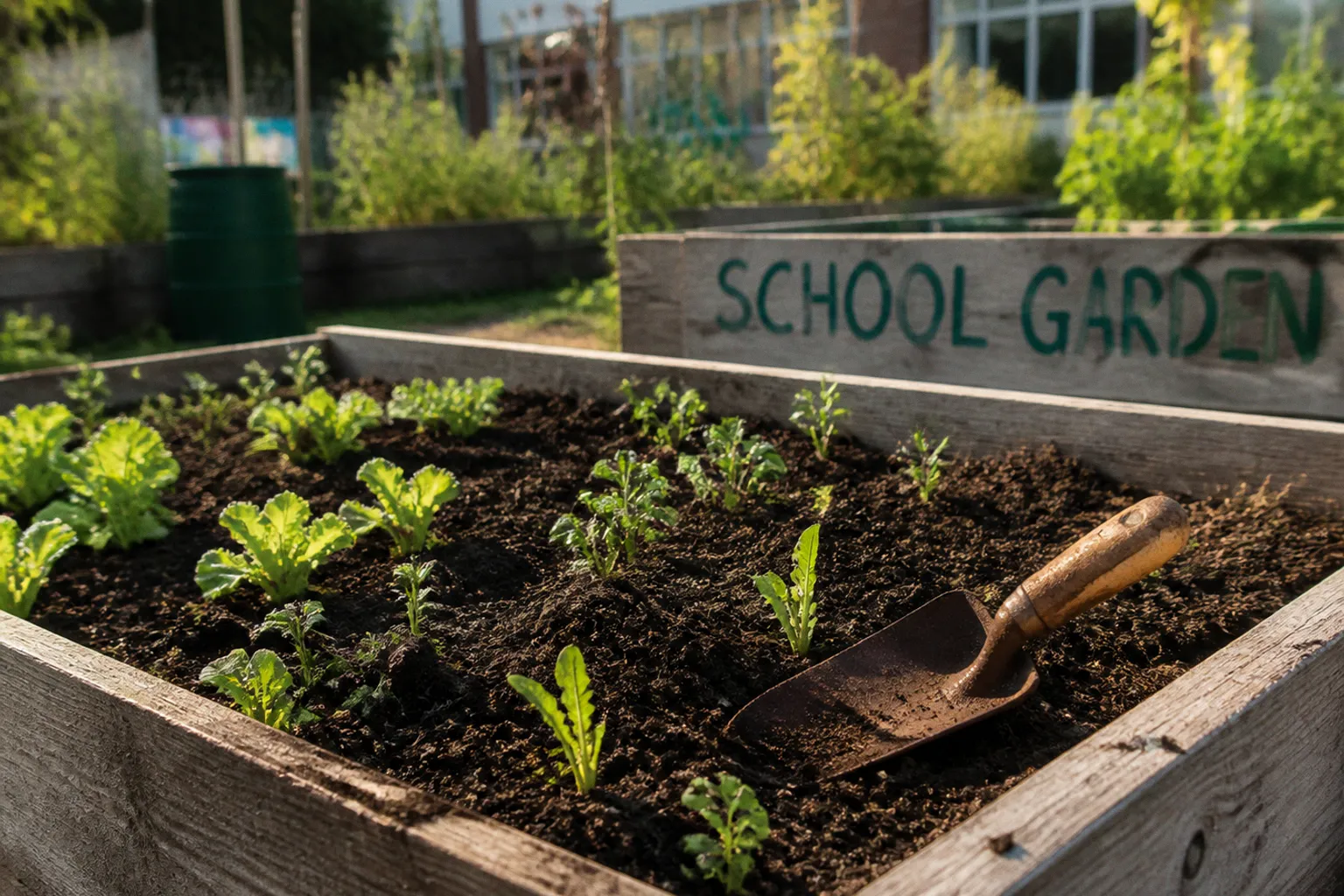
A headmaster in the Konkan stood over a freshly turned bed that was becoming the school's vegetable garden, a trowel in one hand and a sack of municipal compost in the other, and asked me plainly: is this safe for our children to handle, and safe for the tomatoes they will eat at lunch next month? He was not asking a rhetorical question. He was asking because his school sits two streets from the town composting yard, and the bag cost him roughly a tenth of what bagged manure would have. He was asking because stewardship of a school garden is, in his eyes, stewardship of the children themselves, and he wants to do right by both.
That question is the one I want to walk through carefully here, because the answer is not a flat yes or a flat no. It is a layered answer, and the layers are exactly what a school community needs to understand before it opens a single bag. Used well, municipal compost can be one of the most powerful teaching inputs a schoolyard brings in. Used blindly, it carries risks that no child should be quietly absorbing in the name of an eco-lesson.
The Role of Certification in Compost Safety
The single most useful filter a school community can apply is also the simplest one to explain: certification. In North America, the US Composting Council has run the Seal of Testing Assurance, or STA, since 2000, and the program does something that a sack printed with the word "organic" does not. It requires participating manufacturers to submit every batch to an independent laboratory and to publish the results. That single habit turns compost from a black box into a documented input that a school can read.
A certification mark is not a guarantee of perfection; it is a guarantee that someone looked, measured, and wrote down what they found.
For a rural school, this distinction matters enormously. The compost arriving at the gate may carry the same generic label on its woven sack as the compost arriving at a private farm, but only one of those producers has committed to a third-party audit. The audit covers heavy metals, pathogens, and stability, and it gives the headmaster something he can actually put on file: a number, a date, and a name attached to a chain of custody. Without that paper trail, the bag is essentially an act of faith. With it, the bag becomes a recordable decision a school can defend to a parent, a panchayat, or a district education officer.
It is worth being honest about a limitation here. The STA is a North American program, and very few Indian municipal composting facilities carry its seal. That does not mean their compost is unsafe. It means a school community cannot rely on a printed mark and has to ask different questions of the supplier, beginning with whether the facility can show recent lab reports on the same parameters. The principle travels; the sticker does not always travel with it. What stays constant is the right of the school to ask, in writing, what is in the bag.
Understanding Heavy Metal and Pathogen Thresholds
Once a school has decided to ask for documentation, it needs to know what the documentation should actually contain. The clearest reference point for that is the US EPA Class A standard, codified under 40 CFR § 503.13, which sets ceiling concentrations for heavy metals in compost intended for unrestricted use. The numbers are not arbitrary. They were derived from long-term risk modelling and from years of biosolids research, and they are conservative by design because they are written for land application near people, including children.
| Heavy metal | Maximum allowed (mg/kg, dry weight) |
|---|---|
| Lead (Pb) | 300 |
| Arsenic (As) | 41 |
| Cadmium (Cd) | 39 |
| Copper (Cu) | 1,500 |
| Mercury (Hg) | 17 |
| Nickel (Ni) | 420 |
| Selenium (Se) | 100 |
| Zinc (Zn) | 2,800 |
A school community does not need to memorise this table to act on it. It needs to know that lead is the headline number, partly because legacy contamination in urban soils often centres on lead, and partly because children's exposure thresholds sit lower than adults'. A working soil-lead target for a school vegetable plot is below 300 parts per million, and that figure should appear on any compost report the school is handed. If a supplier cannot produce a recent certificate showing lead, arsenic, and cadmium under their respective ceilings, the conversation should pause. That pause is not a failure. It is the school exercising its stewardship in real time.
Pathogens are the second axis, and they have their own clear language. Certified compost must contain less than 1,000 MPN of Fecal Coliform per gram of dry compost, or less than 3 MPN of Salmonella per 4 grams of dry compost. These are detection limits, not aspirations. They reflect what a competent thermophilic composting process is expected to destroy. When a school's garden coordinator asks for a "pathogen report," those two numbers are what the report should contain, and a competent supplier will know exactly where to find them. They will also know that the school is asking the right question, and that alone changes the supplier's behaviour toward the next school that calls.
A quieter but important point: heavy metals do not biodegrade. Heat, time, and microbial activity cannot break them down. They can only be diluted by mixing with cleaner bulk material, or prevented from entering the pile in the first place. That is why source separation at the composting facility — keeping out industrial sludges, roadside leaf litter from high-traffic corridors, and ash from waste incineration — matters as much as the testing itself. A school is essentially asking a question about upstream habits, not just about the finished product in the sack. Testing municipal compost for heavy metals is, when done well, a window into the hygiene of a whole waste system.
Managing Persistent Herbicides in School Vegetable Plots
There is a category of contamination that does not show up on a heavy metals panel and does not show up on a pathogen panel, and that is precisely what makes it the most deceptive. A handful of synthetic auxin herbicides — clopyralid, registered in 1987, aminopyralid in 2005, aminocyclopyrachlor in 2010, with picloram as an older cousin — can survive an otherwise well-run thermophilic composting cycle. They do not break down at typical pile temperatures, and they do not dissipate during curing. They emerge intact in the finished compost, and they damage sensitive broadleaf vegetables in ways that are dramatic, immediate, and entirely unhelpful for a school trying to grow food.
The plant tells the story before the lab does: cupped tomato leaves, twisted pea tendrils, a row of marigolds that simply refuses to flower.
The damage is unmistakable once you have seen it. Tomato leaves cup downward, pea tendrils coil without gripping, beans emerge with fern-like distortion, and the most sensitive indicator crops — sunflowers, marigolds, and the humble tomato seedling — fail visibly within weeks of transplant. A school that has not been warned about persistent herbicides will, in many cases, blame the seed, the weather, the water, or the children who planted it. They will not think to look at the compost, and that is exactly why using municipal compost for vegetables requires this layer of caution.
It is important to be precise about what these herbicides do and do not do. The US EPA has stated that clopyralid and aminopyralid do not pose a human health risk to people eating produce from treated soil. The damage is to the plant, not to the child eating the plant. But a school garden is not a chemical trial; it is a teaching space, and a failed row of tomatoes is a failed lesson in stewardship that the children will remember longer than any successful harvest. The point of screening for persistent herbicides, or of asking the supplier pointed questions about them, is to protect the pedagogical dignity of the garden, not just the plate.
The practical move here is a bioassay that costs almost nothing. A small handful of finished compost, mixed into a pot of sterile potting medium at roughly ten percent by volume, planted with three pea seeds and watched for fourteen days, will tell a school whether the compost is safe for broadleaf planting. If the peas curl, the answer is no. If they grow straight, the answer is yes. The children can run this test themselves, and in doing so they learn more about how soil speaks than any chapter in a textbook will teach them.
The Reality of Microplastics in Industrial Organic Waste
The newest entry on the list of concerns is also the one with the least settled science, and a school community deserves to be told that honestly. Municipal organic waste streams — particularly those that accept packaging residue, sorting losses, and household mixed waste — contain microplastics. Published measurements of industrial compost have found concentrations as high as 253 items per kilogram of dry weight, dominated by polyamide and polypropylene fragments that entered the waste stream as food packaging, textile fibres, and consumer plastic goods. That figure is not a scare tactic. It is the measured reality of an industrial-scale process that takes in whatever a city throws away.
The honest caveat, which I owe the reader: the long-term health effects of consuming produce grown in soil containing these microplastics are not yet established in a way that allows a clear public-health verdict. The unknowns are real, and they deserve to be named rather than papered over. A school community should not be told the science is settled when it is not, and it should not be told that microplastics are harmless when the same cannot be said with confidence. That kind of reassurance, given too early, becomes a liability the first time a parent reads a serious article on the subject.
What can be said with confidence is that source quality controls matter here too. Composting operations that accept only pre-separated kitchen and garden waste, with strict policing of incoming loads, produce finished material with substantially lower microplastic counts than mixed-waste facilities. A school buying bulk compost for school yards from a neighbourhood wet-waste collection programme, where the segregation happens at the household and is verified by the collector, is buying a different product from a school buying compost from a municipal transfer station that accepts everything. The same generic label can cover very different physical realities, and the school needs to be clear about which one it is bringing onto its grounds.
The principle I take from this is one I keep returning to on the road. A school garden is a conversation with a watershed, a market, and a waste system all at once. The compost in the bed carries the habits of the city that produced it, and the children's relationship to that compost is, in a small way, their first relationship to the wider system their household is part of. That is not a reason to refuse compost. It is a reason to ask where it came from, and to teach the children how to ask alongside the adults.
Best Practices for Student Handling and Garden Hygiene
Whatever compost a school decides to use, and whatever guarantees its supplier can offer, the human side of the equation still needs attention. Compost is a biologically active material, and the people handling it are children whose immune systems are still developing and whose hygiene habits are still being formed. The same care that a hospital takes with its inputs, a school garden needs to take with its own, in a way that is proportionate and not fearful.
The baseline protocol is simple enough to teach in a single afternoon and to enforce without resentment, and it covers the small set of habits that turn a garden from a dusty corner into a shared institution:
- Gloves on, every time. Cloth or nitrile, both are fine; the point is that skin does not touch compost directly, and the gloves become a familiar part of the gardening kit.
- Handwashing immediately after. Warm water, soap, twenty seconds, the same routine the children already know from the dining hall, repeated on the way out of the garden.
- No eating in the bed. The garden is a work space, not a snack space; this small rule prevents the largest number of incidents without becoming a moral lecture.
- Covered compost storage. A finished pile that is allowed to dry out and blow around distributes dust, and dust is a poor neighbour for a classroom window or a kitchen garden next door.
- Tool hygiene. Spades, trowels, and watering cans get rinsed at the end of a session and stored under cover, away from where small hands grab first.
These are not bureaucratic items. They are the social habits through which a community tells its children that the soil is worth treating with respect, and through which the children tell their parents the same thing when they come home. Within two seasons, a family that used to handle kitchen waste carelessly often begins to handle it with the same care it learned from the school garden. That diffusion of hygiene outward from the school gate is, in my experience, where the real public-health return on a compost program lives.
Carrying This Forward
What I have learned, riding into these schools over several planting seasons now, is that the question of compost safety is really a question of whether a community is willing to treat its garden as part of its public infrastructure. A playground, a classroom, a water tap — these are things a village protects collectively because they belong to the children. A vegetable bed should be protected in the same way, and that means protecting the inputs to the bed with the same seriousness. School garden compost safety is not a separate technical problem from the rest of the school's stewardship; it is the same problem wearing a green jacket.
If I had to leave a school community with one principle to carry into the next planting season, it would be this: do not buy compost that you cannot read about. A supplier who cannot answer, in writing, what is in the bag is not a supplier a school can build a partnership with. A supplier who can — who can show heavy metals under their ceilings, pathogens under their limits, herbicide screening of some kind, and a credible story about source separation — is a partner in the deeper sense, because they are treating the children as the kind of people whose growing conditions deserve documentation. That is what stewardship looks like at the scale of a schoolyard.
The headmaster in the Konkan, who asked me the question in the first place, went home with a printed list of questions to put to his municipal supplier. A month later he sent a photograph: a row of healthy pea seedlings climbing clean against a bamboo trellis. The compost turned out to be fine. What made it fine was not the answer he received but the fact that he insisted on asking the question, in writing, before a single handful of it touched a child's hands.