Community compost hubs vs home bins for neighborhood waste
A household compost bin can usually handle roughly 1 cubic yard, or 1 cubic metre, of organic material at a time. A neighborhood community compost hub can process 1–2 tonnes of waste per month.
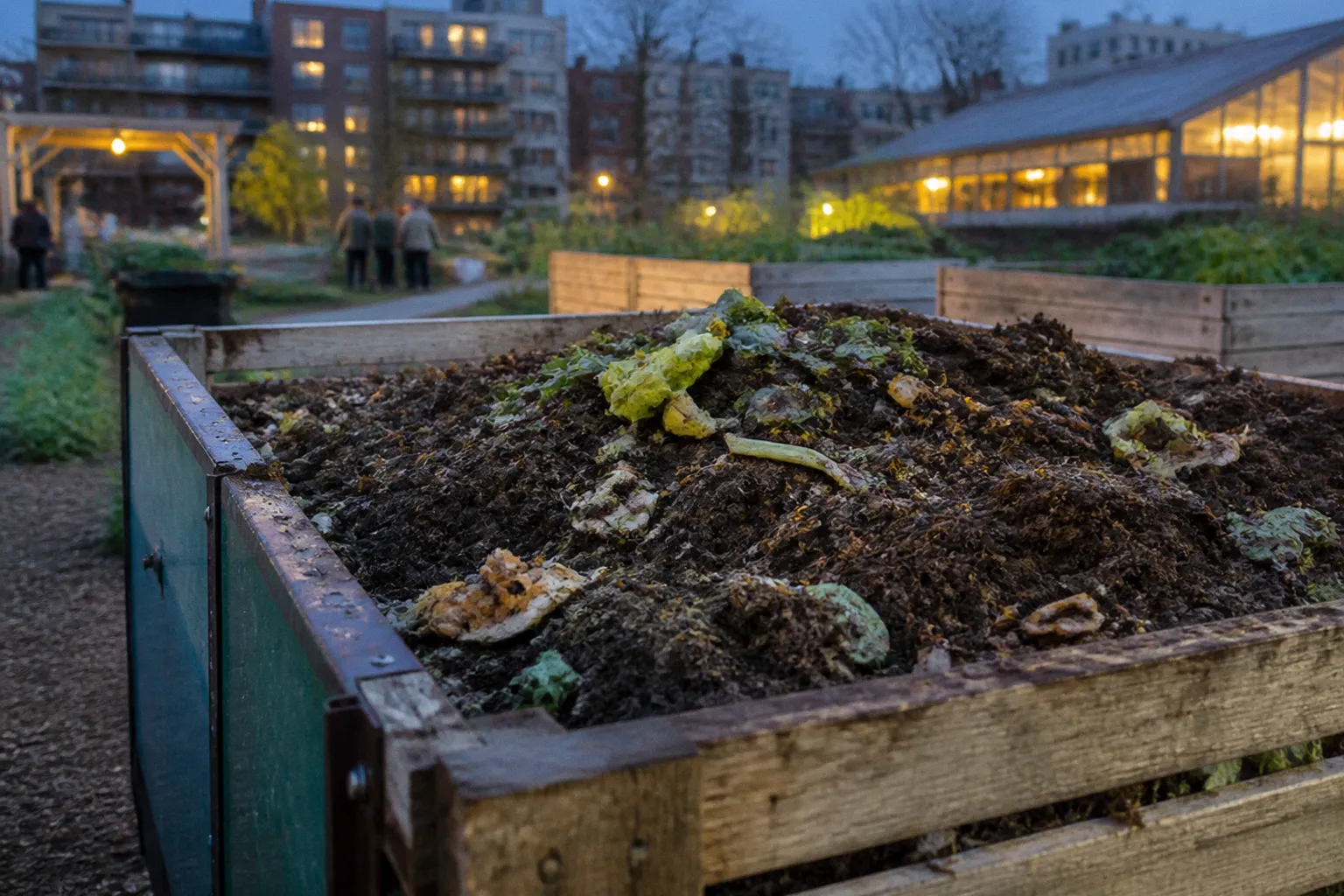
That difference is not a matter of choosing a larger container; it is a change in operating model, temperature control, material acceptance, labor, and accountability.
Compare car rental deals in United Kingdom
See available offersPartner link — DiscoverCars comparisonFor households, composting is primarily a private waste-reduction habit. For a school, housing cluster, community garden, or local nonprofit, it becomes an infrastructure decision. The relevant question is not simply whether composting works. It is whether the selected system can absorb the expected waste stream, maintain quality, and produce a sustainable yield without creating a new bottleneck in collection or management.
The practical comparison between a community compost hub vs home composting bins therefore comes down to scale and control. Home bins offer simple ownership and low entry costs. Hubs provide capacity, material versatility, and measurable diversion, but only when the operating structure is properly funded.
The Thermodynamics of Decomposition: Cold vs. Hot Composting
The central technical distinction is temperature.
Most home composting systems operate as relatively small, low-temperature or “cold” systems. They depend on naturally occurring microbial activity and gradual decomposition. The process is forgiving, but slow. Depending on the mix of materials, moisture, aeration, and seasonal conditions, finished compost may take 3–12 months. In poorly managed bins, the cycle can extend to two years.
That pace is acceptable when a household generates a modest volume of fruit and vegetable scraps, leaves, and garden waste. It becomes less suitable when several hundred residents are contributing food waste every day. A small bin reaches capacity before the first batch has matured, and the problem is no longer decomposition alone. It is storage, collection, odor control, and space allocation.
Community compost hubs can be designed to operate at higher temperatures. Managed piles may reach approximately 130°F–160°F, or 54°C–71°C. At that range, decomposition accelerates and the heat helps destroy pathogens and weed seeds. A well-managed community-scale pile can produce usable compost in approximately 4–8 weeks, although the precise cycle still depends on feedstock, pile design, turning or aeration, moisture, and curing time.
| Parameter | Home composting bin | Community compost hub |
|---|---|---|
| Typical operating scale | Around 1 cubic yard or 1 cubic metre per household | Up to approximately 1–2 tonnes of organic waste per month for a neighborhood-level hub |
| Temperature profile | Usually cold or low-temperature | Managed hot piles can reach 130°F–160°F / 54°C–71°C |
| Time to finished compost | Commonly 3–12 months; sometimes longer | Approximately 4–8 weeks for active hot decomposition, followed by curing where required |
| Typical feedstock | Plant scraps, leaves, grass, limited kitchen waste | Broader organic stream, subject to system design and local rules |
| Pathogen and weed-seed control | Limited by lower temperatures | Improved through sustained high-temperature operation |
| Management model | Individual household | Shared infrastructure with assigned operators, volunteers, or paid staff |
| Primary constraint | Space and slow turnover | Contamination, labor, collection logistics, and governance |
Temperature should not be treated as a marketing specification. A pile that briefly becomes warm is not automatically a high-temperature composting system. The operational value comes from maintaining the correct conditions across enough of the pile for long enough to accelerate decomposition and reduce biological risks.
That requires a carbon-to-nitrogen balance, moisture control, adequate airflow, and routine monitoring. A community hub that accepts large quantities of wet food waste without sufficient dry carbon material may become anaerobic, compacted, and odorous. The equipment may be larger, but the failure mode is familiar: the system receives more material than its process can absorb.
Scale changes the composting problem from “Where do I put the scraps?” to “Who controls the flow, temperature, contamination, and output?”
Material Versatility: Why Hubs Handle What Backyards Cannot
Home composting is often described as if all organic material behaves the same way. It does not.
A backyard bin can perform well with vegetable peelings, coffee grounds, garden trimmings, dry leaves, and other relatively manageable inputs. It is not generally suited to meat, bones, dairy, seafood shells, or bioplastics such as PLA. These materials decompose differently and can attract pests, generate odors, or remain intact when the bin does not reach the required temperature.
Community hubs have a wider technical envelope because they can use larger piles, managed aerated static systems, commercial-grade equipment, or controlled workflows. Under the right conditions, these systems can process harder-to-decompose materials that would be inappropriate for a small household bin.
The qualification is essential: a community hub is not automatically capable of accepting every organic material. Acceptance rules should follow the process design, not the label “community composting.” A hub based on open windrows may have different capabilities from one using an aerated static pile. A school campus program with limited staff should not promise the same material range as a professionally managed neighborhood facility.
A useful intake model separates materials into three categories:
1. Standard household organics — fruit and vegetable scraps, coffee grounds, leaves, grass, and other plant-based material that can be managed by both home bins and most community systems.
2. Higher-risk or slower materials — meat, bones, dairy, seafood shells, and heavily wet food waste, which require stronger temperature management, more robust aeration, and tighter pest control.
3. Non-accepted materials — plastics, treated wood, synthetic packaging, and bioplastics such as PLA unless the specific processing system is designed and permitted to handle them.
For a neighborhood waste reduction program, the intake policy should be visible at the collection point and repeated during onboarding. Contamination is not a minor inconvenience. One plastic bag can be removed manually; hundreds of bags or mislabeled packaging can turn a composting initiative into a sorting operation.
This is where community engagement has a direct operational value. A registered participant system, kitchen caddies, clear signage, and regular feedback can reduce contamination before material reaches the pile. Brisbane’s community composting model, for example, paired community gardens with registered residents and provided kitchen caddies for collecting and transporting food scraps. The design links participation to a practical collection tool rather than relying on general environmental messaging.
Economic Efficiency and Municipal Waste Diversion Metrics
The financial case for decentralized composting is strongest when it is measured against the costs it avoids.
Organic waste is heavy, wet, and expensive to transport. Every tonne diverted close to its point of generation can reduce truck mileage, transfer-station demand, and disposal volume. A modeled decentralized composting program designed to collect 10% of municipal solid waste over a ten-year horizon projected approximately 5% in municipal economic savings, alongside an annual reduction of 19,076 tonnes of carbon-dioxide-equivalent emissions.
These figures should be treated as program-level estimates, not guaranteed returns for every neighborhood. Savings depend on route density, land costs, labor, contamination, collection behavior, and the destination that would otherwise receive the waste. Still, the direction of the economics is clear: localized treatment can reduce the distance and handling required for a material that is generated continuously and discarded quickly.
Cost comparisons also show why the question is not simply whether a household bin is cheaper than a community hub. A home bin may have a lower direct cost for an individual resident, while a hub may create a lower operating cost per tonne at neighborhood scale.
Operational data from California’s community composting programs reported an average cost of approximately $200 per ton for labor and infrastructure, with some programs operating at about $104 per ton. The average cost cited for commercial composting facilities was approximately $373 per ton. The comparison is not universal, but it demonstrates the potential value of distributed systems when they are located close to feedstock and supported by community labor or targeted public funding.
For funders and municipal partners, the core measurement framework should include:
- Tonnage received: the total organic material delivered to the hub.
- Tonnage diverted: the portion that would otherwise have entered disposal or long-distance treatment routes.
- Contamination rate: the weight or volume of non-compostable material removed from incoming loads.
- Cost per tonne: operating expenditure divided by accepted or successfully processed material.
- Processing time: the time from intake to mature compost, not merely the date the pile is closed.
- Participation rate: active contributors relative to the number of households, classrooms, or institutions within the service area.
- Compost utilization: the proportion of finished material used in gardens, school grounds, farms, or other verified applications.
The last metric is frequently neglected. Diversion is not complete when waste enters a pile. It is complete when the resulting material is stable, safe for its intended use, and placed into a productive soil-management cycle. If finished compost accumulates without a distribution plan, the hub has simply moved the storage bottleneck downstream.
Community Composting Initiatives and Corporate Integration
A community compost hub becomes more reliable when responsibilities are allocated before the first collection day. This is particularly relevant for nonprofits, schools, housing associations, and businesses that want to support local green initiatives without operating a waste facility themselves.
A workable partnership model usually has five layers:
1. Feedstock generation: households, school kitchens, restaurants, offices, or community events produce the organic material.
2. Collection and transfer: participants use approved containers, and a defined route moves material to the hub.
3. Processing: trained operators manage the pile, record inputs, correct moisture and aeration problems, and control contamination.
4. Output management: mature compost is allocated to school campuses, community gardens, restoration sites, or agricultural partners.
5. Performance reporting: the program publishes tonnage, contamination, cost, participation, and output figures at a fixed reporting interval.
This structure gives corporate and institutional funders a more precise point of intervention. Funding does not have to be directed only toward bins or construction. The largest operational bottleneck may be collection containers, weighing equipment, staff time, training, land preparation, or the purchase of carbon-rich bulking material.
For education-focused organizations, school campus greening can provide a practical application for the finished product. A school may begin with food scraps from a cafeteria, leaves from the grounds, and a limited number of classrooms. The compost can then support tree plantation drives, garden beds, erosion control, or soil improvement around newly planted areas. Students receive a visible material-flow lesson, but the program remains accountable to measurable waste and land-management outcomes.
For businesses, the integration question is different. A company may sponsor the capital expenditure while a nonprofit or community garden manages daily operations. That arrangement can work if the service agreement defines:
- who owns and maintains the equipment;
- who pays for labor and replacement parts;
- how contamination is recorded and charged;
- which organization holds regulatory responsibility;
- where the finished compost goes;
- and what performance data is reported to the funder.
Without these provisions, “partnership” often means that the most operationally demanding tasks are left to volunteers. Volunteer participation can lower costs, but it is not a substitute for a staffing plan. A hub processing 1–2 tonnes per month requires recurring attention even when the equipment is simple.
Regulatory Landscapes and the Path to Neighborhood Adoption
Regulation is a design parameter, not an administrative detail to be addressed after installation.
Rules differ significantly by jurisdiction and may govern site selection, accepted materials, storage, odor, pest control, leachate, transport, compost quality, and the classification of the finished product. Some European countries, including Germany, Austria, and the Czech Republic, classify certain non-commercial neighborhood composting activities as household composting when they remain within the scale associated with typical home systems. That exemption does not mean every community hub is free from oversight, and it should not be generalized to other jurisdictions.
A neighborhood project should establish its regulatory pathway before purchasing equipment or advertising acceptance of food waste. The scale, feedstock, ownership model, and processing method may each affect the requirements.
The most common adoption error is to treat a community hub as an enlarged backyard bin. That approach understates the consequences of receiving material from multiple households. Once the program collects waste from outside the operator’s own property, questions of transport, nuisance control, worker safety, and accountability become more prominent.
A practical rollout can be staged:
Stage one: Measure the available feedstock
Begin with a short baseline period. Weigh or estimate organic waste from the target households, school kitchen, market, or institution. The objective is not statistical perfection; it is to identify the daily and weekly flow, seasonal variation, and likely contamination.
Stage two: Start with a controlled material list
Accept only the materials that the selected process can handle. A narrow intake list is easier to communicate and produces cleaner data. Expansion should follow evidence from temperature records, contamination rates, labor capacity, and finished compost quality.
Stage three: Assign a site and an operator
The site needs vehicle access, drainage control, sufficient working space, and a buffer from sensitive uses. An operator or operating team should have authority to reject contaminated loads and pause intake when the system is overloaded.
Stage four: Report performance publicly
A monthly dashboard can be simple: tonnes received, tonnes rejected, estimated disposal avoided, contamination incidents, operating cost, and compost distributed. Public reporting supports trust and gives funders a basis for adjusting resource allocation.
Stage five: Expand only after the bottleneck is known
If the hub is full, the solution may be a second processing bay rather than a larger collection route. If contamination is high, education and inspection may matter more than equipment. If labor is the constraint, a paid coordinator may deliver a greater increase in capacity than additional bins.
This staged approach avoids a common failure pattern in local sustainability campaigns: capital investment arrives before the operating model has been tested. The result is visible infrastructure with limited throughput.
Operational Realities: Managing Collective Infrastructure
The physical process is only one part of a community composting initiative. The other part is coordination.
Home composting places most decisions with one household. The resident chooses what enters the bin, how often it is turned, when moisture is added, and where the compost is used. That concentration of control is the main reason home bins can operate with relatively little administration.
A hub distributes those decisions across a larger group. The system must compensate with procedures. Those procedures need not be bureaucratic, but they must be explicit.
A robust operating schedule normally includes:
- intake days or collection windows;
- container cleaning and replacement;
- routine temperature checks;
- moisture and aeration adjustments;
- contamination removal;
- pest and odor inspections;
- maintenance of paths, covers, tools, and drainage;
- batch tracking from intake through curing;
- and a defined route for finished compost.
The hub also needs a capacity threshold. If a pile is designed to process one volume of material and receives two volumes, the excess does not disappear. It remains in containers, on the ground, or in an unprocessed holding area. That creates odor, attracts pests, and damages participant confidence.
A simple capacity policy should specify what happens when intake exceeds throughput. Options include temporarily pausing new registrations, redirecting material to another hub, reducing collection frequency, or expanding the active processing area. The least defensible option is to continue accepting material without recording the overload.
Home bins have their own bottlenecks. They require outdoor space, and their low-temperature process limits the material range. They may also be unsuitable for residents without gardens or for apartment households that cannot maintain a bin safely. In dense neighborhoods, the collective model can therefore improve access even when it costs more per participating household.
The comparison is best understood through operating conditions rather than ideology:
| Operating condition | Home bins are generally stronger | Community hubs are generally stronger |
|---|---|---|
| One household produces a small volume of plant-based scraps | Low complexity and direct control | Unnecessary infrastructure |
| Residents lack outdoor space | Limited suitability | Shared access without individual land requirements |
| Food waste includes meat, dairy, or bones | Poor fit without specialized management | Better fit where high-temperature processing is designed for it |
| The objective is rapid material turnover | Slow cycle | Faster cycle under sustained hot conditions |
| Participants are widely dispersed | No collection route required | Transport may erase some savings |
| A school or apartment complex produces concentrated waste | Limited capacity | Better resource allocation at the point of generation |
| The program has no responsible operator | Household accountability is clearer | High operational risk |
| The finished compost has a defined local use | Suitable at garden scale | Suitable for campus, garden, and restoration applications |
Decentralized Composting vs. Centralized Disposal
The phrase “decentralized” can create the impression that smaller is automatically better. That is not a reliable planning rule.
A community hub is decentralized relative to a large municipal or commercial facility, but it still requires concentration. Feedstock must reach a managed site, and the site must have enough volume to maintain an efficient process. A hub located too far from participants increases collection emissions and labor. A hub placed too close to homes without nuisance controls can create opposition. The objective is not maximum decentralization; it is an efficient match between generation, processing capacity, and end use.
Centralized facilities can provide stronger process control, larger equipment, and professional staffing. Their weakness may be transport distance and the cost of moving wet organic waste. Home bins minimize transport but offer limited capacity and a narrow material range. Community hubs occupy the middle ground: enough concentration to create operating economies, but close enough to reduce unnecessary hauling.
For municipal planners and nonprofit networks, the strongest portfolio may combine all three:
- home bins for households with appropriate space and suitable feedstock;
- neighborhood hubs for dense housing, schools, markets, and community gardens;
- commercial or municipal facilities for materials and volumes that exceed local processing capacity.
That mixed system is more resilient than forcing every participant into a single model. It also allows investment to follow the real waste stream. A rural school with garden space may need a modest home-scale system. A city apartment cluster may need a staffed hub. A regional food market may require a formal commercial processor.
Choosing the Right Model for a Neighborhood Program
The decision should be based on throughput, not enthusiasm. Before selecting a model, the project team should be able to answer several practical questions:
- How many kilograms or tonnes of organic material are generated each month?
- How much of that material is plant-based, and how much requires high-temperature processing?
- Do households have outdoor space, or is shared infrastructure necessary?
- Who will collect the material and how frequently?
- Who has authority to reject contaminated loads?
- What is the expected operating cost per tonne?
- What happens during monsoon periods, heat waves, holidays, or school closures?
- Where will the finished compost be used within a defined time?
- Which local agency or regulation governs the activity?
- What data will be reported to residents, funders, or municipal partners?
The answers determine the appropriate architecture.
Home bins are the lower-complexity option for households that can manage a small, slow process and produce compatible feedstock. They are not a universal solution, particularly in dense neighborhoods or where residents need to dispose of broader food waste categories.
Community hubs are more capable, but they are not self-operating. Their sustainable yield depends on a stable feedstock stream, trained management, contamination control, and a credible use for the finished compost. The program can reduce municipal costs and emissions, but only when the resource allocation includes the recurring work between collection and output.
The strongest neighborhood composting model is not the one with the largest bin. It is the one that keeps feedstock, operating capacity, funding, and end use in balance.
A Funding and Policy Position
For funders, the priority should shift from one-time infrastructure grants to multi-year operating support. Bins, bays, and aeration systems are visible assets, but the performance of a hub is determined by less visible inputs: labor, training, collection containers, contamination monitoring, maintenance, and data management.
For municipalities, policy should recognize that organic waste can be managed through a distributed network rather than a single disposal pathway. A 5% economic saving at system level may justify targeted support, particularly where avoided transport and disposal costs can be measured. Grants or service payments can be tied to verified tonnes diverted, contamination thresholds, and compost utilization rather than to equipment purchases alone.
For schools and community organizations, the most defensible starting point is a controlled pilot. Establish the baseline, select an intake list, assign an operator, record the throughput, and review the bottlenecks after the first processing cycle. Expansion should be earned by performance data.
The community compost hub vs home composting bins decision is ultimately a question of governance as much as technology. Home bins work when responsibility is individual and the material stream is modest. Hubs work when a neighborhood can coordinate collection, processing, reporting, and end use. Programs that acknowledge this distinction can convert organic waste from a disposal liability into a measurable local resource—while avoiding the familiar failure of building infrastructure that nobody is funded to operate.