Is roof runoff safe for community gardens?
Roof runoff can be useful water for a community garden, but it is not automatically clean simply because it has fallen from the sky.
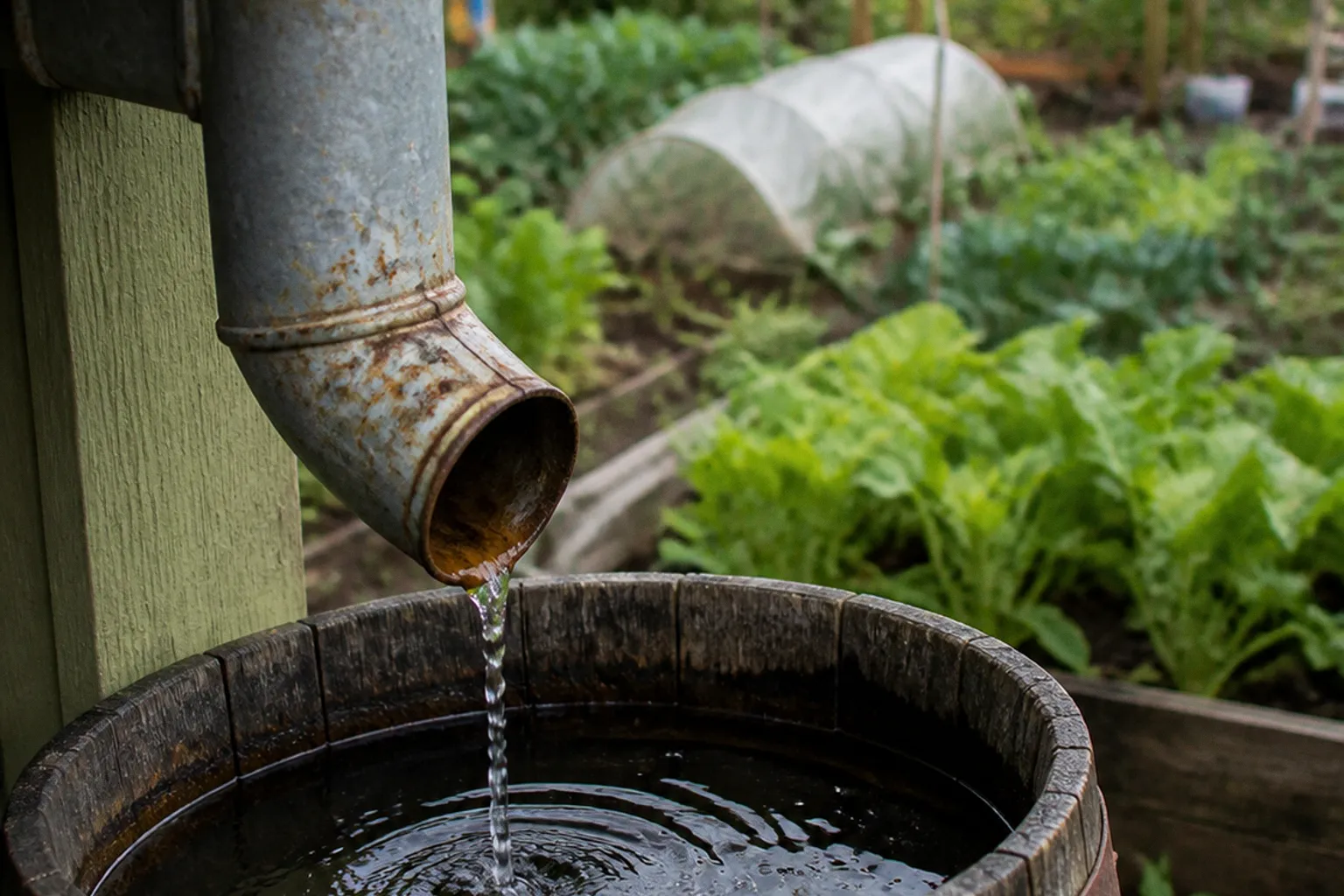
The first water coming off a roof may carry dust, bird droppings, fragments from roofing materials, and pollutants that have settled on the surface between rainfall events. Where the garden grows food for children, families, or a whole village, that distinction is not a technical footnote. It is part of responsible stewardship.
The practical answer is therefore conditional: roof runoff can support irrigation when the collection system is designed for safety, the first flush is diverted, the roof and gutters are understood, and the water is delivered to the soil rather than sprayed over edible leaves. In community gardens, good water management is not only about reducing demand on municipal supplies. It is also about protecting trust between the people who maintain the garden and the people who eat from it.
Rainwater is natural; roof runoff is not
Rain begins with a relatively simple profile, but the moment it meets a roof it becomes runoff shaped by the materials and conditions around it. A roof may hold dust, soot, pollen, bird and animal waste, leaf litter, insects, and residues from nearby roads or industrial activity. Gutters can add their own particles, particularly when they are old, corroded, or made from materials that release metals.
The initial volume draining from the roof is known as the first flush. It generally carries the highest concentration of accumulated pollutants because it washes the surface before the roof has been rinsed by continuing rainfall. Depending on the roof and its surroundings, this water may contain pathogens as well as lead, zinc, copper, and polycyclic aromatic hydrocarbons, commonly called PAHs.
That does not mean every roof is equally hazardous, nor does it mean every drop of collected water must be discarded. It means the garden needs a system that recognises the difference between rainfall and roof water. A clean-looking tank is not proof of clean water, and clear water can still carry dissolved contaminants.
This is especially relevant when the crop is eaten raw. A few leaves of coriander, lettuce, spinach, or other leafy greens may receive water directly on their surface, while root vegetables and fruiting crops have different exposure pathways. The garden’s irrigation method, soil condition, roof material, and harvesting habits all belong in the same conversation.
Roof runoff is a resource only when the collection system protects the people who depend on it.
The first flush is the first line of protection
A first-flush diverter is one of the most important measures in rainwater harvesting for edible crops. Its purpose is to prevent the earliest, dirtiest portion of a rainfall event from entering the main storage tank. Once that initial volume has been separated, later water can be directed into storage for irrigation.
The mechanism does not need to be elaborate to be useful, but it does need to be understood and maintained. A diverter may use a separate chamber or pipe that fills first, after which subsequent runoff passes into the tank. Someone must periodically empty or clean that chamber, otherwise the system can become a neglected pocket of sediment and organic matter.
The appropriate first-flush volume depends on factors such as:
- the roof’s catchment area and surface condition;
- the length of time since the previous rainfall;
- the amount of dust, leaf litter, and bird activity around the roof;
- local air pollution and nearby traffic;
- the design and cleanliness of the gutters;
- whether the roof is metal, tile, membrane, asphalt shingle, or another material.
There is no single universal figure that makes every roof runoff system safe. A small rural school roof surrounded by trees presents a different contaminant profile from a large urban building beside a busy road. The system should therefore be adjusted through observation, maintenance records, and, where food is grown at meaningful scale, water testing.
The first-flush device is not a complete treatment plant. It reduces the initial pollutant load, but it does not remove every contaminant that may be present later in a storm. This is why it works best as one part of a wider chain that includes sound storage, soil protection, and careful irrigation.
What the garden team should observe
A simple monitoring routine can reveal problems before they become embedded in the growing system. After a long dry period, look at the first water diverted from the roof. Excessive sediment, oily sheen, unusual colour, strong odour, or visible organic matter should not be dismissed as merely unattractive. These signs may indicate that the collection surface or guttering needs attention.
The tank itself should be covered and protected from light where possible. This reduces the opportunity for algae growth and keeps leaves, insects, and animals from entering. Gutters and screens require cleaning, but cleaning should be done in a way that does not simply move concentrated debris into the garden beds.
If the roof has recently been painted, treated, repaired, or replaced, the water should not be used on edible crops until the materials and manufacturer’s guidance have been reviewed. Roofs with lead flashing, copper components, or pesticide-treated surfaces deserve particular caution. The same applies when the roof receives runoff from another surface whose contamination history is unknown.
Roofing materials change the conversation
The question is not only whether the water has been harvested. It is also: harvested from what?
Non-metal roofs are sometimes treated as a straightforward option, yet studies have found that runoff from such roofs can still contain phosphate, copper, lead, and zinc at concentrations that may exceed groundwater protection thresholds, depending on the roof’s age and the materials used in the roof and gutters. Asphalt shingles, sealants, coatings, fasteners, and accumulated atmospheric deposits can all influence what reaches the tank.
Metal roofs are not automatically unsuitable. Their condition, coating, age, joints, flashing, and surrounding environment matter. However, roofs containing lead or copper elements require a more conservative approach because these metals can enter runoff and accumulate in soil over time. A roof that is acceptable for watering ornamental plants may not be a sensible source for a bed of salad greens.
For a community garden attached to a school or public building, the roof should be mapped before the tank is connected. The people responsible for the project should be able to answer, in ordinary language:
1. What material covers the roof?
2. Are there lead flashings, copper gutters, treated surfaces, or old coatings?
3. Does runoff pass over areas where birds regularly perch?
4. Are there chimneys, vents, roads, workshops, or industrial sites nearby?
5. Is the roof shared with another drainage system?
6. Can the first flush be separated and the tank cleaned safely?
That conversation is an act of integration. It brings facilities staff, teachers, gardeners, elders, and students into the same stewardship process instead of leaving a hidden technical decision to one person.
Watering the soil is safer than wetting the leaves
The safest ordinary practice for using roof runoff on edible crops is to apply the water directly to the soil or root zone. Drip irrigation and soaker hoses are especially useful because they place water beneath the foliage and reduce splash onto the edible parts of plants.
Overhead spraying is less desirable when the water has not been treated to a standard appropriate for direct contact with food. Spraying can distribute contaminants across leaves, increase the chance of contact with pathogens, and leave water sitting in folds and crevices that are difficult to wash thoroughly. It may also create unnecessary mist and splash between beds.
A well-designed irrigation layout can be both safer and more efficient:
| Irrigation approach | Main advantage | Main concern with roof runoff |
|---|---|---|
| Drip lines at soil level | Delivers water close to roots with little leaf contact | Emitters need filtration and regular cleaning |
| Soaker hoses | Simple, low-splash watering along beds | Hose placement may need adjustment as crops mature |
| Hand watering at the base | Flexible for small gardens and new plantings | Requires consistent practice and supervision |
| Overhead sprinklers | Covers large areas quickly | Can wet edible leaves and spread contaminated droplets |
| Direct filling of open channels | Useful in some traditional beds | May cause erosion, splash, and uneven distribution |
The difference between watering the base of a plant and spraying its leaves may appear minor during a busy workday. In a shared garden, however, it is precisely the kind of small operational choice that determines whether a careful water-harvesting project remains trustworthy.
Where overhead irrigation is unavoidable, the garden should separate crops by exposure and use the most reliable water source available for leafy vegetables and herbs. Roof runoff may be reserved for fruit trees, ornamental plantings, established perennial crops, or soil-directed irrigation, depending on local conditions and testing.
The timing of irrigation also matters. Watering early in the day gives the soil time to absorb moisture and allows foliage, if it becomes wet accidentally, to dry more quickly. It is preferable to avoid strong pressure that produces splash and aerosolised droplets. These are not complicated interventions, but they depend on a shared understanding rather than a sign fixed beside the tank and forgotten.
The safest watering system is one that makes the careful action the easiest action for everyone who uses it.
Soil and roots provide filtration, but not permission to ignore risk
Soil is not an inert medium. Its particles, organic matter, microorganisms, and plant roots interact with water as it moves through the growing bed. Roots and soil microorganisms can act as natural filters, and plants selectively absorb some substances while many contaminants remain bound in the soil or are excluded from edible plant tissues.
This natural filtration is valuable, but it is not a guarantee. The behaviour of a contaminant depends on its chemical form, concentration, soil pH, organic matter, drainage, and the length of time the water is applied. A garden that receives contaminated runoff repeatedly may gradually build up pollutants in the soil even if the vegetables appear healthy.
For that reason, raised beds should not be treated as sealed safety devices. Their growing medium should be clean and traceable where possible, and the garden team should know whether collected water is being used occasionally during dry spells or continuously throughout the growing season. Repeated use creates a different stewardship responsibility from emergency watering during a short period of drought.
Plant selection can support risk management. Crops whose edible portions remain below the soil surface are not automatically risk-free, because soil contamination can affect root crops and soil can splash onto harvested produce. Leafy greens are often more exposed to direct irrigation contact, while fruiting crops such as tomatoes, beans, and peppers can be watered at the base with limited contact once their fruit develops above the soil.
In practical terms, the garden should combine several modest safeguards:
- keep harvested rainwater away from direct contact with edible leaves;
- use mulch to reduce soil splash during watering and rainfall;
- wash produce thoroughly before eating;
- prevent children from drinking from irrigation outlets or tanks;
- keep irrigation hoses and fittings separate from drinking-water equipment;
- maintain a record of roof repairs, tank cleaning, and unusual runoff events;
- test water or soil when the roof history, surrounding land use, or long-term exposure creates uncertainty.
Testing is particularly valuable when the garden is near heavy traffic, workshops, industrial activity, old painted buildings, or areas where airborne dust may accumulate. A community garden water testing programme does not need to become a scientific exercise that excludes the people who care for the land. Results should be explained plainly, with enough context for gardeners to understand what action follows from them.
Storage hygiene determines what happens after collection
A first-flush diverter can reduce the initial contamination, but poor storage can undo that work. Tanks, barrels, and smaller containers should be covered securely, protected from animals, and positioned so that overflow does not erode beds or carry sediment into other parts of the garden.
The tank should not be located where children can climb onto it or open it without supervision. In a school setting, the physical arrangement must account for curiosity, play, and the fact that maintenance tasks may be performed by people with different levels of training. Clear labels and simple operating instructions support agency when they explain what the water is for, rather than merely forbidding access.
A storage inspection should look for:
- accumulated sediment at the bottom of the tank;
- cracks, leaks, or degraded seals;
- mosquito access and standing water around the tank;
- blocked inlet screens or overflow routes;
- algae caused by light entering the container;
- cross-connections with potable water systems;
- hoses or watering cans that have been used for other purposes.
Water that has a stale smell or visible growth should not be sent into edible crop beds until the cause is understood. Cleaning a tank is not simply a matter of emptying it into the nearest drain. The sediment may contain concentrated pollutants and should be handled in accordance with local environmental and public-health guidance.
The responsibilities should be shared, but not vague. One person may coordinate inspections, another may organise the workday, and elders or experienced gardeners may guide how irrigation fits into local cultivation patterns. The purpose is not to create bureaucracy around a tank. It is to make sure the system remains cared for after the launch event, when the photographs have been taken and the attention has moved elsewhere.
Green roofs can reduce runoff before it reaches the tank
A green roof offers a different form of intervention. Instead of collecting every drop from a conventional roof, planted layers intercept rainfall, hold water temporarily, and release some of it through evaporation and drainage. Reported interception can range from about 15% to 90% of rooftop runoff, while vegetated layers may absorb roughly 50% to 60% of runoff overall, depending on the system and weather conditions.
This can reduce the volume entering storm drains and soften the sudden flow that often causes erosion around community buildings. It may also contribute to cooling, habitat creation, and environmental education, particularly when the roof is visible from a classroom or used as part of a school campus greening project.
A green roof is not, however, a substitute for a safe edible-water plan. Its plants and growing medium can retain some pollutants, but runoff from a green roof still requires appropriate design and management. The system must be structurally suitable, professionally installed where necessary, and maintained so that the growing layer, drainage paths, and waterproofing remain functional.
In a rural school or community centre, the most realistic arrangement may be a combination of approaches: a planted roof or vegetated section to reduce runoff, a conventional collection surface selected for cleaner water, and a tank used for soil-directed irrigation. The physical design should follow the community’s actual capacity to maintain it. A sophisticated green installation that no one can repair is less valuable than a modest system that remains understood and cared for over time.
Building a shared protocol without taking ownership away
Environmental projects succeed when technical safety and social participation reinforce each other. If a visiting crew installs a tank and leaves behind instructions that do not fit local routines, the equipment may become an object rather than infrastructure. If the community is involved only after decisions have been made, it has been denied the agency needed to steward the system.
When I work at the intersection of volunteer crews and village leadership, I see the value of asking practical questions before proposing a physical solution. Who will use the water? Which crops are culturally important? Who normally cleans the roof and gutters? Are there periods when the school is closed? Which gardeners already understand drip irrigation? What happens when the tank overflows during a storm or runs dry during a long hot spell?
These questions reveal the social shape of the environmental project. They also prevent a common mistake: assuming that a single design can serve every community. In one place, students may monitor rainfall and help maintain a school garden. In another, older gardeners may hold the knowledge of seasonal planting while younger volunteers manage the fittings. In both cases, the project becomes stronger when knowledge moves in more than one direction.
A practical community protocol might include:
- diverting the first runoff from each substantial rainfall event;
- keeping the storage tank covered and inspecting it on a regular schedule;
- using drip lines, soaker hoses, or careful base watering for edible crops;
- reserving untreated roof runoff for non-edible plants when roof materials are uncertain;
- recording roof repairs and changes to gutters or coatings;
- stopping use when water shows unusual colour, odour, or visible contamination;
- testing water or soil where local conditions create a credible concern;
- explaining the system to new volunteers, teachers, and students before they use it.
The protocol should be written in the language people use in the garden, not in academic terminology. A diagram may help if it is clear and locally understandable, but the most durable safeguard is often a conversation repeated at the start of each planting season.
The answer depends on the whole system
So, is roof runoff safe for community gardens? It can be used safely for irrigation when the risks are understood and reduced through first-flush diversion, suitable roofing materials, protected storage, soil-directed watering, and ongoing observation. It should not be assumed to be safe for drinking, and untreated runoff should not be sprayed casually over edible leaves.
Where the roof contains lead flashing, copper elements, pesticide treatments, questionable coatings, or a history that cannot be established, caution should guide the decision. In such cases, testing may be appropriate, or roof runoff may be directed only to ornamental plantings and trees rather than food beds. When uncertainty remains, the community has not failed by choosing a safer water source. That is a sound act of stewardship.
The strongest rainwater harvesting projects do more than capture water. They create a working relationship between infrastructure and dignity: the roof is maintained, the tank is understood, the crops are protected, and the people who eat from the garden have a meaningful voice in how it operates. Environmental sustainability is not achieved by installing equipment and declaring the problem solved. It is built through integration, dialogue, and the patient distribution of responsibility.
A community garden does not need perfect conditions to make good use of roof runoff. It needs a system honest enough to acknowledge risk, practical enough to be maintained, and shared enough that care continues long after the first rainfall fills the tank.