Greywater in community gardens: is it safe for crops?
The water bucket outside the school kitchen in a small hamlet doesn't stay empty for long, and this past dry season I watched a community garden committee argue about what to do with the steady…
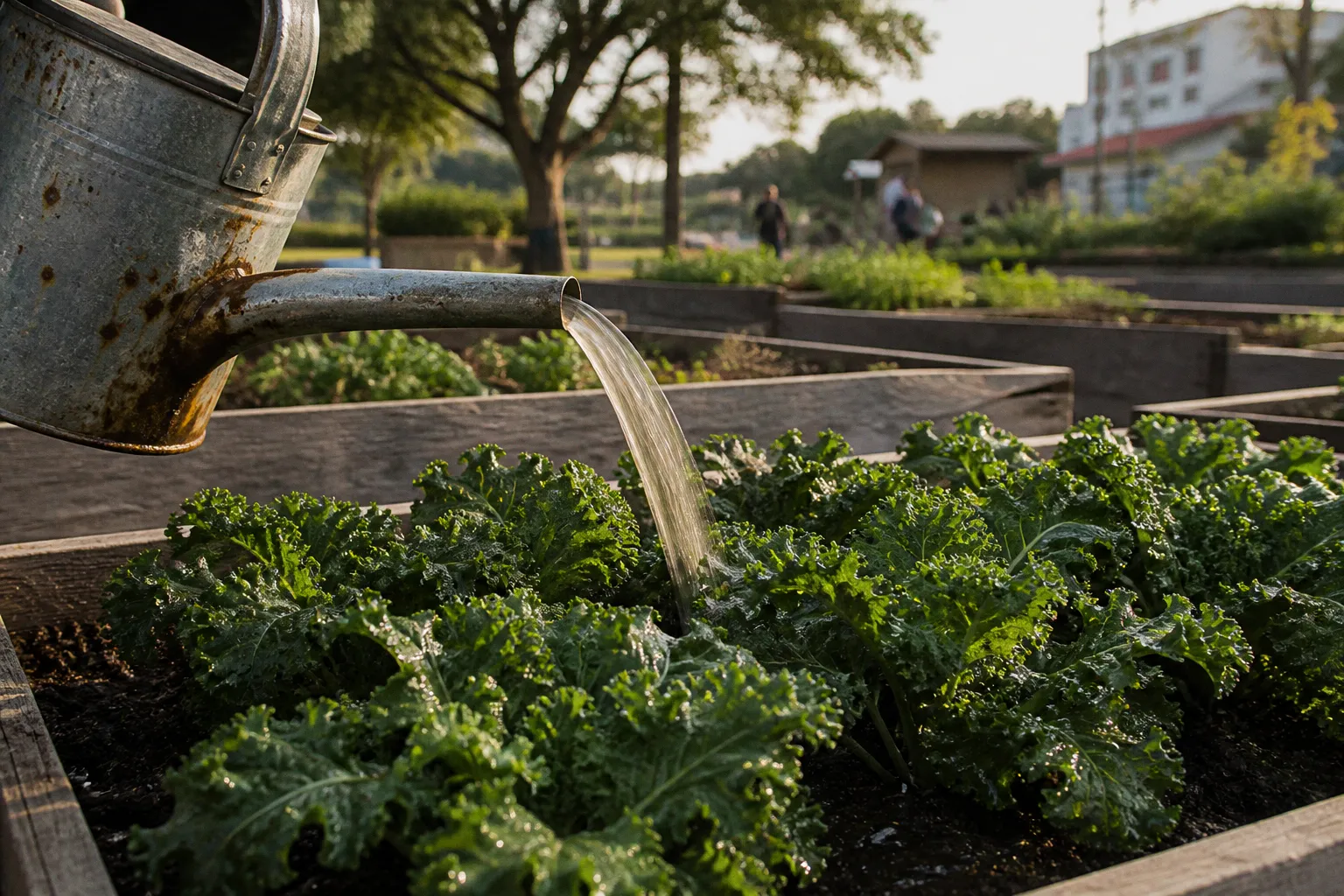
The water bucket outside the school kitchen in a small hamlet doesn't stay empty for long, and this past dry season I watched a community garden committee argue about what to do with the steady stream of rinse water from the cooking pots, the washbasins, and the laundry stones. Three teachers, two mothers, and the village panchayat representative leaned over the tomato beds and asked the question that has quietly become one of the most practical sustainability questions for any school campus greening project we help coordinate: can we use this water again? Greywater use in community gardens is one of those topics where the simple intuition — water that touched soap is still mostly water, after all — runs straight into the harder realities of microbiology, soil chemistry, and child health.
The honest answer is yes, but it is a yes that comes wrapped in real conditions. The water that flows from a kitchen sink, a shower drain, or a washing machine is not sewage, and it carries far fewer pathogens than what leaves a toilet. But it is also not the same as rain water or well water, and it changes character quickly. When we work with communities on campus greening, we frame greywater reuse as a stewardship practice rather than a shortcut — something that requires a little infrastructure, a little attention to what goes down the drain, and a clear understanding of which crops will receive that water and which absolutely should not.
The 24-Hour Rule: Why Untreated Greywater Turns Toxic
The single most important number to memorize is twenty-four. Untreated greywater — meaning anything that comes out of a household or school washbasin, bucket, or washing machine and is then held in a tank or barrel — should not sit for more than 24 hours before it is either used on the soil or sent through filtration and disinfection. This is not a cautious recommendation or a guideline that can be bent in dry weather; it is the line at which the microbiology of the water changes. Bacteria that arrive in small numbers in fresh greywater begin to multiply as soon as the water cools and oxygen levels drop, and within a day the same water that smelled faintly of soap can carry enough pathogens to create real health risk, particularly for the children who play in and around school gardens.
What this means in practice is that any greywater collection system in a community garden has to be sized to the daily output of the buildings it serves, not to a once-a-week flush. A 200-litre drum that fills from the school's washing station on Monday morning will need to be emptied onto the garden, routed through a filter, or treated with a disinfection step before Tuesday afternoon. The simplest implementation we have seen working in rural settings is a direct-flow system: the washbasin drains through a coarse filter into a small subsurface distribution trench or a mulched basin around a fruit tree, with no intermediate tank at all. When a holding tank is unavoidable, it should be opaque, covered, and fitted with a tap at the bottom so the oldest water is drawn off first.
There is also a quiet rhythm to greywater that experienced committees learn to feel. The washbasin flows heaviest in the morning and at the end of the school day, and the garden's thirst rises and falls with the sun. A system that tries to store water between those two rhythms is fighting gravity and biology at the same time. A system that pipes the greywater directly into a mulch-covered trench next to a fruit tree, by contrast, hardly needs anyone to think about it after the first week.
Targeting the Right Crops: Where Greywater Belongs and Where It Doesn't
The second hard rule is about what you plant, and this is where the conversation in any community garden committee gets specific. Greywater is safe for fruit trees, vines, mature shrubs, and established ornamentals, provided it is delivered to the root zone rather than splashed onto leaves or fruit. It is not safe — or at least not without professional-grade treatment — for leafy greens such as lettuce or spinach, or for root vegetables like carrots and potatoes, where the edible part grows in direct contact with the soil that the greywater is wetting, or is eaten raw after a wash that may not remove every trace of contamination. In a school garden, this distinction is not abstract. The children who tend the beds will eventually eat what those beds produce, and the path between a drip line and a salad is shorter than most adults remember.
A practical way to think about it: water the roots of plants you do not eat raw, and water them below the soil surface. Anything destined for the kitchen — particularly raw salads, root crops, and herbs that will not be cooked — belongs on the rain-fed or well-fed side of the garden.
| Crop type | Greywater safe? | Delivery method | Notes for the school garden |
|---|---|---|---|
| Fruit trees (mango, guava, citrus, custard apple) | Yes | Drip or subsurface | Keep water off fruit and foliage; highest-value use in dry season |
| Mature woody ornamentals (neem, pongamia, hibiscus hedge) | Yes | Drip or subsurface | Lowest-risk category; excellent for campus boundary planting |
| Vines on trellis (grape, passionfruit, ivy gourd) | Yes, with caution | Drip at base only | Avoid wetting fruit; train canes away from outflow |
| Tomatoes, brinjals, capsicum | Conditional | Strictly subsurface drip | Fruit is above ground but leaves and soil splash easily |
| Leafy greens (lettuce, spinach, coriander, mint) | No | — | Edible parts contact irrigated soil or are eaten raw |
| Root vegetables (carrot, potato, radish, beet) | No | — | Edible part grows in the wetted soil layer |
| Acid-loving ornamentals (azalea, hydrangea, gardenia, begonia) | No | — | Sensitive to greywater alkalinity and salt |
This is not a moral judgment about the plants. The shrubs and trees are simply better at handling both the chemistry and the microbial load, because their edible parts are held away from the wet soil. The tomato patch that the schoolchildren are so proud of is a useful intermediate case: the fruit is above ground, but the plants are tender and the leaves frequently get splashed. Most committees we work with end up keeping the kitchen garden on clean water and using greywater to sustain the larger landscape — the boundary trees, the herb spiral's woody perennials, the orchard behind the playing field.
Soil Chemistry and Detergents: Managing Salt and Boron Accumulation
The next layer of complexity is invisible until it isn't. Greywater tends to be alkaline, and it carries salts — primarily sodium, but also boron, chlorine residues, and the trace minerals that come off skin and food. Over months and years, these accumulate in the soil. In clay soils especially, sodium degrades soil structure: the particles disperse, water stops percolating evenly, the surface seals over after rain, and roots suffocate. The visible sign, which I have watched appear gradually in a couple of the older school gardens we visit, is a pale crust on the bed surface and stunted growth even when the watering schedule looks correct.
Treat the drain like part of the garden. The detergent in the washbasin ends up in the tomato bed within a week.
The simplest mitigation is also the most overlooked: what goes down the drain matters more than how much water you pour on the garden. Powder detergents are the worst offenders, because they are formulated with high concentrations of sodium salts to keep them free-flowing in humid climates. Liquid detergents, and especially liquid castile or plant-based formulations, carry far less sodium and rarely any boron. Boron is the more insidious of the two for gardeners, because plants have a narrow tolerance window — roughly 0.5 to 1.0 mg/l for sensitive species, 1.0 to 2.0 mg/l for moderate tolerance, and 2.0 to 10.0 mg/l for the most tolerant — and above those thresholds growth simply fails without an obvious cause.
In practical terms, when a community is setting up a greywater-fed garden, the committee chooses two or three detergents — ideally liquid, fragrance-light, low-sodium — and the households that feed into the system agree to use those. This is a small act of collective agency that turns a private purchasing decision into a shared stewardship agreement, and it is one of the moments where a greywater project quietly becomes a community project. Where boron in the water supply is already a concern — some bore wells in semi-arid regions carry natural boron — it is worth getting the well water tested before assuming the detergent is the only source.
A useful diagnostic for long-running systems is the mulch test. A two-inch layer of mulch, straw, or even stones over the discharge point accomplishes two things at once: it hides the greywater outlet from children and animals, and it buffers the soil from the alkalinity shock of a fresh application. In California's greywater code this is a literal requirement, with a two-inch cover specified by regulation, and we have borrowed the practice in our Indian school gardens because it works regardless of the legal jurisdiction. In clay-soil regions receiving less than about 20 inches of annual rainfall, periodic soil flushing with clean water is also worth building into the annual calendar, so accumulated salts do not build to toxic levels.
Safe Distribution Methods: Avoiding Aerosols and Surface Pooling
How the water reaches the soil is the third leg of the stool. Spraying, misting, or sprinkler application is strongly discouraged — and in many jurisdictions prohibited outright — because it creates aerosols. These fine droplets can drift several metres, land on playground equipment, classroom windows, vegetable beds, or directly on a child's skin, and they carry whatever the greywater carried. The risk is not only ingestion but also inhalation, particularly for younger children with developing lungs.
The safe methods are unglamorous and effective: drip irrigation laid on the soil surface, subsurface drip lines buried ten to fifteen centimetres down, or simply a mulch-covered trench that the greywater trickles into. All three keep the water below the surface and out of the air. Surface pooling is the other failure mode to avoid, because pooled greywater is a breeding ground for mosquitoes and a contact point for curious hands. After night irrigation, it is good practice to keep people and animals off the wetted area for at least eight hours, and after rain, to wait a full 48 hours before irrigating with greywater so the soil can drain without becoming anaerobic.
A short set of operational numbers has saved us rework in the field more than once:
- 24 hours — maximum safe storage time for untreated greywater
- 48 hours — minimum wait after rainfall before greywater irrigation resumes
- 8 hours — minimum exclusion period for children and animals after night watering
- 2 inches — mulch, straw, or stone cover required over discharge points
- 0.5–1.0 mg/l — boron ceiling for sensitive plant species
- 10–15 cm — burial depth for subsurface drip lines
These are not magic numbers; they are the operational envelope within which a greywater system stays on the safe side of the line. Outside the envelope, the same water becomes a liability.
Navigating Local Regulations and Environmental Compliance
The legal picture is uneven, which is the polite way of saying there is no single answer. Washington State in the United States gave its counties until July 2014 to implement formal greywater reuse rules; South Australia and other arid-zone jurisdictions publish detailed guidance through bodies like the Central Otago District Council equivalents and through resources such as GreenCape's Safe Use of Greywater booklet, which appeared in October 2017; the UC Master Gardener Program continues to update its community guidance, most recently in June 2025. India's regulatory framework is still developing across states, and most school campuses and community gardens operate in a space where good practice precedes formal rule.
What this means for a community project is that you cannot rely on a generic national standard. The responsible path is to identify the local public health authority, the district panchayat, and the state pollution control board — and to ask them, in writing, what the current expectations are. In practice, the regulators we have worked with are not obstructionist; they are often grateful that someone is asking before the system is built. A greywater proposal that shows you have thought about the 24-hour rule, the crop selection, the detergent choice, and the distribution method will usually receive a constructive response, because it removes several objections in advance.
There is a deeper point here, and it is the one I find myself returning to after each school visit. Greywater reuse is one of the few sustainability practices where the household, the garden, and the regulatory authority all have to be in the same conversation. It cannot be installed as a piece of equipment any more than a school library can be installed as a set of shelves. The water moves through the community, and so does the responsibility for it.
Building a Greywater Plan That Lasts
For a community garden committee that wants to move from conversation to action, the order of operations matters more than the size of the budget. Start with the crop plan: decide which beds will receive greywater and which will stay on clean water, and plant accordingly. Then audit the detergents in the contributing households and converge on two or three accepted products. Design the distribution system — drip, subsurface, or mulch-covered trench — and size any holding tank to a single day's output at most. Walk the plan past the local health authority before the first trench is dug. And finally, set a quarterly review where the committee checks soil condition, plant vigour, and any signs of pooling, salinity crusting, or mosquito breeding.
When all of that is in place, greywater stops being a clever idea and becomes a quietly working part of the campus ecosystem — fruit trees that survive the dry season, ornamental shrubs that frame the school entrance, vines that produce without drawing down the village well. The point is not to celebrate the technology. The point is to weave one more thread of stewardship into the life of the school, and to do it with the kind of care that lets the children who tend the garden grow up understanding that water, like any other shared resource, is something you negotiate with the people you share it with. That, more than any particular drip line, is what a community greywater system is for.