Drip irrigation vs clay pot ollas in community gardens
A well-designed drip irrigation system can achieve application efficiency of 90% or higher.
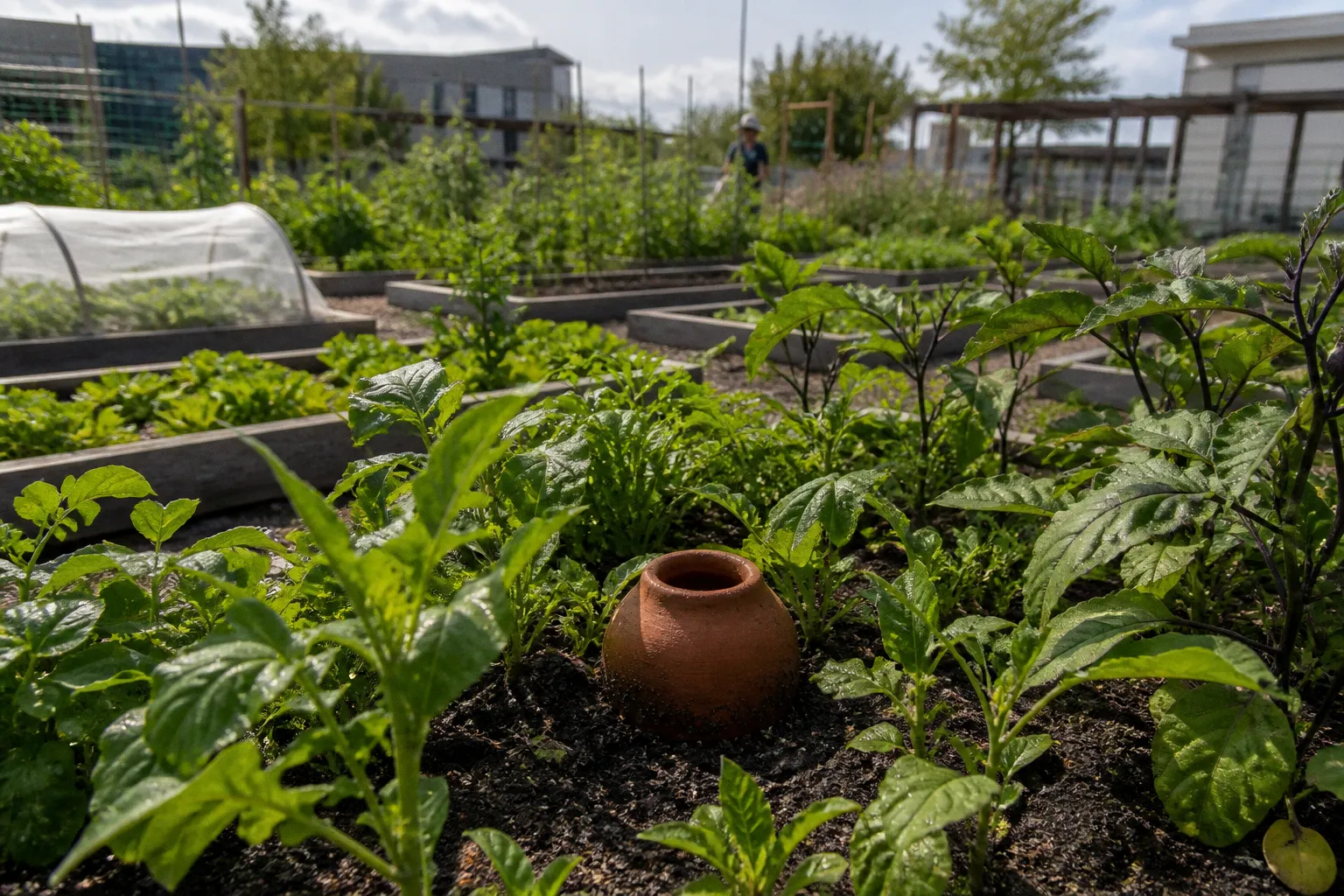
Clay pot ollas, by contrast, can reduce water use by 50–70% compared with traditional surface watering, without pressurized lines, electricity, timers, or a complex distribution network.
Compare car rental deals in United Kingdom
See available offersPartner link — DiscoverCars comparisonThat makes the choice between drip irrigation and ollas less about finding a universal winner and more about matching infrastructure to operating conditions. A community garden attached to a rural school, for example, may have irregular volunteer coverage, limited maintenance capacity, and no dependable power supply. A larger garden with multiple beds, a storage tank, and scheduled watering may gain more from automation than from individually buried pots.
The practical question is not simply which method uses less water. It is which system can deliver the required water to the required root zones, at the required scale, with a failure rate the garden team can manage.
The Mechanics of Moisture: How Ollas and Drip Systems Differ
The two systems solve the same allocation problem through different physical mechanisms.
Drip irrigation distributes water through a network of tubing and emitters. Water enters the system under pressure, passes through filtration, and exits at controlled points near the plants. Timers can regulate duration and frequency, while the layout can be divided into zones according to crop type, soil conditions, or bed elevation.
Olla irrigation uses buried, unglazed terracotta vessels. The pot is filled with water and sealed with a lid. As the surrounding soil dries, soil moisture tension draws water through the porous clay walls. The water moves directly into the root zone rather than being sprayed across the soil surface.
That difference has several operational consequences:
- Drip irrigation places water at predetermined emitter locations.
- Ollas release water according to the moisture demand of the surrounding soil.
- Drip requires a pressurized supply and functioning components.
- Ollas require suitable vessels, correct burial depth, periodic refilling, and protection from physical damage.
- Drip can serve a large number of beds through a single managed system.
- Ollas are better suited to concentrated planting zones where one vessel can serve several nearby plants.
An olla does not saturate the entire bed. Its effective wetted radius depends on soil texture, pot capacity, crop maturity, and the surrounding root structure. A typical one-gallon olla can water two to three tomato plants or four to five pepper plants within an effective wetted radius of roughly two feet, with refills commonly required every three to five days.
That operating pattern is valuable in gardens where crops are clustered and volunteers can refill vessels on a predictable schedule. It becomes less convenient when the planting plan contains long rows, widely dispersed plants, or frequent crop rotation.
Drip irrigation distributes water through infrastructure; an olla distributes water through soil demand. The distinction determines both the system’s strengths and its failure points.
Water Efficiency and Soil Health Impacts
Water efficiency is often presented as the decisive argument in a low-cost garden irrigation comparison. The metric matters, but it needs to be interpreted correctly.
A properly designed drip system can exceed 90% application efficiency because water is delivered close to the plant and losses from runoff, wind drift, and broad surface wetting are limited. This performance depends on design quality and operating conditions. Poor filtration, uneven pressure, damaged tubing, or excessive irrigation duration can reduce the practical result well below the theoretical capability of the system.
Ollas achieve efficiency through a different route. Their walls release water below the soil surface, so the system largely avoids surface evaporation. The water remains concentrated around the root zone, and the release rate slows as the soil becomes moist. Compared with traditional surface watering, olla irrigation can save between 50% and 70% of water.
The comparison therefore has three different baselines:
| Performance factor | Drip irrigation | Clay pot ollas |
|---|---|---|
| Water delivery | Controlled through emitters and tubing | Released through porous terracotta walls |
| Reported efficiency | 90% or higher for well-designed systems | 50–70% water savings versus surface watering |
| Power requirement | Usually requires pressure; timers may require electricity | No electricity or pressurized line required |
| Surface evaporation | Low when installed correctly | Very low because water is released underground |
| Best planting pattern | Rows, repeated beds, and zoned layouts | Dense clusters around individual vessels |
| Main water-loss risk | Leaks, pressure imbalance, poor scheduling, damaged lines | Oversized or poorly placed pots, exposed openings, cracked vessels |
| Disease environment | Depends on emitter placement and watering schedule | Foliage remains dry, reducing conditions associated with fungal disease |
Ollas also have a plant-health advantage in crops that respond poorly to wet foliage. By keeping leaves dry, the method can reduce plant fungal diseases by up to 80% under suitable conditions. That figure should not be treated as a universal disease-control guarantee: disease pressure still depends on crop genetics, airflow, humidity, sanitation, and planting density. The mechanism is nevertheless clear. Water delivered into the soil does not create the same leaf-wetting cycle as overhead watering.
Drip systems can also support strong soil-health outcomes. They can be calibrated to deliver frequent, moderate applications rather than occasional flooding. This reduces runoff and allows the garden team to maintain a more stable moisture profile. The system’s advantage is control; the olla’s advantage is passive response to local soil moisture.
Where each method loses efficiency
Drip irrigation loses efficiency when the system is technically sound on paper but poorly managed in the field. A timer may continue running after rainfall. An emitter at the beginning of a line may discharge more water than one at the far end if pressure is not balanced. Mineral deposits can narrow the outlet, while insects and sediment can obstruct emitters.
Ollas lose efficiency through mismatch. A small pot serving too many mature plants will empty quickly and provide uneven moisture. A large pot in a lightly planted bed may allocate more water than the crop can use. A vessel placed too far from the root zone will release water into soil that contributes little to plant uptake.
Neither method eliminates the need for observation. The difference is where the observation occurs. With drip, the garden team monitors pressure, filtration, flow, emitters, and scheduling. With ollas, it monitors vessel condition, refill intervals, soil coverage, and plant response.
Scalability and Infrastructure Requirements for Community Plots
The question of scale is where the drip irrigation vs ollas community garden debate becomes most practical.
A small school garden with several raised beds can operate effectively with ollas if the crops are planted in clusters. The system can be installed incrementally, with one or two pots added as planting density increases. This lowers the infrastructure threshold and allows the garden to remain functional even when electrical access is unavailable.
A larger community garden usually introduces more complex resource allocation problems:
1. Distance between planting areas.
Long runs and separated beds favor tubing because water can be distributed from a central source without placing a vessel beside every crop cluster.
2. Number of crops and irrigation zones.
Tomatoes, leafy greens, peppers, and seedlings do not necessarily share the same water schedule. Drip systems can divide the garden into zones, while ollas tend to operate according to the local demand around each pot.
3. Volunteer availability.
Ollas require physical refilling. That task may be manageable every few days in a compact garden, but the labor requirement grows with the number of vessels. Drip systems shift labor toward periodic inspection and scheduled repairs.
4. Water-source conditions.
Drip requires sufficient pressure and filtration. A gravity-fed or irregular source may not support reliable performance without additional equipment. Ollas can function without a pressurized line, making them more resilient in low-infrastructure settings.
5. Expansion plans.
A garden that expects to add beds, extend crop rows, or support several school programs benefits from a system designed around zones and distribution capacity. Ollas are easier to add locally but harder to coordinate as a single network.
This is not a matter of small equals ollas and large equals drip. Layout matters as much as area. A large garden composed of compact, intensively planted beds may use ollas successfully. A relatively small garden with narrow rows and dispersed crops may be easier to manage with drip lines.
Infrastructure requirements at a glance
| Requirement | Drip irrigation | Clay pot ollas |
|---|---|---|
| Water source | Pressurized supply or suitable pump | Any source that allows manual filling |
| Filtration | Required to protect emitters | Not required for the pot itself, though clean water reduces sediment |
| Electricity | Often used for timers or pumps, but not always essential | Not required |
| Installation | Tubing, connectors, emitters, valves, and possibly timers | Buried terracotta vessels and lids |
| Expansion | Efficient when planned through additional zones and lines | Straightforward for individual beds, labor-intensive at larger scale |
| Volunteer training | Focuses on system inspection and troubleshooting | Focuses on refilling, placement, and vessel protection |
| Failure visibility | May be hidden until plants show stress or a flow test identifies the problem | Usually visible through empty, cracked, or displaced pots |
For grassroots environmental projects, this distinction has a direct funding implication. A grant that pays for equipment but not maintenance capacity may produce a technically impressive drip installation with a low sustainable yield. Conversely, a low-cost olla program can fail if the project plan assumes that refilling will happen automatically.
The relevant budget is not only the purchase budget. It includes installation labor, replacement components, water access, volunteer time, training, inspection, and the management structure that keeps the system in service after the initial project launch.
Maintenance Realities: From Clogged Emitters to Terracotta Care
Maintenance is the point at which theoretical efficiency becomes field performance.
Drip irrigation contains more failure points because it contains more components. Mineral buildup can clog emitters. Insects may obstruct outlets. Tubing can be damaged by tools, animals, sunlight, or routine movement through the beds. Connections may loosen, and pressure irregularities can create uneven delivery across the same line.
These failures are not necessarily difficult to repair, but they require a defined response process. A community garden needs someone who can identify whether a dry plant is suffering from a blocked emitter, insufficient pressure, a closed valve, or a scheduling problem. Without that diagnostic capacity, the system may continue operating while quietly under-watering part of the garden.
A practical drip maintenance program should include:
- Periodic inspection of filters and flushing points.
- Visual checks for leaks, displaced tubing, and damaged connectors.
- Flow comparison between the first and last emitters on a line.
- Seasonal review of timer schedules as crop demand and weather change.
- Replacement stock for common connectors and emitters.
- A simple map showing valves, zones, and line routes.
This is a modest operational system, but it prevents a common bottleneck: the entire garden depends on equipment that no single volunteer understands.
Ollas have fewer mechanical parts and no emitter network, but they are not maintenance-free. Each vessel must be filled, covered, and checked. Terracotta can crack if struck by tools or compressed by heavy movement around the bed. The pot opening must remain accessible enough for refilling while protected from debris and contamination. Soil may settle around a vessel, altering its exposure and the area it serves.
The olla maintenance program is more manual:
- Inspect pots for visible cracks before each planting cycle.
- Confirm that lids remain in place and openings are not blocked.
- Monitor how long each vessel remains full under current weather conditions.
- Adjust planting density when crop roots extend beyond the wetted zone.
- Mark pot locations so they are not damaged during cultivation.
- Remove or protect vessels during activities that involve digging or bed reconstruction.
The key difference is failure detection. A clogged drip emitter can be hidden inside an otherwise intact system. A broken olla is usually easier to identify, but the affected plants may already be under-watered by the time the break is noticed.
The lower-maintenance system is not the one with fewer parts. It is the one whose routine matches the people, time, and skills available to the garden.
Selecting the Right System for the Garden’s Layout
A decision should begin with the garden map rather than with the irrigation product.
Count the beds, measure the distances between them, identify the crop clusters, and document the water source. Note whether the garden is managed by a stable team or by rotating volunteers. Record which tasks can be performed weekly and which depend on a specific individual being present.
The following conditions generally point toward ollas:
- Compact beds with crops planted within a concentrated radius.
- No reliable electricity or pressurized water supply.
- A team that can refill vessels on a predictable schedule.
- A preference for low-complexity infrastructure.
- Crops such as tomatoes and peppers that can be arranged around individual water sources.
- A school or community setting where the irrigation method is also part of an environmental education program.
The following conditions generally point toward drip irrigation:
- Multiple beds arranged in rows or separated zones.
- A reliable water source with adequate pressure.
- A need to irrigate many plants on a repeatable schedule.
- Limited capacity for manual refilling.
- A garden expansion plan that will add beds or increase production density.
- A team capable of maintaining filters, emitters, tubing, and timers.
A hybrid system can be more rational than a forced choice. Drip may serve long rows and perimeter beds, while ollas support demonstration plots, high-value crop clusters, or areas without convenient tubing access. This approach also distributes operational risk. If a drip zone is temporarily offline, the entire garden does not lose its only watering method; if volunteers miss one olla refill cycle, the automated zones continue operating.
A five-step selection process
1. Map the water source and pressure conditions.
If the supply cannot reliably support pressurized distribution, a drip system may require additional infrastructure before it can perform as designed. Ollas avoid that threshold.
2. Group crops by water demand and planting geometry.
Dense clusters are compatible with olla irrigation. Repeated rows with consistent spacing are easier to serve through drip lines.
3. Calculate labor as an operating resource.
Manual refilling is not free simply because it requires no electricity. Estimate who will perform it, how often, and what happens during school holidays, weekends, or volunteer turnover.
4. Define failure response before installation.
A drip system needs a person who can locate clogs and leaks. An olla system needs a refill and inspection routine. If the response plan is unclear, the infrastructure is not ready for deployment.
5. Select performance metrics that reflect the project’s purpose.
Water volume used is one metric. Add plant survival, yield, refill frequency, repair incidents, volunteer hours, and the percentage of beds receiving consistent moisture.
That final step matters for environmental awareness programs. Students and volunteers can learn more from a system that produces visible, trackable results than from a general message about conservation. A garden can record weekly water use, compare surface watering with olla performance, or document how often emitters require cleaning. The data turns irrigation into a practical sustainability lesson rather than a decorative feature.
Cost, Procurement, and Sustainable Yield
Exact installation costs vary widely according to site conditions, water access, vessel quality, pipe lengths, filtration requirements, and local procurement. A responsible project plan should avoid treating a unit price as the full cost of either system.
For drip irrigation, procurement typically covers the distribution network and its control points: tubing, emitters, filters, connectors, valves, and timers where needed. The system may also require a pump or pressure-management equipment. These components create a higher initial coordination burden, but they can support a larger number of beds once installed.
For ollas, procurement centers on durable terracotta vessels, lids, transport, installation, and replacement stock. The infrastructure is simpler, but the system’s operating model carries more recurring labor. If a garden depends on frequent manual filling, the project should measure volunteer capacity as carefully as it measures water consumption.
A useful project budget separates four categories:
- Capital allocation: equipment and installation.
- Operating allocation: water access, refilling, inspections, and routine cleaning.
- Replacement allocation: broken pots, clogged emitters, damaged tubing, and connectors.
- Measurement allocation: meters, logs, signage, training materials, or student monitoring activities.
This structure makes the environmental project more auditable. It also clarifies why the least expensive purchase is not necessarily the lowest-cost system over its useful life.
The relevant outcome is sustainable yield: the amount of reliable plant production and educational value generated by the system without exhausting water, volunteer labor, or maintenance funds. An irrigation method that saves water but fails during school breaks may have a lower practical yield than a less elegant system with dependable oversight.
A Decision Framework for Community and School Gardens
For most community gardens, the decision can be reduced to five operating questions:
1. Can the site support pressure, filtration, and basic line maintenance?
If yes, drip becomes technically viable. If no, ollas may avoid a substantial infrastructure bottleneck.
2. Are plants arranged in rows or clusters?
Rows favor drip distribution. Clusters favor the localized release pattern of ollas.
3. Who performs the recurring work?
Drip shifts effort toward inspection and repair. Ollas shift effort toward refilling and physical checks.
4. How costly is a failure?
In a teaching garden with a few beds, a failed olla may affect a small crop area. In a larger network, an unrecognized drip failure can affect an entire zone.
5. What must the project demonstrate?
If the objective is reliable production across many beds, drip may offer stronger control. If the objective includes water conservation education, low-infrastructure design, and visible soil-moisture principles, ollas may provide a clearer teaching platform.
The strongest implementation is usually the one that makes performance legible. Garden managers should be able to answer how much water was used, how often the system required attention, which beds performed best, and what failed during the season. Those metrics support future funding decisions and prevent environmental initiatives from being judged only by installation photographs.
Final Position: Match Infrastructure to Governance
Drip irrigation and clay pot ollas are not competing technologies in the abstract. They are different governance models for water.
Drip irrigation concentrates control in a network of components, schedules, and zones. It is the stronger option for larger, structured layouts where the garden can support pressure, filtration, troubleshooting, and planned expansion. Its 90% or higher application efficiency is achievable when the system is designed and maintained as an operating asset rather than installed and abandoned.
Ollas distribute control across the soil and the people who refill the vessels. They are well suited to compact crop clusters, low-infrastructure sites, and community programs that value water efficiency without electricity or pressurized lines. Their 50–70% water savings against surface watering are meaningful, and their dry-foliage delivery can reduce fungal disease pressure, but they should not be presented as a universal solution for large agricultural fields.
For rural school gardens and grassroots environmental projects, the decision should be recorded as a resource-allocation choice: assess layout, water source, labor, maintenance capability, and expansion requirements before selecting equipment. Funders and program managers should also support the less visible elements—training, spare parts, monitoring, and seasonal oversight—that determine whether the installation produces a lasting result.
The policy adjustment is straightforward: finance irrigation as a maintained service, not as a one-time object. When project budgets account for water, labor, repairs, and impact metrics together, both drip systems and ollas can contribute to resilient school campuses and community gardens. The correct system is the one that continues delivering water after the launch team has left.