Community solar projects: avoiding maintenance and budget traps
A community solar array does not fail when a panel cracks. It fails earlier, when the budget treats operations as a footnote and calls projected generation “savings.”…
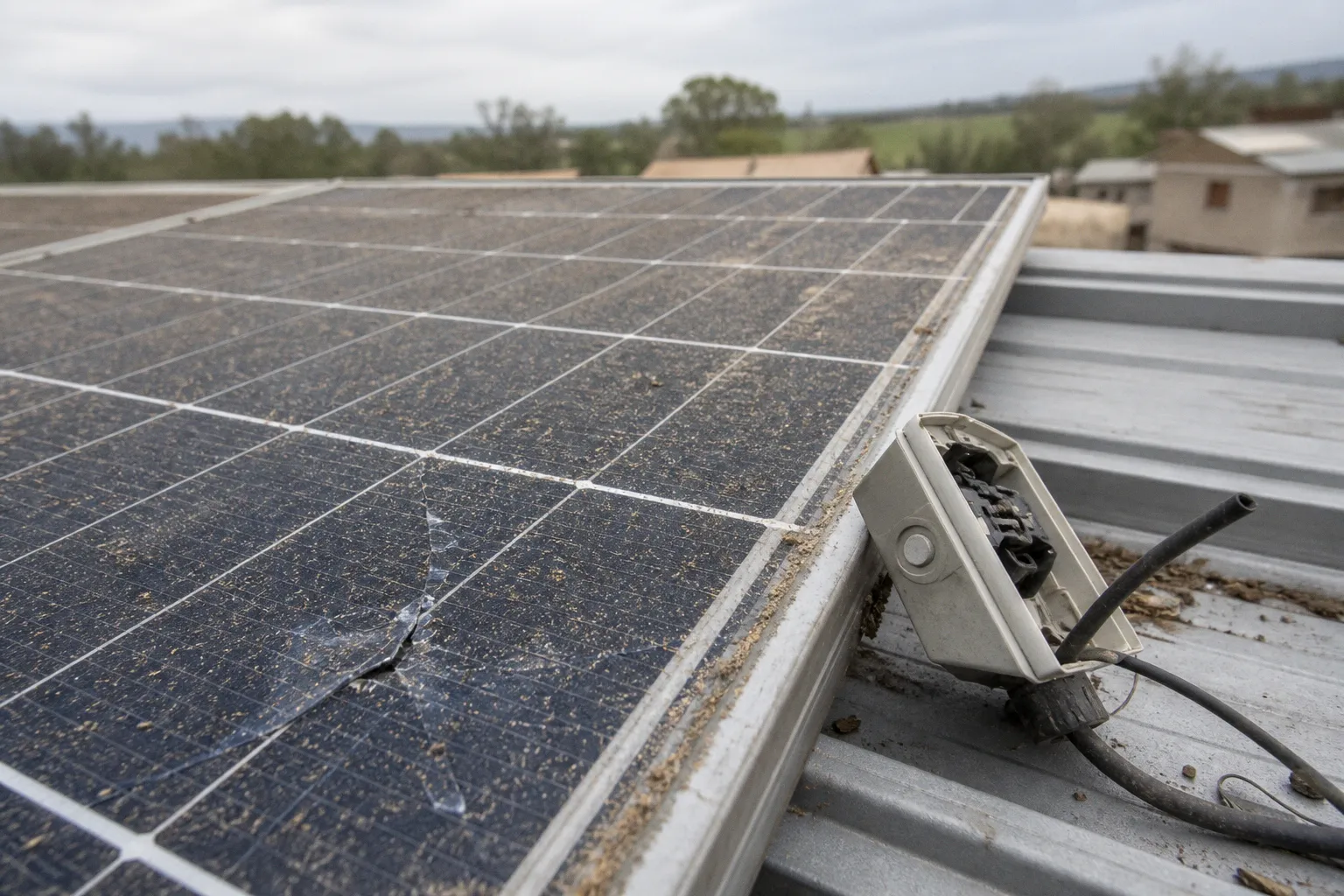
We have seen the same job-sheet error in different forms: capital money gets hauled into steel, modules, trenching, and interconnection. Then the crew leaves, the monitoring portal gets a password nobody owns, vegetation runs under the lower module edge, one inverter drops out, and the project starts billing subscribers against an output forecast that no longer matches the field.
That is where community solar project maintenance costs and efficiency traps start to bite. The panels may still look clean from the access road. The numbers do not.
For schools, community centers, and non-profit coalitions, the risk is sharper. These projects are often sold as a way to lock down community center solar energy savings without putting hardware on every roof. That can work. But subscription savings, operational performance, and the site’s maintenance burden are three separate loads. Torque them together only after each one has its own line in the budget.
Beyond installation: the O&M budget that disappears on paper
The common mistake is simple: treating solar operations and maintenance as a small annual percentage, then moving on. That is not a budget. It is a blank space with a number taped over it.
A functioning O&M plan has to cover four working lanes:
- Monitoring and diagnostics: data collection, alarm review, weather data, communications equipment, and someone assigned to act when the system flags a fault.
- Preventive work: inspections, electrical checks, vegetation control on ground mounts, hardware tightening where specified, drainage checks, and access-road maintenance.
- Corrective work: labor, travel, replacement parts, inverter faults, damaged conductors, communications failures, failed modules, and switchgear issues.
- Risk transfer and records: insurance, warranties, service contracts, as-built drawings, equipment serials, response-time commitments, and a clear escalation path.
None of this is decorative administration. It is the work that tells us whether a fault is a two-hour reset, a two-week warranty claim, or a quarter of lost generation.
For a 500 kW ground-mounted example in a federal PV O&M cost model, normal replacement of failed components represented 14% of annual maintenance cost. Insurance represented 21%. Those are not edge cases. They are major budget blocks before a severe storm, fire, or other hazard even enters the picture. That particular model did not estimate those major hazard-repair costs.
So do not pad the normal maintenance line and call it storm reserve. Keep those buckets separate. Otherwise, the first serious weather event will pull money from routine inspection and make the next fault harder to find.
The array is not “low maintenance” if nobody has funded the work that begins after commissioning.
For community groups, the operating structure also needs one named owner for each failure point. “The installer will handle it” is not a structure. The installer may hold a workmanship warranty. The inverter manufacturer may hold another warranty. The site host may control the gate. A third-party operator may own the monitoring login. The utility may need to confirm that the grid was available before availability can be calculated.
When the system goes down, we need to know who unlocks the gate, who pulls the logs, who approves the truck roll, and who pays while a warranty claim moves through its queue.
Use benchmarks as a floor marker, not a quote
NREL’s Q1 2023 benchmark for a 3 MWdc ground-mounted community solar system modeled annual PV O&M at $39.83 per kWdc-year at a minimum sustainable price and $40.51 per kWdc-year at a market price. These figures are in 2022 U.S. dollars.
They are useful. They are not your bid.
A 3 MWdc project has scale. It can spread dispatch, monitoring, insurance administration, and site management across a larger asset base. A smaller school-linked or community-backed array may carry higher per-kilowatt costs. A site with a rough access track, heavy weed growth, flood exposure, security problems, or a long drive from qualified electrical labor can carry more again.
We use a benchmark to stop people from pretending that O&M is free. Then we rebuild the number from the site outward.
| Budget line | What gets missed | What the operating plan needs |
|---|---|---|
| Monitoring | A portal subscription is assumed to equal active oversight | Named operator, alarm thresholds, daily or scheduled review, communications troubleshooting |
| Preventive maintenance | “Panels have no moving parts” becomes the whole plan | Electrical inspection scope, site access, vegetation and drainage work, documented intervals |
| Corrective repairs | Inverter or cable failures are treated as warranty-only events | Labor allowance, travel, spare-part pathway, warranty claim procedure, repair response time |
| Insurance | Premium is counted but deductibles and exclusions are ignored | Deductible reserve, hazard review, coverage boundaries, claim records |
| Subscriber administration | Billing and enrollment are folded into “outreach” | Subscription platform, payment handling, customer support, transfers, dispute process |
| Major replacement | Expensive equipment is left outside the forecast | Reserve strategy for inverters and other high-cost corrective work |
The other line that gets dropped is subscriber acquisition and administration. NREL estimated subscriber recruitment at $0.08/Wdc for its benchmark community-solar project. That is a development cost, not panel maintenance. Still, it hits the same project budget and it does not vanish when the array is energized.
If the project depends on low-income households, nonprofit partners, or a rotating base of renters, the enrollment work can be operationally hard. People move. Utility accounts change. Credits arrive late or are misunderstood. A subscriber needs help, and the field operator gets dragged into a billing problem because no one else is carrying it.
That is one of the hidden costs of solar for NGOs: the project team thinks it is funding energy infrastructure, then finds itself running a small customer-service operation with utility dependencies.
Build the budget in passes, not one lump sum
We normally break the operating budget into three passes.
1. Base run cost. Monitoring, scheduled inspection, routine site work, insurance, subscription administration, reporting, and ordinary repairs.
2. Corrective reserve. The money available for failures that do not wait for a grant cycle: inverter service, damaged wiring, communications hardware, field labor, and emergency access work.
3. Long-cycle replacement and hazard exposure. Equipment with a known service life, plus storm, flood, fire, and other losses that insurance may not fully carry.
This prevents a bad habit: using the same dollar three times. A project cannot claim that an insurance policy, an equipment warranty, and a contingency fund all cover the same inverter failure until someone reads the exclusions, deductible, labor terms, transport terms, and response time.
Storage does not bolt on for free
Adding batteries changes the operating job. It adds equipment, controls, thermal management, safety procedures, and another layer of diagnostics. It may solve a real community need. It may also turn a lean solar budget into a repair budget with a solar array attached.
In NREL’s same benchmark configuration, adding 1.8 MWdc / 7.2 MWh of energy storage to a 3 MWdc community solar project raised modeled annual O&M to $75.25 per kWdc-year at the minimum sustainable price and $76.79 per kWdc-year at the market price.
That is not a small uplift. It is nearly a different operating category.
The mistake is usually made at the planning meeting. People hear “battery backup” and picture resilience. We need to bypass that label and ask the working questions:
- What exact loads will the storage system support?
- For how long, under what solar and grid conditions?
- Who holds the battery-management-system access and control authority?
- What safety protocol applies when a fault alarm lands at night?
- Is there trained local response, or does the site wait for a distant contractor?
- What happens to the project budget when HVAC, communications, or control components fail inside the storage enclosure?
For a rural classroom network, storage may make sense if it protects a defined load: lighting, network equipment, water pumping, refrigeration, or a critical learning space. But “the school has a battery” is not an operating plan. Neither is “the community center will be resilient.”
Set the load. Set the duration. Set the response crew. Then price the work.
If storage has no dispatch rule, no service protocol, and no replacement reserve, it is a liability wearing a resilience label.
Raw output is a poor mechanic
A project produces less electricity in a cloudy month. That does not prove the array is underperforming. It proves the weather changed.
We do not diagnose a community solar system by comparing this month’s kilowatt-hours with last month’s and calling the difference “efficiency.” That method sends crews chasing weather.
The proper performance measure is the performance ratio: actual production divided by modeled production using measured solar-resource and temperature data for the same period. That comparison separates weather variation from system loss. It gives us a working basis to investigate module soiling, shading, outages, inverter clipping, communications gaps, or equipment faults.
Availability needs the same discipline. It measures the percentage of time the system is operational and capable of delivering power when both the solar resource and the grid are functioning. A grid outage is not necessarily an array outage. A missing data feed is not proof that the modules stopped producing. Sort the evidence before assigning blame.
Federal reference material indicates that a weather-corrected performance ratio of 85% and availability of 95% should be achievable. Treat these as reference points, not universal legal standards and not numbers to copy into every contract. Terrain, design, weather, curtailment, equipment mix, and local grid conditions all matter.
For systems in the 1,001–3,000 kW range, a government O&M template recommends calibration every one to two years and quarterly performance reports. That is a useful rhythm for larger community assets: check the instruments, then report against a weather-corrected model before a small loss turns into a year of thin credits.
A sound quarterly report should show more than generation. We want:
1. Actual production against weather-corrected modeled production.
2. Availability, with grid outages and planned shutdowns identified separately.
3. Open alarms, their age, and the party assigned to close them.
4. Corrective work completed, with cost and downtime.
5. Vegetation, drainage, fencing, and access-road conditions for ground mounts.
6. Forecast impact from module age and known equipment limits.
Module degradation is often around 0.5% per year. That is normal aging, not a scandal. But subscription-credit forecasts that assume flat annual output are built on a bad premise. The loss may look minor in year one. It compounds across a contract term.
This is where solar installation mistakes for community buildings often begin even before the project starts operating: a promoter models perfect annual output, a nonprofit expects a fixed bill reduction, and nobody shows how weather, degradation, billing cycles, and outages move the final credit.
A subscription is not the same thing as savings
Community solar is often presented as solar panel leasing for non-profits. The comparison is close enough to start a conversation and loose enough to cause trouble.
In a standard community solar structure, subscribers make a monthly payment for a share of project output and receive a utility-bill credit tied to that output. The value of the deal depends on the credit formula, utility rules, project generation, payment terms, fees, and the subscriber’s own bill. It does not depend only on whether the panels are producing.
A fixed monthly subscription can make budgeting easier. It can also become a premium if bill credits fall short of the payment. A floating payment can be designed to guarantee savings, but it is harder to explain, harder to audit, and easier to mishandle if the formula is buried in a contract.
For a nonprofit that needs predictable operating expenses, we would rather see the payment mechanics written in plain terms than accept a glossy claim about “guaranteed green power.”
The U.S. Department of Energy identifies several subscriber-protection practices that deserve to be treated as field requirements even where they are not mandated:
- clear upfront disclosure of payment terms and expected bill-credit mechanics;
- no sign-up fee or exit fee;
- month-to-month terms where possible;
- transferability within the utility territory;
- an accessible complaint process;
- a credible path to household savings, with at least 20% identified by DOE as a best-practice threshold in relevant programs.
That 20% figure is not a nationwide rule. Do not sell it as one. The same applies to upfront fees: surveyed community-solar programs have reported fees ranging from $75 to $325, but a range is not a justification. For a mission-led project, the cleaner move is to strip out entry and exit charges unless there is a hard operating reason they must exist.
The other contract point is renewable-energy claims. Subscribers do not automatically own renewable-energy certificates or other environmental attributes just because their bill carries a solar credit. If a school or NGO wants to report climate claims, the contract must say who holds those rights. No assumption. No marketing shortcut.
Keep the route open after commissioning
The real test of a community solar project comes six months after the ribbon-cutting, when the contractor is gone, the rainy season has changed the site, and a subscriber asks why the utility credit does not match the pitch deck.
At that point, we need documents, reserves, and authority. Not optimism.
Before the project starts taking subscriptions, the operating team should be able to put its hands on:
- the final system design, equipment list, warranty files, and commissioning records;
- a live monitoring login controlled by the project owner or a contractually accountable operator;
- a weather-corrected production model and a degradation assumption;
- service-level terms that state response times, not vague “support” language;
- insurance details, deductibles, exclusions, and a major-repair reserve;
- a subscriber agreement that shows payment, bill credit, transfer, cancellation, and complaint terms in plain language;
- written ownership of renewable-energy certificates and environmental claims.
If one of those pieces is missing, do not paper over it with a larger savings forecast. Stop. Get the document. Fund the line. Assign the person.
Community solar can carry real value for rural schools, community facilities, and households that cannot host rooftop systems. But the work is not finished when modules are bolted to racking. We still have to monitor, mow, inspect, repair, insure, reconcile credits, and explain the numbers without hiding the friction.
That is the route. Keep it funded, keep it documented, and do not promise savings that the operating plan cannot haul.