Tribal ecotourism: planning traps that waste funding
The most expensive mistake in a tribal ecotourism venture is often made before the first visitor arrives.
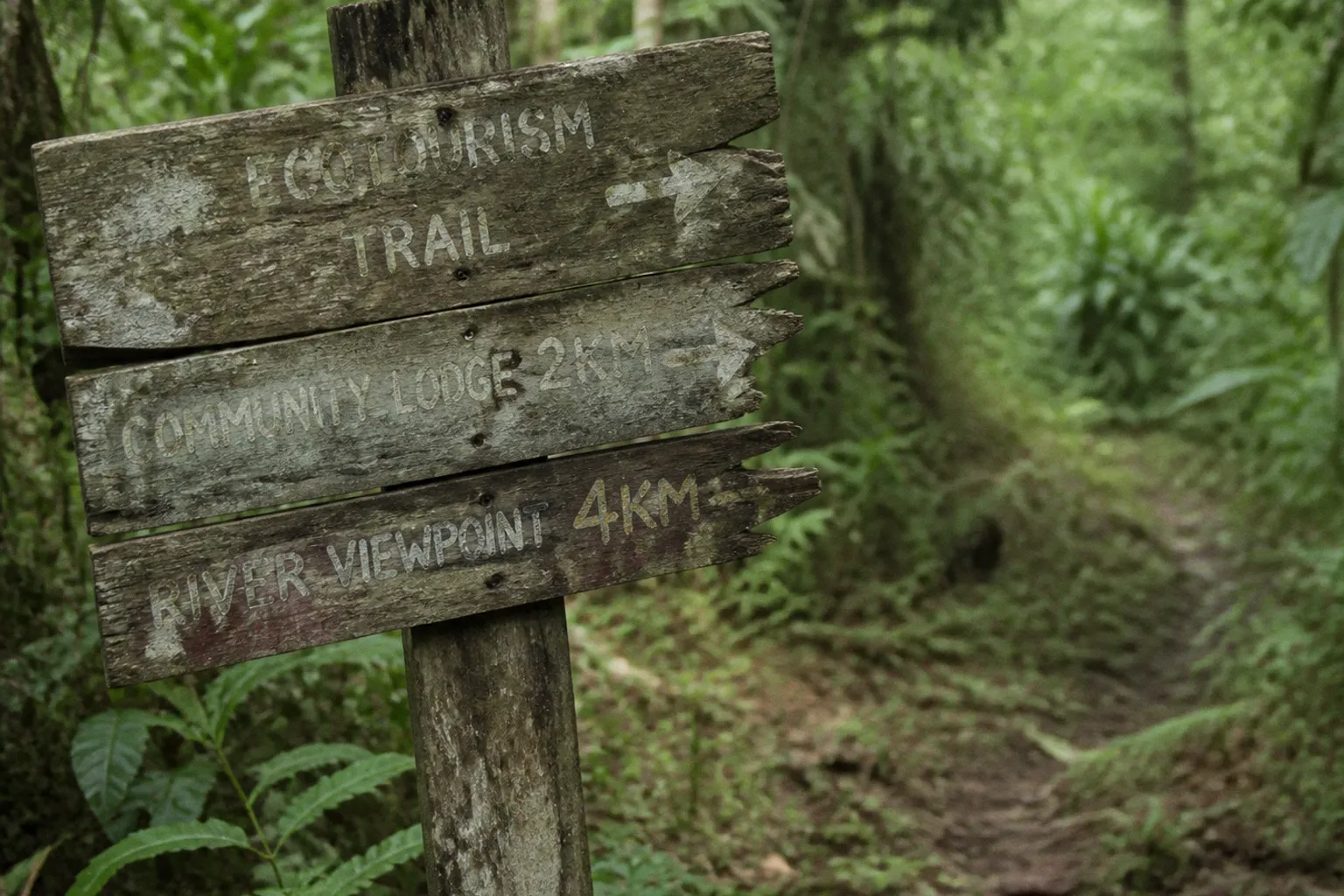
Funding is committed to buildings, vehicles, branding, and launch events, while the less visible systems that keep a project alive — access, maintenance, bookkeeping, governance, waste management, and land rights — are left for later.
Later is where these projects usually break.
An eco-lodge can look complete and still be commercially stranded. A trail can be opened without anyone being responsible for repairs. A community can be named as the beneficiary while an outside operator controls bookings, transport, procurement, and the visitor relationship. The result is a project that appears successful in photographs but produces little durable income locally.
That is the pattern behind many tribal ecotourism venture planning mistakes. The failure is rarely one dramatic error. It is usually a chain of ordinary decisions that quietly move control and value away from the community.
The practical question is not whether a project can attract visitors. It is whether the community can own, operate, maintain, and govern the enterprise after the donor-funded construction phase is over.
The Hidden Costs of Infrastructure-First Planning
The first trap is the most obvious and still the most common: treating construction as the project rather than as one component of it.
A proposal arrives with architectural drawings, a site layout, perhaps even a polished visualisation of cabins among the trees. The budget is easy to present. Buildings are visible. A new lodge photographs well. A completed structure gives donors and officials something to inaugurate.
Then the project meets the road.
In remote or protected areas, basic infrastructure is not a supporting detail. It determines whether the enterprise can function at all. A road that becomes unusable during the wet season affects guests, food deliveries, medical access, waste removal, and staff attendance. An unreliable power supply affects refrigeration, communications, lighting, water pumping, and digital payments. Poor sanitation places the community’s water sources at risk. Weak mobile connectivity can make bookings and emergency coordination unnecessarily difficult.
These systems also create recurring costs. A solar installation needs battery replacement, technical support, and a clear maintenance budget. A road needs drainage and periodic repair, not just an opening ceremony. A wastewater system needs an operator who understands what to inspect and what to do when it fails. If the proposal does not identify those responsibilities, it has not solved the infrastructure problem. It has merely moved it into the operating phase.
The sequencing should be reversed. Before finalising a building design, the planning team needs to establish:
1. How people and supplies will reach the site.
The assessment should cover seasonal access, vehicle limitations, emergency evacuation, and the cost of keeping the route usable. “Accessible” is not a sufficient description. A site may be reachable by a four-wheel-drive vehicle in dry weather and effectively isolated for part of the year.
2. How power will be supplied and repaired.
The plan should name the system, its expected demand, the person or contractor responsible for maintenance, and the source of replacement parts. “The community will maintain it” is not an operating arrangement unless the community has the training, tools, time, and money to do so.
3. How water and wastewater will be managed.
Visitor numbers change the load on wells, springs, toilets, washing areas, and drainage. The design must account for peak use rather than the average week. Greywater and sewage cannot be treated as an afterthought in a watershed where local households depend on the same water system.
4. How the site will communicate with the market and with emergency services.
A booking channel, payment process, visitor information system, and emergency contact procedure should exist before the first marketing campaign. Digital access is not a luxury when the project depends on advance reservations and remote travel.
5. Who will maintain every asset.
A community building, trail, bridge, vehicle, or solar unit should have a named custodian, a maintenance schedule, and a budget line. If nobody owns the task, the asset will deteriorate regardless of how much was spent on construction.
A useful test is to remove the donor-funded capital from the proposal and ask what remains. Can the community still pay for repairs, utilities, accounting, insurance, cleaning, transport, and basic administration? If the answer is no, the project may be a construction grant disguised as an enterprise.
A building is not an ecotourism business. It is only the part of the business that is easiest to photograph.
Infrastructure-first planning also distorts community participation. Once a design and contractor have been selected, consultation becomes ceremonial. Residents are asked to approve a plan that has already been decided, rather than to shape the operating model. That is one reason participation can remain shallow even when a project is formally described as community-based.
The community should be involved before the site, scale, facilities, and visitor model are locked. It needs to decide what kind of tourism is acceptable, which areas are off-limits, which cultural practices are not for sale, and what work it is prepared to take on. Those decisions are not obstacles to development. They are part of the feasibility study.
Navigating the Three Channels of Economic Leakage
A project can be physically located in a tribal community and still deliver very little economic value to it. Tourism revenue leaves through several channels, some visible in the accounts and some hidden in the way the project is organised.
External leakage
External leakage occurs when visitor spending is captured by businesses outside the community. The booking platform may be controlled elsewhere. Transport may be supplied by a city-based operator. Food, furniture, building materials, guides, and maintenance services may all be sourced from outside the region even when local alternatives exist.
This is not always avoidable. Remote projects may need specialist suppliers, outside insurance, or transport links that local businesses cannot yet provide. The problem begins when external procurement is treated as the default and no plan exists to build local alternatives.
The budget should show which goods and services can be supplied locally now, which could be supplied locally after training or investment, and which must remain external for safety or technical reasons. That distinction is more useful than a broad promise to “maximise local benefits.”
Internal leakage
Internal leakage occurs within the community. Revenue arrives locally but is controlled by one household, one office-holder, one cooperative faction, or one person who has the strongest relationship with the outside operator.
The symptoms are familiar: the same family provides the rooms, guides the visitors, controls the cash collection, and speaks for the project in negotiations. Other households may be invited to participate, but they do not have a defined route to income or decision-making power.
This is not solved by using the word “cooperative” in a proposal. The institution needs written rules covering membership, voting rights, procurement, employment, use of communal assets, and distribution of surplus. Financial authority should not rest with one person. Nor should community meetings be the only place where decisions are recorded.
A transparent account structure matters because people are more likely to accept unequal earnings when the reason is visible and agreed. One household may provide accommodation; another may supply food; another may guide visitors or maintain trails. The payment method can vary, but the basis for payment must be clear.
Invisible leakage
Invisible leakage is harder to identify because it is often described as expertise, coordination, or capacity building. It includes repeated consultancy assignments with no transfer of responsibility, training that produces certificates but not usable skills, marketing costs that generate attention but no bookings, and workshops held far from the people expected to operate the project.
The issue is not that consultants or outside partners are never needed. Specialist support can be valuable, particularly for engineering, legal work, accounting, safety, market research, and environmental assessment. The question is what the community owns after the consultant leaves.
Every external assignment should have a defined output and a handover plan. A financial consultant should leave behind a working accounting process that a named local person can use. A marketing adviser should train someone to update the booking information and respond to enquiries. A technical contractor should provide maintenance instructions, spare-parts information, and a realistic service arrangement.
The following table is a more useful starting point than a generic local-benefit statement:
| Leakage channel | How it appears | Planning response |
|---|---|---|
| External | Outside operators control bookings, transport, procurement, or visitor spending | Map the value chain and identify which functions can be locally owned or transferred over time |
| Internal | Revenue and authority concentrate in one household, office, or faction | Record membership, voting, payment, procurement, and disclosure rules before operations begin |
| Invisible | Consultancy, training, and promotion consume funds without building local control | Tie external support to practical handover, measurable outputs, and a declining dependency on outside management |
The goal is not to keep every rupee inside the village at any cost. The goal is to know where money goes, why it goes there, and whether the arrangement increases or reduces community control over time. A budget without that map is a leakage plan.
Addressing the Fifteen Operational Barriers to Local Capacity
Community-based ecotourism research and field experience point to a recurring group of operational barriers. They are often discussed as “capacity gaps,” a phrase so broad that it becomes useless. The barriers are easier to manage when separated into four working clusters.
The first cluster contains four capital and financial planning barriers: inadequate startup capital, the absence of a workable business model, weak financial planning, and no contingency reserve. A project may have enough money to build and still lack the money required to open, staff, maintain, and repair the site.
A business model should answer basic questions in plain language. What will visitors pay for? Which activities are seasonal? Which costs rise with every additional guest? What happens when occupancy is low? How much income must be retained for maintenance before any surplus is distributed?
A community institution does not need to imitate a large hotel company. It does need a reliable system for recording income and expenses, approving payments, storing receipts, reviewing cash balances, and reporting results to members. If those tasks are beyond the current capacity of the cooperative, the project should fund a part-time bookkeeper or establish a supported accounting arrangement before opening. Training is useful, but the books still need to be kept every month.
The second cluster contains four skills and knowledge barriers: limited hospitality skills, weak business-management knowledge, inadequate marketing capability, and insufficient guiding expertise. A family that knows the landscape well may still need help with reservations, food safety, guest communication, pricing, complaints, and emergency procedures. Cultural knowledge and commercial hospitality are related, but they are not interchangeable.
Training should follow the actual operating calendar. Staff need practice with check-in, cleaning, cooking, guiding, first response, payment records, and guest feedback. They also need follow-up support after the initial course. A certificate at the end of a workshop proves attendance; it does not prove that the service can be delivered safely and consistently.
The third cluster contains four governance and institutional barriers: no formal community organisation, unclear decision-making, disputes over roles, and the absence of a conflict-resolution process. These problems surface quickly when several households share a project but have different expectations about work and income.
The operating agreement should cover issues that development proposals often avoid:
- Who can join the enterprise and under what conditions?
- Who can sign contracts or authorise spending?
- How are paid roles allocated?
- How are absences, poor performance, or misconduct handled?
- How can a household challenge a decision?
- What happens when a leader’s term ends?
- How are financial statements shared with members?
Writing these rules does not eliminate conflict. It makes conflict manageable. Without them, every disagreement becomes a dispute about authority.
The fourth cluster contains three market and demand barriers: overestimating visitor demand, failing to identify target visitors, and lacking a clear distinction from competing destinations. The original list is sometimes described as fifteen separate challenges, but the barriers are more accurately counted here as fifteen when the business-model and financial-planning issues are treated as a linked planning problem rather than two unrelated failures.
Demand forecasts deserve particular suspicion when they are built from aspiration. A remote site may have extraordinary ecological or cultural value and still struggle to attract enough visitors during the first operating seasons. Travel time, road conditions, safety perceptions, price, weather, language, and booking convenience all influence demand.
A credible forecast should compare the project with destinations that have similar access conditions and visitor profiles. It should distinguish between interest expressed during a consultation and a paid reservation. It should also show what happens if the optimistic case does not materialise.
The sensible response to uncertainty is staged operation. Open a manageable number of facilities, test the visitor route, learn which activities people actually book, and expand only when the community can maintain quality and environmental safeguards. Cutting a forecast on paper is not enough if the project still builds and staffs itself for the original fantasy.
Mitigating Environmental Risks from Rapid Scaling
The environmental failure usually begins after the project receives its first positive attention.
Visitor numbers rise, the implementing organisation wants visible results, and the project treats growth as proof that the model is working. More beds are added. More vehicles arrive. More meals are prepared. More groups use the same trails and water sources. The waste system, staffing plan, and visitor rules remain unchanged.
That is not scaling. It is overloading.
In forested and riparian areas, the consequences can move quickly through the local water system. Untreated sewage, poorly managed greywater, fuel spills, plastic waste, and unmanaged food refuse affect not only wildlife and visitors but also residents who depend on nearby water sources. The destination’s ecological quality is the asset being sold. Once that quality declines, the enterprise loses both its environmental purpose and its market appeal.
Environmental safeguards are often labelled as a later phase because they are less visible than a lodge. That is a planning error. The toilet, drainage channel, waste collection system, water-monitoring procedure, and visitor code of conduct need to be operational before expansion, not added after the site has exceeded its capacity.
A practical environmental operating plan should identify:
- the maximum visitor load for each trail, campsite, water point, and accommodation area;
- how wastewater is treated, inspected, and repaired;
- where solid waste is sorted, stored, transported, and finally disposed of;
- who records water quality concerns and who has authority to suspend operations;
- which seasons require lower visitor numbers or temporary closure;
- how wildlife disturbance, noise, firewood use, and vehicle movement are controlled;
- how complaints from residents are received and acted upon.
The word “capacity” must refer to more than beds. It includes the ability to collect waste, clean facilities, protect water, guide visitors, repair paths, and enforce rules. A site that can sleep more guests than it can safely manage is not more successful. It is borrowing against its own ecological base.
A responsible expansion decision should therefore be based on evidence from operations: maintenance records, water observations, waste volumes, incident reports, community feedback, and financial results. If those records do not exist, the project is not ready to scale. Growth without information is simply a faster way to discover failure.
Securing Land Tenure and Fair Benefit Distribution
Land tenure is often treated as a legal formality at the end of project preparation. It should be addressed at the beginning.
A community may have long-standing customary rights and still face uncertainty over the authority to build, lease, operate, or restrict access. A government permission may allow an activity without granting durable control over the land. A boundary may be understood locally but not recorded in the project documents. Several households may rely on the same area under different customary arrangements.
These uncertainties affect more than investor confidence. They shape whether residents are willing to contribute labour, whether the project can obtain insurance or permits, and whether the community can retain the assets if an implementing organisation withdraws.
Due diligence should establish:
- who holds the relevant rights to the land;
- which institution is authorised to sign on behalf of the community;
- whether households or neighbouring communities have overlapping claims;
- whether the proposed use is compatible with forest, conservation, cultural-heritage, and local-government rules;
- what permissions are temporary and what rights are durable;
- what happens to buildings, equipment, and improvements if the project closes.
The community should not sign a revenue-sharing agreement simply because a recognised leader presents it as settled. Authority needs to be demonstrated through the community’s own decision-making process, with attendance, objections, resolutions, and signatures recorded in a form members can understand.
Benefit distribution must also go beyond a promise that “the village will benefit.” The agreement should distinguish between wages for work, payments for the use of land or cultural assets, reimbursement of operating expenses, contributions to a community fund, and distribution of any surplus. Mixing these categories creates confusion and makes it difficult to see who is being paid for labour and who is receiving a share as a rights-holder.
The agreement should specify how revenue is calculated. Gross receipts, net operating income, and distributable surplus are not the same thing. If the document does not define which figure is being shared, a dispute is already built into the contract.
It should also include:
- a public process for approving budgets and major purchases;
- a reserve for maintenance and unexpected repairs;
- regular financial reporting to member households;
- a complaint and appeal mechanism;
- rules for changing the agreement;
- a clear reversion clause for assets if the project ends.
Without documented land rights and an agreed distribution system, a tribal ecotourism project can become a land transfer wrapped in development language.
The strongest agreements are not necessarily the longest. They are the ones that answer practical questions before money, visitors, and political pressure enter the picture. Who decides? Who earns? Who carries the risk? Who owns the asset when the grant period is over?
Before the Ground Is Broken
The final decision should not be framed as a choice between optimism and opposition. A community may want tourism and still reject a particular site, scale, partner, or contract. A donor may be willing to fund construction and still need to fund accounting, maintenance, training, legal due diligence, and environmental monitoring.
Before construction begins, the project team should be able to show a connected operating plan rather than a stack of separate documents. The road assessment should match the visitor forecast. The visitor forecast should match the water and waste systems. The staffing plan should match the expected service. The financial model should include maintenance. The land agreement should match the institution that will receive the revenue. The governance rules should match the people who are expected to work in the enterprise.
If those pieces do not align, more funding will not repair the design. It will only make the eventual failure more expensive.
The most reliable tribal ecotourism projects are not the ones with the largest buildings or the most ambitious opening targets. They are the ones that make control visible. The community knows who can sign, who can spend, who must report, who can challenge a decision, and who is responsible when a toilet blocks, a road washes out, a booking is cancelled, or a visitor breaks the rules.
That is the less glamorous work of ecotourism planning. It does not produce the best launch photograph. It does produce a better chance that the project will still belong to the community when the photographers have left.