Community food pantry: a roadmap from vision to first visitor
Three weeks before opening day, we walked into the converted garage with a clipboard, a tape measure, and a calibrated thermometer. The chest freezer was cycling at 18°F. The upright refrigerator held a flatscreen TV someone's uncle had donated.
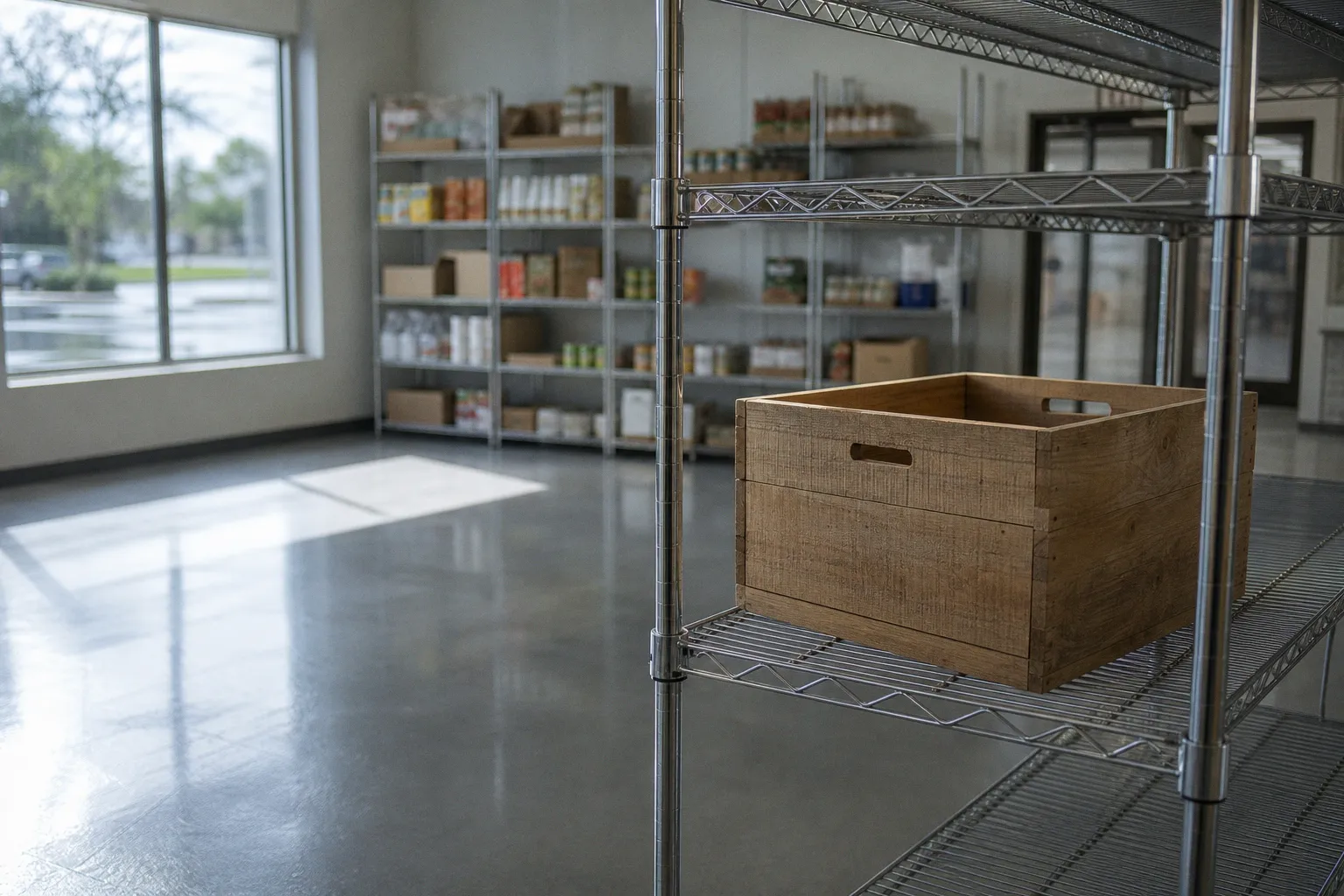
The concrete floor sloped toward a street drain that fed directly into the alley. We unlocked the door, ran the numbers, and decided this was not going to be a pantry. Not yet.
That first walkthrough is where most pantry projects stall. The vision is solid. The volunteer roster is half-built. The donations are trickling in. Then somebody asks who is actually eligible to receive food, and the room goes quiet. What follows is the operational scaffolding: cold-chain integrity, state-level compliance, partnership paperwork, and a volunteer schedule that does not collapse when the lead coordinator catches the flu. This is the work. It is unglamorous, and it is the difference between a ribbon-cutting and a real distribution.
Mapping Local Service Gaps and Partnership Requirements
Before a single can is shelved, the route has to be plotted. We start with a service-area map and a list of every existing distribution point within a defined radius. Feeding America's partner-agency recruitment guide flags this as the first move: do not duplicate what is already working. Lay down a grid, mark the zip codes, and overlay the current pantry sites, mobile routes, and meal programs. If a household already has a 15-minute walk to a functioning pantry, your project is not a priority. If the map shows a 45-minute drive across two counties with no reliable public transit, you have your gap.
The mapping exercise takes a Saturday and a stack of printed census-tract overlays. Pull the American Community Survey data for your proposed service area — household income distribution, vehicle access, and SNAP participation rates are the three numbers that tell you whether the gap is real. Then call every church, school, and community center within the radius. Ask what they already distribute, on what schedule, and what they cannot meet. The five cold calls you make before launch will save you three re-launches after.
Once the gap is documented, the next decision is the operational model. Three options dominate:
- Independent 501(c)(3) — full autonomy, full administrative load. Tax-exempt status, a board, annual filings, and a separate operating budget. This is the longest road and the most paperwork.
- Fiscal sponsorship — operate under an existing nonprofit's umbrella. Faster launch, lower overhead, but you answer to the sponsor's reporting requirements and brand.
- Food-bank partner agency — the most common route. The regional food bank handles sourcing, sometimes subsidizes refrigeration, and grants you access to TEFAP (The Emergency Food Assistance Program) and bulk rescue product. In exchange, you meet their screening criteria, which typically include tax-exempt or legitimate religious status, sustained distribution for 3–6 months, on-site refrigeration for perishables, food-safety certification or equivalent, and the number of households you intend to serve.
The third option is the one most grassroots launches should anchor on. It clears the cold-chain question, the liability question, and the sourcing question in a single move. The trade-off is the screening process. Be prepared for a pre-approval site visit. The food bank will inspect your storage capacity, your refrigeration, your volunteer roster, and your operating history. If you have none of the above, build a coalition with a church or community center that already does, and launch as a satellite.
If the food-bank route closes — and it does, in saturated markets — fiscal sponsorship buys you six to eighteen months of operating runway while you file for independent status. Do not skip the partnership phase entirely. Pantries that try to source exclusively from grocery rescue and direct donations hit a wall at month four, when the donors realize you are not a 501(c)(3) and route their product elsewhere.
Navigating TEFAP Eligibility and State-Specific Compliance
This is where the paperwork multiplies. TEFAP is a federal program, but it is administered by the states, and the states hand the distribution to local agencies — usually food banks, which then work through partner pantries. If your pantry wants to distribute USDA Foods, you must contact your state distributing agency and apply to become a TEFAP local agency. There is no shortcut.
The eligibility rules are non-negotiable. For household distributions, each state must set a uniform statewide income standard between 185% and 300% of the federal poverty guidelines. The exact threshold depends on the state. What the pantry cannot do is add its own layer on top of the state standard. No extra income test. No veteran status carve-out. No proof-of-ID requirement that goes beyond what the state mandates. The uniform rule applies to every household that walks through the door.
Here is the operational reality in table form:
| Compliance Element | Federal Rule | State/Pantry Discretion |
|---|---|---|
| Income eligibility ceiling | 185%–300% of federal poverty guidelines | State sets the exact figure within the band |
| Additional eligibility criteria | None allowed for TEFAP foods | Pantry cannot add income tests, ID, or residency rules |
| Distribution frequency | No federal minimum or maximum | State tailors frequency to local emergency-feeding system |
| Frequency per individual | No federal cap per month | State or pantry may set practical limits |
| Required records | Accurate household-served records | List of households or signature on receipt per distribution |
Frequency is flexible. USDA does not set a hard ceiling on how many times a household can receive TEFAP foods in a month. States and pantries build their own schedules around demand and inventory. That gives you room to scale, but it also means every distribution must be tracked accurately. The recordkeeping requirement is the audit trail that protects your operating agreement.
The intake conversation matters. The pantry applies whatever eligibility and documentation procedures the state distributing agency requires — self-declared income on a household list, a signature on a receipt, residency attestation, whatever the state's TEFAP plan specifies. The pantry's job is to administer those procedures faithfully, not to construct new ones. A volunteer who asks for an extra document the state does not require has just created a barrier that a federal program was specifically designed to remove. Document the state's exact intake procedure during onboarding, train to that procedure, and stop there.
One warning: TEFAP participation is not automatic. The state distributing agency selects the local agencies. If your state is saturated or your pantry fails to meet the state's criteria, you may operate without TEFAP access and source exclusively through food-bank rescue and donations. That is a workable model, but it changes the budget and the supply chain.
Establishing Cold-Chain Integrity and Storage Standards
The freezer at 18°F was the failure that killed the first launch. Cold-chain integrity is not optional. It is the structural backbone of any pantry that handles perishables, and it is the first thing a food-bank partner inspector will check.
USDA food-safety guidance is the baseline. Two numbers anchor the entire system:
- Refrigerated storage: 40°F (4.4°C) or below.
- Frozen storage: 0°F (-18°C) or below.
Every refrigerator and freezer on site needs an appliance thermometer. Calibrate them before opening day. The cheap dial thermometers drift within weeks; the digital probe models hold calibration longer and are worth the extra dollars per unit. Log the temperature twice a day — once at the start of the shift, once at the end. The danger zone is 40°F to 140°F. Bacteria multiply rapidly across that range. If the temperature drifts, the product is at risk, and the inspection trail begins: what drifted, when, for how long, and what was discarded.
For perishables left out during distribution, the rule is two hours at room temperature, one hour if the ambient temperature is above 90°F (32.2°C). Anything past that window goes in the trash. This is not a judgment call. It is a hard discard line. On a hot July distribution day the ice cream starts to slump within forty minutes; the floor lead pulls it back into the cooler at minute thirty and writes a note in the log.
Shelf-stable storage has its own tolerances. Canned goods belong in a cool, dry area, ideally below 85°F (29.4°C). Bulging, rusted, leaking, or deeply dented cans are rejected on intake. Set up a receiving station at the door with a flashlight and a checklist. Train every volunteer to inspect donations before they touch the shelf. A can of beans that looks fine on the outside can be compromised on the seam, and a single bad can contaminates the case. Date-mark every perishable that arrives; if the use-by date is within seventy-two hours, flag it for first-out distribution.
Build the storage layout before the first delivery. Designate zones:
- Dry storage (canned, boxed, shelf-stable) — pallets off the concrete floor, six inches of clearance from the walls, no direct sunlight. Concrete sweats in summer; the bottom row of pallets is where cans quietly rust.
- Refrigerated storage — dairy, produce, prepared foods. Thermometer visible from the door. Wire shelving, not solid, so cold air circulates and the floor lead can see the drain pan.
- Frozen storage — meat, frozen vegetables, prepared meals. Chest freezer preferred for volume; upright freezer for organization. A weekly inventory walk is faster on an upright, even if the chest holds more.
- Allergen and dietary separation — gluten-free, halal, kosher, baby formula. Keep these physically separated and clearly labeled. A mixed shelf is how a celiac household ends up in the ER.
The physical plant determines your capacity. Measure the floor square footage. Calculate the cubic footage of your refrigeration. Divide by the average household size you intend to serve. That number is your realistic throughput per distribution. Anything beyond it is a bottleneck — and bottlenecks are where dignity erodes, because they are where the line forms out the door in the rain.
Operational Continuity and Volunteer Management Strategies
A pantry that depends on a single coordinator is a pantry that closes when that person gets sick. The Feeding America guide is blunt on this: identify at least one backup person who can keep the operation running if the lead volunteer or staff member is unavailable. Build the bench before you need it.
Volunteer structure runs on three tiers:
1. Lead coordinator — scheduling, partner liaison, compliance. One primary, one secondary. Both trained on the same SOPs.
2. Floor leads — intake, distribution, temperature logging. One per shift, minimum.
3. General volunteers — sorting, packing, carrying, driving. Recruited from the community, vetted, and trained on food safety before their first shift.
The lead coordinator's job is half operational, half political. They run the morning shift, file the monthly report, and answer the food bank's emails within forty-eight hours. The secondary coordinator shadows for the first sixty days, then takes one shift per week independently so the bench depth is real, not theoretical.
Recruitment should target the service area. Post at the library, the school, the church bulletin, the local small business. Ask the food bank for volunteer referrals. Screen for reliability, not enthusiasm. A volunteer who shows up ten times in a row is worth more than fifty who sign up and ghost. Ask for a two-shift-per-month commitment during the interview — anyone who flinches at that line is not going to make it through distribution day in February.
Training is short and documented. Every volunteer signs off on:
- Cold-chain temperature checkpoints, including the discard rules.
- Donation intake inspection (canned goods, dented cans, expired labels, swollen seams).
- The state's TEFAP eligibility and documentation procedures for this pantry's distribution model — administered faithfully, with no pantry-specific eligibility tests, ID checks, or recordkeeping added on top.
- Site safety and emergency procedures, including who calls 911 and who escorts a visitor out.
The shift schedule should be published four weeks in advance. Volunteers commit to a specific window. No-shows are tracked. Patterns matter. If a volunteer misses three shifts in a row, reassign them.
Documenting Distribution and Maintaining Regulatory Records
Records are the audit trail. TEFAP requires accurate documentation of every household served. USDA specifies two acceptable formats: a list of households served at each distribution, or a recipient signature on a receipt or list. Either works. Pick the one that matches what the state distributing agency mandates and use it on every shift.
The minimum record set for each distribution event:
- Date, time, and location of the distribution.
- Number of households served.
- Number of individuals served (if requested by the state).
- Type and quantity of food distributed (TEFAP vs. non-TEFAP, by category).
- Temperature log for refrigeration and freezing units.
- Volunteer roster and shift hours.
- Incidents or deviations from SOP.
Records are retained for the period required by the state and the food bank. Three years is a common baseline; some states go longer. Store them in two places: a physical binder at the site and a digital backup in the cloud. If the building floods, the records survive. If the laptop is stolen, the binder survives. Redundancy is cheap compared to a failed audit.
Monthly reporting goes to the food-bank partner and, if applicable, the state distributing agency. The format is usually a spreadsheet or an online portal. Submit on time. Late submissions are the first signal that triggers a partner review, and a partner review is the first step toward a frozen operating agreement. The report also tells you what you did not track during the month — and that gap is what you fix before the next cycle.
Audit the cooler, not the website. The paperwork is what protects the operation when the inspector walks in.
Pre-Opening Checklist
Before the first visitor walks through the door, run this list once. Then run it again.
- Service-area gap documented and mapped against existing distribution points.
- Food-bank partnership agreement signed, or fiscal sponsor identified, or 501(c)(3) status secured.
- State TEFAP eligibility confirmed, with the state uniform income standard posted at intake.
- Refrigerator and freezer thermometers installed and calibrated. Temperature log binder in place.
- Dry storage layout designated, with pallets and wall clearance.
- Donation intake station set up with inspection checklist.
- Volunteer roster built: lead coordinator, backup coordinator, floor leads, general volunteers.
- Training completed and signed off for every volunteer, including the state-mandated intake procedure.
- Distribution schedule published four weeks out.
- Recordkeeping format selected (household list or signature receipt), aligned with the state requirement, and printed.
- Monthly reporting calendar confirmed with food-bank partner.
- Insurance and liability coverage verified with the site owner and the food bank.
- Local permits, zoning, fire inspection, and health-department approvals confirmed with the city or county.
If the thermometer is not in the cooler on day one, the cooler is not a cooler. It is a liability.
The difference between a pantry that lasts and a pantry that folds is not the funding. It is the operational scaffolding. Cold-chain integrity, state compliance, a volunteer bench, and a recordkeeping system that can survive an audit. Build those four legs, and the rest is logistics.