Mobile shower units: a viable solution for urban homelessness?
Yes—but only when a mobile shower unit is treated as a dependable public service rather than a vehicle with plumbing inside it.
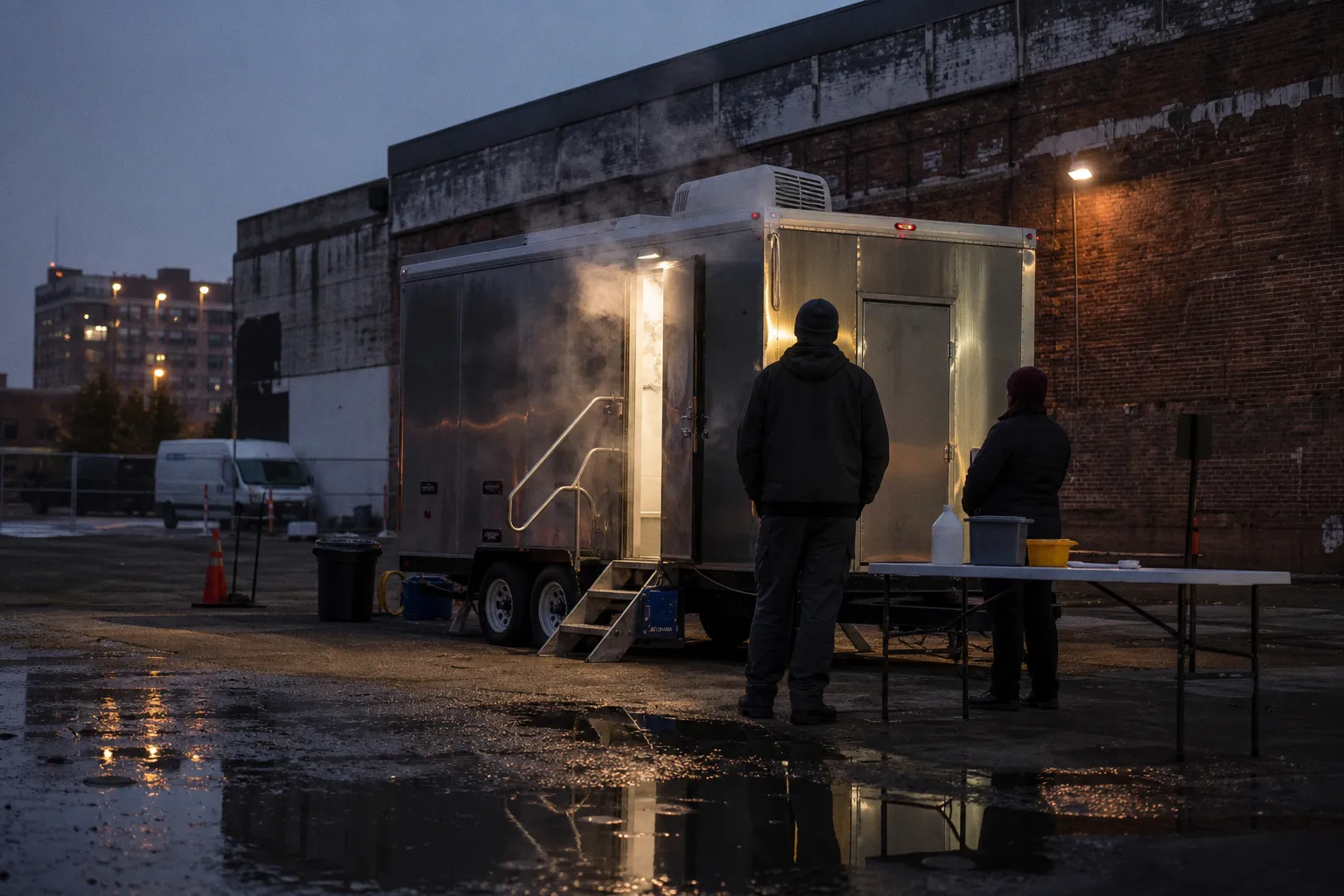
For people living outdoors, in vehicles, or moving between temporary places to sleep, access to a hot shower is often governed by a chain of small exclusions: the public facility that requires a membership, the shelter shower available only to overnight guests, the clinic appointment that must come first, the fear of leaving a bag unattended, the long walk to a place that may already be full. A shower trailer can shorten that chain. It can bring privacy, warm water, clean towels, and a human welcome closer to where people already are.
But the question is not whether a shower is valuable. It plainly is. The harder question is whether a community can keep the service safe, accessible, clean, supplied, staffed, and trusted week after week. That is where many well-intentioned grassroots sanitation initiatives either become part of the local welfare fabric—or become an expensive unit parked behind a warehouse.
A mobile shower is not a cure for homelessness. It is a practical promise: today, your body and privacy will be treated as worthy of care.
The first requirement is not the trailer—it is the local agreement around it
When people search for mobile shower unit requirements for homeless outreach, they often expect a universal list: buy a trailer, fill the tanks, find a parking space, open the doors. In reality, there is no single nationwide operating checklist that settles every question. The rules and approvals depend on the city, the exact site, the funding source, the utility provider, local health and building authorities, street-use rules, and whether the programme is operating alongside a shelter or as an independent outreach service.
That variability is not bureaucracy for its own sake. Water enters the unit, people use it in a private space, wastewater leaves the unit, and the service is often parked in public or semi-public places. Each part touches a local system that must be brought into dialogue before the first guest arrives.
For shelters receiving U.S. Emergency Solutions Grants shelter-operations assistance, federal standards require sanitary facilities that are operational, private, and adequate for personal cleanliness and human-waste disposal. The water supply must be free from contamination. Those standards do not automatically mean that every independently operated trailer is governed in precisely the same way, but they establish the right baseline: a shower that is unreliable, exposed, or supplied with questionable water is not a meaningful hygiene service.
In my experience facilitating conversations between volunteer teams and the people who know a neighbourhood best, the decisive early meeting is rarely about the paint colour of the trailer. It is about stewardship. Who approves the stop? Who unlocks access to water or sewer connections? Who responds if the generator fails? Who hears residents’ concerns without allowing those concerns to become a veto on the dignity of people sleeping outside? Who tells guests, clearly and respectfully, what is available and when?
A workable local agreement usually needs to cover:
- A host site with consent and a purpose. Faith communities, service centres, public-health partners, shelters, outreach hubs, and community organisations can all be possible hosts, but permission must be explicit and operational rather than informal goodwill.
- Water and wastewater arrangements approved for that site. A unit cannot simply dispose of greywater into a storm drain, street, ground, or an unapproved sewer point. The receiving utility and relevant local authorities determine what is permitted.
- A schedule people can rely on. A shower service that appears once and then disappears teaches people not to spend precious time walking to it. Consistency is part of access.
- Neighbourhood communication. The message should explain practical arrangements—hours, queue management, waste handling, contact person—not frame guests as a disruption to be managed.
- Clear connections to other support. Hygiene access works best when it sits beside outreach workers, healthcare, laundry, clothing, food, document support, benefits navigation, and housing pathways, without making any of those services a condition of receiving a shower.
The mobile unit is therefore only one piece of infrastructure. The other piece is social integration: the relationships that allow a service to arrive without displacing, humiliating, or abandoning the people it was meant to support.
Accessibility has to be designed into the route, not added at the door
A trailer with a shower is not automatically accessible merely because its entrance has a handrail. The approach to the unit, the turning space, the doorway, the shower compartment, the controls, the water temperature, and the assistance available on site all shape whether a person with limited mobility can use the service with independence.
Under the 2010 ADA Standards, an accessible transfer-type shower compartment has a clear internal space of 36 by 36 inches. A standard roll-in shower must be at least 30 inches wide and 60 inches deep, with an entry at least 60 inches wide. Accessible shower spray units must deliver water at no more than 120°F (49°C), and a hand-held hose must be at least 59 inches long.
These figures are not a substitute for confirming which requirements apply to a particular operator, site, and funding arrangement. They do, however, show why accessibility cannot be patched on with a portable ramp after procurement. A narrow compartment, an abrupt step, a difficult latch, or fixtures that cannot be reached safely can turn a nominally available shower into another service from which someone is quietly excluded.
| Design question | Transfer-type shower | Standard roll-in shower |
|---|---|---|
| Clear interior dimensions | 36 × 36 inches | At least 30 × 60 inches |
| Entry requirement | Depends on compliant design details | At least 60 inches wide |
| Best suited to | A person transferring from a mobility device, where the layout supports this | A person remaining in a wheelchair or using more open access |
| Water delivery limit for accessible spray units | No more than 120°F / 49°C | No more than 120°F / 49°C |
The physical route matters just as much as the shower bay. Can a wheelchair move from the pavement to the unit without crossing broken ground? Is there a safe waiting area out of traffic and rain? Is the entrance visible enough to feel safe, but private enough that guests are not displayed to passers-by? Is there space for someone to wait with a support worker, interpreter, child, or personal belongings?
For covered emergency shelters, accessibility obligations may arise under Section 504, the Fair Housing Act, and Title II of the ADA where applicable. Independent programmes should not assume they are exempt from the wider ethical duty merely because a particular funding rule does not directly govern them. The standard worth pursuing is simple: if someone arrives needing a shower, the programme should have thought seriously about what might stop them from using it.
Cleanliness is a daily practice, not a closing-time task
The most difficult part of mobile shower trailer maintenance is not the visible dirt. It is the repetition. Between each guest, there must be time, supplies, staff attention, and a rhythm that protects the next person without making the current one feel rushed through an assembly line.
Public-health guidance from King County describes shower facilities as high-labour, high-maintenance environments. It calls for routine cleaning and disinfection between users, daily deep cleaning or cleaning whenever contamination is visible, provision of towels and hygiene supplies, waste collection, and prompt maintenance. This is the unglamorous centre of homeless hygiene program logistics: the work that people only notice when it fails.
A sensible operating routine has several layers.
1. Prepare before opening. Check fresh-water levels, wastewater capacity, electrical systems, ventilation, fixtures, locks, temperature controls, cleaning supplies, towels, soap, menstrual products, bins, and basic repairs. A guest should not be asked to step into a unit while staff discover that there is no hot water or no functioning drain.
2. Welcome and orient each guest without interrogation. Sign-in can help with safety, capacity, and programme learning, but it should collect only what is genuinely needed. The queue is a place for calm explanation, not a test of deservingness.
3. Protect belongings as part of the service. A person may decline a shower if their bag, documents, medication, or sleeping gear has nowhere secure to go. Safe storage, a clear line of sight, or staff-supported monitoring is not an optional extra.
4. Reset the space after every use. Cleaning and sanitising should include touchpoints, floors, fixtures, and any restroom elements. Municipal contracts may be even more prescriptive. Fresno’s FY2025–26 mobile-shower operations solicitation, for example, required shower and restroom units to be cleaned and sanitised after every use and again at the end of each operating day.
5. Deep-clean and inspect daily. Small faults grow quickly in a high-use trailer: a leaking hose, weak latch, blocked drain, empty dispenser, damaged flooring, or failing heater. Repairing them promptly protects both safety and trust.
6. Record what the unit is telling you. Logs for cleaning, water, wastewater, repairs, service interruptions, and guest feedback may feel mundane, yet they reveal whether the programme is resourced for reality rather than aspiration.
King County guidance recommends two people on site: one to manage sign-in and the queue, and one to monitor showers and clean. That is a useful operational benchmark, not a binding national staffing rule. The number may need to rise when there are multiple stalls, a crowded site, heightened safeguarding needs, or a fuller wraparound service.
One person cannot simultaneously welcome a guest with patience, protect the queue from confusion, clean a shower properly, monitor water levels, answer a neighbour’s question, and respond to an emergency. Asking a single volunteer to do all of it is not frugality. It is placing the programme’s reliability on somebody’s exhaustion.
The dignified shower is not the one with the newest fittings; it is the one that is clean, private, open when promised, and staffed by people who have time to notice what is needed.
Water, wastewater, and power decide whether the service can keep its promise
A mobile shower programme lives or dies by its utility plan. The trailer may look self-contained, but it is still dependent on fresh water, hot-water production, power, and lawful wastewater disposal. These systems must be matched to the intended number of guests, the duration of the stop, the climate, the route, and the available connections.
There is no universal evidence-based figure for gallons used per guest, wastewater generated per guest, ideal tank capacity, or the correct number of stalls for a population. Programme planners should be wary of anyone offering one neat number as though every city, vehicle, and service model had the same conditions.
Instead, start with the route and work backward:
- Will the unit fill at an approved source before arriving, connect on site, or use a combination of both?
- Where will wastewater go at the end of the shift, and what written approval or service arrangement supports that plan?
- Is the hot-water system capable of maintaining safe, reliable temperatures through the operating window?
- Does the site offer approved electrical capacity, or is the unit relying on a generator? If a generator is used, what noise, fuel, ventilation, fire-safety, and refuelling arrangements are necessary?
- How will staff know, during the shift rather than after a failure, that fresh water is nearing depletion or wastewater is nearing capacity?
- What happens if a connection fails, a tank reaches its limit, or a cold-weather condition affects plumbing?
The City of Fresno solicitation provides a useful illustration of how locally specific these arrangements can become. It required coordination of approved water, sewer, and utility connections, including connection to city-designated water and sewer points. That is not a nationwide rule. It is a reminder that public utilities are not a backdrop; they are operational partners whose requirements must shape the programme from the beginning.
Site selection also carries a human dimension. The most technically convenient location can still be the wrong one if people cannot reach it safely, if police activity makes guests feel watched, if the queue is exposed to hostility, or if the unit is placed so far from other services that someone must choose between keeping a medical appointment and waiting for a shower.
The strongest portable hygiene stations for community use tend to be situated where several needs can be met without forcing people to perform their hardship in public: near trusted service providers, on predictable transit routes, with a safe waiting area, and with space for outreach workers to offer conversation rather than simply crowd control.
Towing a trailer is a different skill from running a welfare service
There is a tendency to treat transport as a minor procurement detail: choose a trailer, attach it to a truck, make a schedule. Yet mobile units carry water, wastewater systems, heating equipment, and heavy fittings. Their weight, dimensions, towing demands, parking constraints, insurance, driver qualifications, and maintenance needs can determine whether a programme is viable.
Again, the rulebook is local. In Fresno’s FY2025–26 solicitation, the specified trailer had a gross vehicle weight rating of 13,000 pounds, and drivers were required to hold a California Class A licence alongside a compliant tow vehicle. Those are not universal U.S. requirements. They show, however, why a programme should verify vehicle classification and licensing rules before it buys or leases a unit, not after volunteers have already committed to a route.
A practical transport plan should account for:
- the fully loaded weight, not just the trailer’s empty brochure weight;
- the towing capacity and braking requirements of the vehicle;
- local driver licensing rules and insurer conditions;
- turning radius, height clearance, parking access, and the street layout at every regular stop;
- fuel, generator maintenance, tyre inspections, and safe storage;
- contingency coverage when the usual driver is ill, unavailable, or not licensed for the equipment;
- time for setup, connection, cleaning, draining, and travel—not only the hours when guests are showering.
Fresno’s procurement also specified at least eight operating hours per day, including five service-delivery hours, on at least 20 weekdays each month. That is a contractual model for one city, not a universal minimum. But it exposes a common mistake: counting only guest-facing time when estimating staffing and cost. The vehicle must arrive, be positioned, connected, monitored, cleaned, and returned. Those labour hours are part of the service, not administrative overhead.
A 2022 qualitative evaluation of mobile hygiene stations in Seattle and King County reached a similarly grounded conclusion. Staff identified trailer rental, partnerships, funding, location, and maintenance as central factors in implementation, and continuity depended on confronting those logistical and financial pressures rather than treating them as afterthoughts. The study involved interviews with four programme employees, so it cannot prove broad health or housing outcomes. Its value lies elsewhere: it describes the operational truth that frontline teams recognise quickly.
Hygiene access belongs beside housing work, not instead of it
There is a temptation in public discussion to demand that every intervention demonstrate one grand outcome. Does the shower unit end homelessness? Does it reduce emergency-department use? Does it solve public health? The available evidence does not allow those claims, and responsible programmes should not make them.
Housing is the solution to homelessness. Income, healthcare, legal support, harm-reduction services, safety from violence, and accessible public systems all matter. A shower trailer cannot replace any of them.
Still, we should resist the opposite error, which is to dismiss basic hygiene because it does not carry the whole burden. The CDC has recommended consistent, low-barrier access to laundry and hot showers for people experiencing homelessness. In the specific context of body-lice infestation, it recommends a hot shower alongside clean clothing and bedding, while also emphasising dignity, safety, and the security of personal belongings.
That language matters. People do not experience their lives in separate policy compartments called “public health,” “housing,” and “self-respect.” A clean towel may support someone before a job interview, a benefits appointment, a clinic visit, family contact, or simply a night when they want to sleep feeling less exposed. The impact cannot always be captured neatly in a dashboard, yet it is real enough to shape whether someone returns to a service, speaks to an outreach worker, or feels able to take the next step.
For community organisations, the best measure is not how many photographs the unit produces or how impressive it looks at a fundraising event. It is whether guests return because the service is reliable; whether staff can maintain it without burnout; whether local partners see it as strengthening the existing care network; and whether the programme leaves people with more agency, not more dependence on a one-off gesture.
So, are mobile shower units viable?
They are viable when the community has planned for the work beyond the shower: accessibility, safe water, approved wastewater handling, frequent cleaning, trained staffing, secure belongings, transport capacity, predictable locations, and long-term funding. They are especially valuable as a low-barrier point of contact within a wider network of housing and welfare support.
They are not viable when a group treats the unit as a symbolic donation, assumes a volunteer can run it alone, improvises sewer disposal, overlooks driver licensing, or opens only when a sponsor visit makes it convenient. A trailer can travel, but trust moves much more slowly.
For those of us who work between volunteer crews and community leadership, that is the principle worth carrying forward: physical infrastructure earns its place only when it is held within relationships of accountability. Bring the unit, certainly. But bring the staffing, the maintenance plan, the listening, the local permissions, and the humility to let people who will use the service help shape it.