Senior check-in models for local volunteers
Nearly 14 million adults aged 65 and older live alone in the United States, while the CDC estimates that one in four seniors falls each year. Those figures do not describe a single problem.
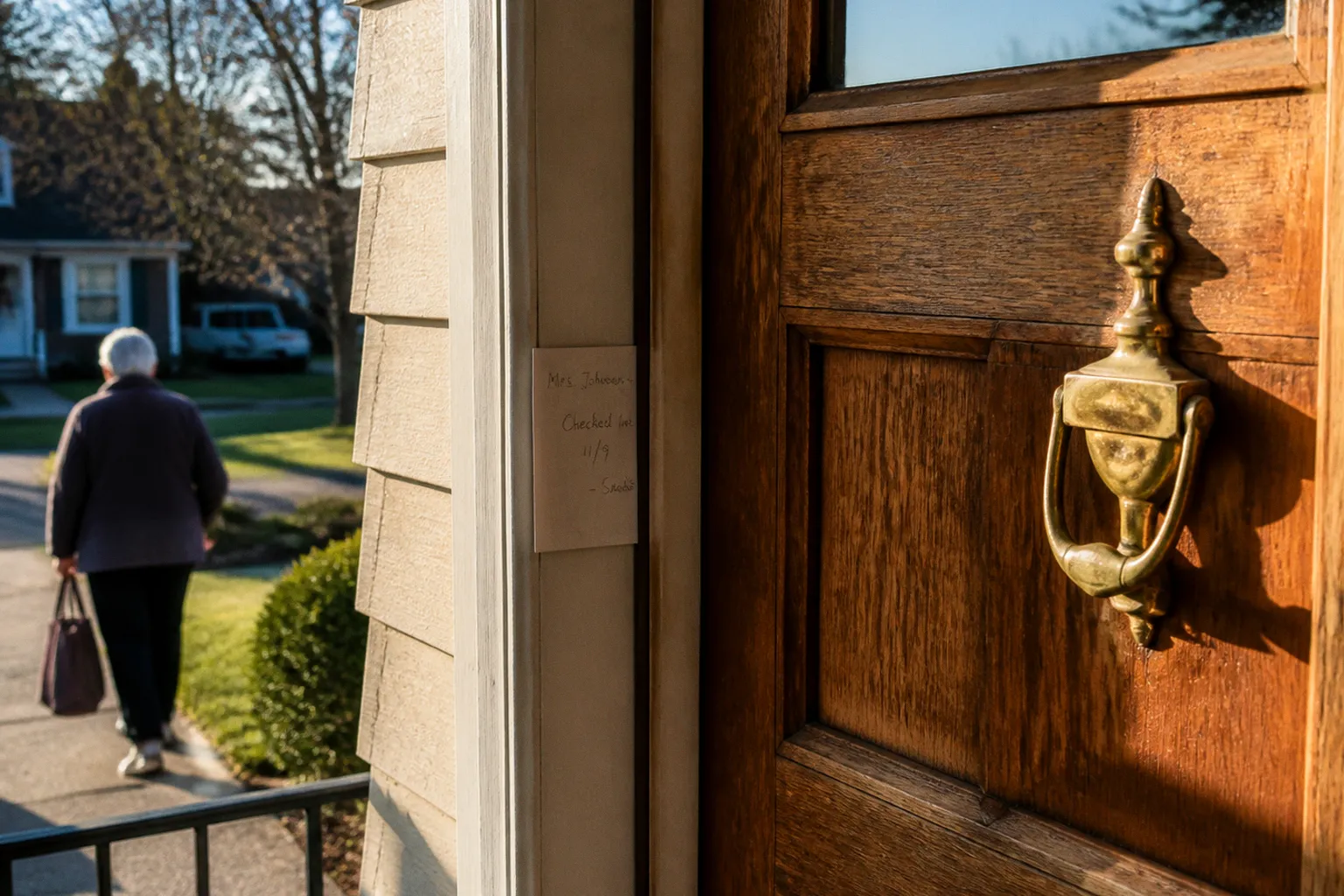
Senior Check-In Program Models for Local Volunteers
They describe a recurring exposure to risk: a missed call, an unnoticed fall, an empty medication box, or several days without meaningful social contact.
Compare car rental deals in United Kingdom
See available offersPartner link — DiscoverCars comparisonFor local volunteers, the operational question is therefore not whether senior outreach is worthwhile. It is how to design a senior check in program model that can identify risk early without promising services the organization cannot safely deliver. The strongest programs combine a defined contact schedule, a practical escalation protocol, trained volunteers, and a clear boundary between social support and medical care.
A telephone reassurance program may be the correct starting point for one neighborhood. A wellness buddy model, grocery delivery route, or home-visit add-on may be more effective in another. The difference is not branding. It is resource allocation: volunteer hours, transport capacity, response time, geographic coverage, and the reliability of the escalation chain.
Risk-Stratified Outreach: Frequency Must Follow Exposure
A universal daily call sounds equitable, but it is not always operationally sound. If every participant receives the same frequency of contact, a small organization can exhaust its volunteer pool while still failing to provide adequate attention to people facing the highest risk.
Senior check-in program models typically use risk profiling to set the outreach schedule:
- Low-risk participants: one scheduled check-in per day.
- Medium-risk participants: two scheduled check-ins per day.
- High-risk participants: two to three check-ins per day, with a rapid response process after a missed call.
The profile should not be treated as a medical diagnosis. It is a logistics tool for deciding how much contact a program can responsibly allocate. A local organization may consider whether a participant lives alone, has a recent history of falls, lacks nearby family support, has difficulty using a phone, or regularly depends on others for food and transport. The information should be limited to what the program needs to coordinate a safe response.
The model is more useful when risk categories are visible to coordinators but do not stigmatize participants. A senior placed in a high-frequency category is not being labeled as incapable. The organization is acknowledging that a missed contact carries a different operational consequence for someone who has no nearby support than for someone whose daughter visits every evening.
A practical comparison of outreach models
| Model | Primary function | Volunteer requirement | Best use | Main bottleneck |
|---|---|---|---|---|
| Daily telephone reassurance | Confirms contact and provides brief social connection | Low to moderate | Broad coverage across a dispersed community | Missed calls require disciplined follow-up |
| Volunteer wellness buddy | Combines companionship with errands, walks, or activity access | Moderate to high | Seniors experiencing isolation or mobility barriers | Travel time and volunteer matching |
| Home-visit add-on | Provides an in-person confirmation when remote contact is insufficient | High | Higher-risk participants or phone-inaccessible households | Safeguarding, transport, and scheduling |
| Senior grocery delivery program | Addresses food access and creates a welfare touchpoint | Moderate | Households with mobility or transport limitations | Route density and delivery continuity |
| Student volunteer calls | Adds regular companionship through supervised calls | Moderate coordination | Low-risk seniors and intergenerational programs | Training, supervision, and continuity during school breaks |
This table reflects different functions rather than interchangeable services. A grocery delivery route is not automatically a check-in system. A friendly visitor is not an emergency responder. A telephone call can confirm that someone answered, but it cannot establish that the home is safe when the participant reports a fall or cannot communicate clearly.
The most scalable senior outreach model is not the one with the most services. It is the one with the clearest response when a scheduled contact fails.
Telephone Reassurance vs. In-Person Wellness Buddies
Telephone reassurance remains the most efficient foundation for local elderly support options because access is comparatively high. Pew Research reports that 96 percent of Americans aged 65 and older own a cellphone or landline. That makes a phone call more practical as a first-line channel than an app-based system, particularly when volunteers are serving seniors with different levels of digital confidence.
The call itself should be brief, consistent, and structured. A volunteer can confirm that the participant is safe, ask whether there is an immediate issue requiring escalation, and record the outcome using a simple status code. The system should not encourage volunteers to improvise medical questioning or make judgments about symptoms.
A practical call record might distinguish between:
1. Answered and stable: the participant responds normally and reports no immediate concern.
2. Answered with a support request: the participant needs help with food, transport, a household task, or contact with a family member.
3. Answered with a safety concern: the participant reports a fall, acute distress, inability to access essential supplies, or another situation requiring coordinator review.
4. No answer: the escalation sequence begins according to the participant’s risk category.
5. Invalid or unavailable contact: the coordinator must correct the record rather than treating the participant as successfully reached.
The friendly visitor vs telephone reassurance comparison is often presented as a question of warmth versus efficiency. That framing is incomplete. The two models produce different operational outputs.
A telephone program maximizes contact density. One volunteer can make several calls in a scheduled block without travel, which improves geographic reach and makes the service easier to scale. It also creates a time-stamped record of attempted contact. Its limitation is that it depends on a working line, an answered call, and the participant’s ability to communicate.
A wellness buddy program produces more context. Volunteers may accompany an older resident to a local activity, run an errand, take a companion walk, or provide practical support during a routine outing. Eurajoki municipality’s wellness buddy approach illustrates this broader function: social contact is combined with participation in community life and assistance with ordinary tasks.
The cost is volunteer capacity. An in-person visit consumes not only the interaction time but also travel, coordination, and safeguarding overhead. For rural communities, distance can become the dominant bottleneck. A program that appears to have enough volunteers on paper may still lack sufficient route capacity if participants are widely distributed.
Where each model performs best
Telephone reassurance is stronger when:
- participants are geographically dispersed;
- the organization has limited transport capacity;
- the primary objective is regular contact and early identification of missed check-ins;
- the program needs a low-cost first layer before adding home visits;
- coordinators can maintain accurate call records and emergency contacts.
Wellness buddies are stronger when:
- isolation is the central problem rather than phone access;
- participants need help reaching activities or completing small errands;
- the organization can match volunteers and participants consistently;
- travel routes are short enough to sustain regular attendance;
- a coordinator can manage boundaries, consent, and safeguarding.
The two models should not be forced into competition. A local program can use telephone reassurance as the daily control layer and reserve wellness buddy visits for participants whose needs are social, practical, or mobility-related. This is more efficient than assigning every senior to an in-person volunteer from the beginning.
Escalation Protocols: The Program Is Defined by Its Missed Calls
A check-in service has limited value if it records a missed call but has no agreed response. The escalation protocol is the program’s safety architecture. It must tell volunteers what to do, what not to do, and when responsibility moves to the coordinator or an emergency contact.
For high-risk participants, standard models use an immediate escalation window of approximately 15 minutes after a missed call. Lower-risk participants may have a less intensive sequence, but the sequence should still be documented. The objective is not to create an emergency dispatch service. It is to avoid an unstructured delay when a person may be unable to answer.
A basic protocol can be organized into five stages:
1. Retry the scheduled contact.
The volunteer makes the defined follow-up attempt rather than assuming that a missed call is accidental.
2. Use the approved secondary channel.
If the participant has consented to text messaging or another contact method, the volunteer uses it according to program rules. If there is no approved secondary channel, the volunteer does not search for informal alternatives or disclose personal information.
3. Notify the coordinator.
The coordinator reviews the participant’s risk profile, recent contact history, and any known support arrangements. This prevents each volunteer from making an isolated decision.
4. Contact the designated emergency contact.
If the participant remains unreachable and the situation meets the program’s threshold, the coordinator contacts the person listed for welfare concerns.
5. Request a police non-emergency welfare check when safety concerns persist.
This is appropriate when repeated contact attempts fail and the available information indicates a possible safety issue. It is not a substitute for calling emergency services when there is an immediate, known danger.
The protocol should also specify the difference between a missed call and a concerning call. If a participant answers but reports a serious fall, severe distress, or an urgent safety problem, the matter should not be filed as a routine social-support request. Volunteers must escalate according to the organization’s approved procedures and local emergency guidance.
The information a coordinator actually needs
A small program does not require an elaborate case-management platform to begin. It does require reliable records. At minimum, the coordinator should maintain:
- participant name and preferred contact method;
- scheduled contact frequency;
- risk category and date of last review;
- consented emergency contact details;
- relevant access notes, such as language or hearing requirements;
- volunteer assignment and backup coverage;
- timestamp and outcome of each attempted check-in;
- escalation actions and resolution status.
The last two fields are where many informal programs lose accountability. A note stating “no answer” is not enough if no one can determine whether the second attempt occurred, who was contacted, or whether the matter was resolved.
A useful system separates contact activity from support requests. The first records whether the scheduled check-in happened. The second records whether the participant needs groceries, transport, companionship, or another non-medical service. Combining everything in one free-text note makes trend analysis difficult and increases the chance that a critical issue is buried in narrative.
Integrating Student Volunteers Without Weakening Continuity
Student volunteers can expand the capacity of a senior check-in program while creating a structured form of intergenerational support. Organizations such as Senior Check In pair high school students with older adults for one to two calls per week; students receive community service hours, while participants gain a predictable social connection.
This model is suitable for a defined segment of the program, particularly lower-risk participants whose principal need is conversation and routine contact. It should not be the only coverage for a participant who requires multiple daily checks or a rapid welfare response.
The operational distinction matters because student availability is seasonal. School calendars, examinations, holidays, transport arrangements, and volunteer turnover can all affect continuity. A program that counts every enrolled student as active capacity will overstate its sustainable yield.
A more reliable structure includes:
- a coordinator or adult supervisor responsible for assignment and escalation;
- a short call guide that keeps the interaction within a non-medical scope;
- a documented process for reporting a missed call or concerning disclosure;
- backup volunteers for absences;
- a transition plan when a student leaves the program;
- restrictions on private communication channels and unsupervised commitments.
Students should not be asked to diagnose cognitive decline, provide medical advice, administer care, or manage an emergency. Their role is social contact and observation within a defined protocol. If a participant describes a situation outside that scope, the student reports it to the supervisor rather than attempting to solve it personally.
Designing the call for consistency
A call guide is not a script that removes human connection. It is a control mechanism that prevents uneven service quality. The volunteer can use natural conversation while still covering the required points:
- confirm the participant’s identity and immediate safety;
- ask whether there is a problem requiring coordinator attention;
- listen for a change in the participant’s ability to communicate;
- avoid collecting unnecessary medical details;
- record the outcome before moving to the next assignment.
The program should also decide whether students may call independently or only within supervised time windows. The answer depends on safeguarding policy, participant preference, and local requirements. The central principle is that social warmth cannot replace operational ownership. Someone must remain accountable when a volunteer reports a concern.
Adding Grocery Delivery and Home Visits to the Contact Network
Senior grocery delivery programs are often treated as separate from check-in services, but they can function as a coordinated support layer. A delivery creates a scheduled point of contact and may identify practical problems that a phone call cannot reveal. However, the driver or volunteer must understand that delivery is not a home-care service and not a medical assessment.
The strongest integration is simple: the delivery record includes whether the handoff occurred and whether the participant requested a follow-up. It does not require the volunteer to inspect the home, interpret health conditions, or remain in the residence without authorization.
Route planning is central to sustainability. A delivery program with scattered participants can consume disproportionate volunteer time through travel. Local organizations should group routes geographically, set delivery windows that volunteers can meet, and maintain a backup plan for vehicle or rider shortages. In communities where motorcycles are already used for school-rehabilitation or aid logistics, the same fleet discipline can support welfare routes, but only if the organization accounts for payload, weather, fuel, safety equipment, and rider availability.
Home visits require an even tighter operating framework. They may be useful as an add-on for participants who cannot reliably use a phone or who need an in-person welfare confirmation. They also introduce safeguarding and personal-security risks. A responsible program should define:
- whether visits are conducted by one volunteer or two;
- how consent is recorded;
- what happens if the participant does not answer the door;
- which situations require immediate withdrawal and escalation;
- how visit times and outcomes are logged;
- how volunteers protect participant privacy.
A home visit should never become an informal promise of ongoing household care. Once volunteers begin performing tasks outside the original service definition, the program’s liability, training requirement, and resource allocation can change quickly.
A volunteer network becomes dependable when every extra service has an owner, a boundary, and a measurable handoff.
Building a Local Model That Can Scale
The appropriate senior check in program model is the one a local organization can maintain after the launch period. Early enthusiasm can produce a large participant list, but enrollment is not impact. Coverage, response time, retention, and resolved support requests are more useful impact metrics.
A practical implementation sequence is:
1. Map the service area.
Identify participant locations, travel distances, phone access, existing community groups, and available emergency contacts. This establishes the geographic and communication constraints before volunteers are assigned.
2. Start with a limited service promise.
A daily call for a defined number of participants is easier to manage than a broad promise of calls, visits, deliveries, and transport. The initial model should be large enough to reveal bottlenecks but small enough to correct them.
3. Create risk tiers and contact frequencies.
Use a transparent intake process and review the tier when circumstances change. Risk profiling should determine the response level, not determine a participant’s worthiness for support.
4. Install the missed-contact protocol before launch.
Confirm that emergency contacts are current, coordinators know their responsibilities, and volunteers understand the difference between a routine missed call and an immediate safety concern.
5. Add specialist layers only after the base layer is stable.
Wellness buddies, grocery delivery, student calls, and home visits should extend the system rather than conceal weaknesses in the telephone or coordination layer.
6. Review capacity through actual operating data.
Track completed contacts, missed contacts, average escalation time, unresolved requests, volunteer absence, and participant continuation. These measures reveal whether the program is producing reliable coverage or merely generating activity.
A program can use a basic monthly review to identify its main constraint. If missed calls are high, the issue may be participant phone access, scheduling, or volunteer reliability. If calls are completed but support requests remain unresolved, the bottleneck may be transport, food access, or insufficient coordinator capacity. If wellness buddy visits are frequently canceled, the problem may be route design rather than volunteer motivation.
Metrics that support decisions
The most useful metrics are operational rather than decorative:
- Scheduled-contact completion rate: the share of planned check-ins that were successfully completed.
- Missed-contact response time: the interval between a missed call and the first documented follow-up.
- Escalation resolution rate: the share of flagged cases that reached a recorded outcome.
- Volunteer retention and backup coverage: whether the program can maintain service during absences.
- Participant continuity: whether seniors remain connected to the same service over time.
- Unmet request volume: the number and type of needs that the organization cannot currently fulfill.
- Route efficiency: relevant for grocery delivery and home visits, especially in rural areas.
These metrics should be interpreted together. A high completion rate with no escalation records may indicate strong stability, but it may also indicate weak reporting. A large number of support requests may reflect poor service quality, or it may show that participants trust the program enough to disclose practical needs. Data requires operational context.
Defining the Boundary of Non-Medical Care
Non-profit check-in programs occupy an important space between formal care systems and everyday community support. They can reduce isolation, identify a missed contact, help coordinate a welfare check, accompany a senior to an activity, or deliver groceries. They do not replace medical telemetry, home healthcare nursing, or emergency dispatch.
That boundary should appear in volunteer training, participant consent materials, and coordinator procedures. Ambiguous language creates two risks. Participants may expect services the organization cannot provide, while volunteers may attempt tasks for which they are not trained or authorized.
The service description should state what volunteers can do:
- make scheduled social and welfare calls;
- document contact outcomes;
- report concerns to the coordinator;
- provide approved companionship or errands;
- support grocery delivery routes;
- initiate the defined escalation process.
It should also state what they cannot do:
- diagnose medical or cognitive conditions;
- administer medication or medical care;
- promise emergency response times beyond the program’s protocol;
- transport participants without an approved policy and suitable safeguards;
- enter a home or handle personal information outside agreed procedures.
This is not excessive caution. It is a resource and risk-control measure. A social welfare program becomes more credible when its limits are explicit, because participants and volunteers can distinguish reliable support from an informal promise.
The Best Model Is a Layered One
For most local organizations, the strongest design is layered rather than singular:
- telephone reassurance provides routine coverage;
- risk stratification determines contact frequency;
- student volunteers extend low-risk companionship;
- wellness buddies address isolation and mobility barriers;
- grocery delivery connects food access with a welfare touchpoint;
- home visits remain a controlled add-on;
- coordinators own escalation and unresolved cases.
This structure allows funding to follow demonstrated need. If the data shows that many participants miss calls because of hearing or mobility barriers, the next investment may be in alternative contact arrangements or in-person support. If the primary gap is food access, delivery capacity may produce more impact than increasing call frequency. If high-risk participants are not receiving timely follow-up, additional coordinator capacity is more urgent than recruiting another cohort of casual callers.
The policy adjustment is straightforward: fund the response system, not only the visible activity. A list of completed calls is not the same as a functioning welfare network. Sustainable yield comes from dependable schedules, documented handoffs, trained volunteers, and a coordinator who can act when the routine breaks.
Local volunteers do not need to reproduce a healthcare system to make senior outreach effective. They need a defined operating model that matches contact frequency to risk, keeps social support within safe limits, and converts a missed check-in into a managed response rather than an unanswered question.