Community fridge traps that waste food and funds
A community fridge can move one to four tonnes of surplus food in a month when the operation is staffed, monitored, and supplied with usable stock.
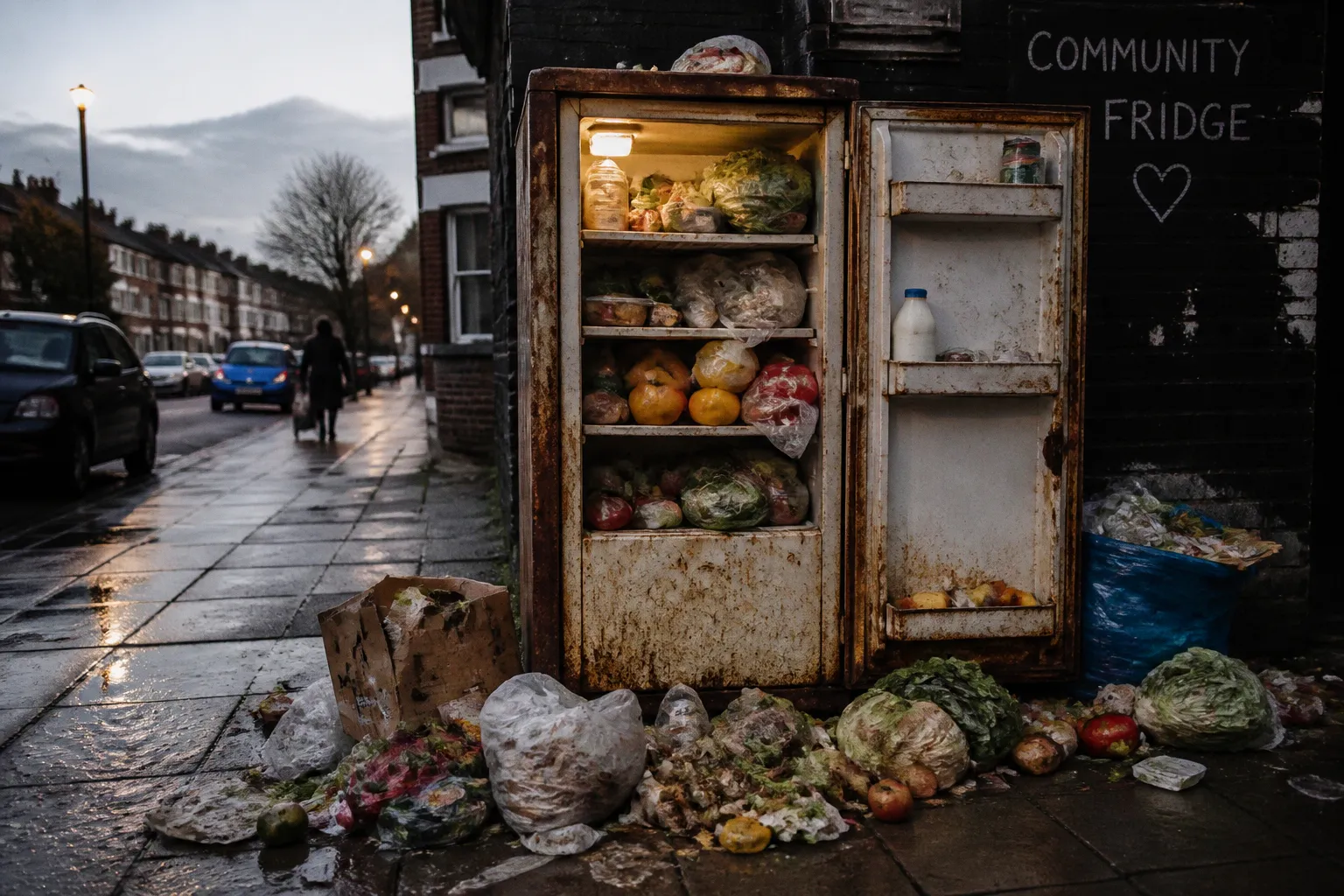
It can also turn donated food, volunteer hours, electricity, and transport into one large spoilage bill when nobody owns the daily work.
The failure usually starts small. A temperature log is skipped. A box arrives without a date. A home-cooked meal goes in because the donor means well. Nobody removes it. Two days later, the fridge is full of food that cannot be traced, checked, or safely redistributed.
That is not a food-sharing model. It is unmanaged inventory with a plug.
Community fridge food waste prevention depends on simple controls: a cold unit that stays at or below 4°C, temperature checks twice a day, clear donation rules, and a volunteer rota with named responsibility. If those parts are missing, the fridge begins wasting the same resources it was built to recover.
The first failure is usually operational, not charitable
Community fridges run on a decentralised mutual-aid model. People and local businesses can donate surplus food. Other people can collect it. There are no eligibility checks and no fee at the point of access.
That open structure is the strength of the model. It is also the weak point.
A conventional food operation has a purchasing system, a stockroom, trained handlers, recorded deliveries, and someone with authority to reject a damaged or unsafe item. A public fridge often has none of those controls unless the operating group builds them deliberately.
The fridge does not know:
- who placed the food inside;
- when it was prepared or opened;
- how long it was warm during transport;
- whether the package contains allergens;
- whether the use-by date has passed;
- whether the item was stored correctly before donation;
- whether anyone is scheduled to inspect it before the next collection.
That information gap creates the first trap. Open access is mistaken for zero management.
We need to treat the site like a small food-distribution point, not like a cupboard with a compressor. The unit needs a site lead. The lead needs a rota. The rota needs a backup. If a temperature alarm, power cut, leaking package, or overflowing shelf has no assigned response, the problem will wait until the next person happens to notice it.
Usually, that is too late.
The cost of a full fridge
Spoiled food is the visible loss. It is not the whole loss.
The operating group may also pay for:
- electricity used to chill food that will be discarded;
- fuel and vehicle time for collecting surplus;
- cleaning supplies and protective equipment;
- replacement shelves, seals, handles, and thermometers;
- waste collection or disposal;
- volunteer time spent sorting and removing unusable stock;
- emergency repairs after a neglected fault;
- administrative work created by unclear records.
A community fridge can redistribute a substantial volume of food and still lose resources if the intake is not matched to local demand. A large delivery has no value if the unit cannot hold it safely or if the food does not move before its usable window closes.
A fridge packed with untracked food is not impact. It is deferred disposal.
The same applies to oversized rescue runs. We should not haul stock simply because it is available. We need to know the fridge capacity, the collection time, the likely demand, and the handling condition. Otherwise the vehicle becomes part of the waste stream.
Community fridge health regulations start at the site boundary
Rules vary by location. We should not assume that a community fridge sits outside food law because it is charitable, volunteer-run, or free to use.
In the UK, a registered community fridge must register as a food business with the local authority and follow food safety requirements monitored by Environmental Health Officers. Other jurisdictions use different registration systems and enforcement structures. The operating group needs to confirm the local position before opening, relocating, or changing the type of food accepted.
The legal work is not a decorative folder. It sets the operating limits.
A site plan should identify:
1. Who owns the food operation.
The responsible organisation needs a named contact, not only a group email.
2. Who checks the equipment.
The fridge, thermometer, electrical supply, seals, drainage, and surrounding area need inspection.
3. Who controls donations.
Donors need clear rules before food reaches the shelves.
4. Who records temperatures.
The record should show the date, time, reading, and initials of the person who checked it.
5. Who removes unsafe stock.
Nobody should debate a leaking, expired, warm, or unlabelled item while it occupies shelf space.
6. Who responds to a failure.
Power loss, refrigeration failure, pest activity, flooding, and vandalism need a defined shutdown procedure.
The temperature target is direct: refrigerated food should be held at or below 4°C. The reading should be taken twice daily and logged. A single check at opening does not cover the entire operating period. A fridge that is cold at 08:00 may be warm by late afternoon if the door seal has failed, the unit is overloaded, or the condenser cannot reject heat.
We need to measure the equipment in service, not trust the display by habit. A built-in display can show the cabinet setting while the food zone runs warmer. Use a suitable thermometer, place it where the reading represents the stored food, and keep the record with the site documentation.
The log is not proof that every item was safe. It is a control that lets us identify a trend before the stock is lost.
Donation rules must be hard enough to work
Loose rules create loose stock. Loose stock creates disposal.
A public food-sharing site needs a short donation standard that a donor can understand before arrival. If the rule requires a volunteer to explain every exception at the door, the system will fail during busy periods.
The base line should exclude:
- unlabelled packages;
- expired items;
- home-cooked food where the operator cannot verify preparation and storage conditions;
- opened goods;
- leaking or damaged packaging;
- food with unclear dates or storage instructions;
- products that require refrigeration but arrived warm;
- items that show mould, swelling, off-odours, pest contact, or other signs of spoilage.
The precise list should follow local food safety guidance and the organisation’s registration conditions. The principle does not change: if we cannot identify the item, date it, and decide how it must be stored, we cannot anchor it in the system.
Label before shelf
Every accepted item needs enough information to support a decision. That normally means the product name, relevant date information, storage instruction, and allergen information where applicable. Original packaging is the cleanest route because it carries details the volunteer may not be able to reconstruct.
A hand-written label is not a licence to accept anything. It can record a missing operational detail only when the source and handling history are known. It cannot turn an unknown meal into traceable food.
We should separate stock by condition and movement:
| Stock condition | Action at intake | Shelf decision |
|---|---|---|
| Sealed, dated, and within the usable period | Record and store according to the label | Place where it can move first |
| Sealed but close to its date | Record clearly and prioritise | Move ahead of slower stock |
| Unlabelled or unclear | Reject or place in a controlled review area | Do not offer to the public |
| Opened or damaged | Reject unless local rules specifically allow it and handling is verifiable | Keep out of public access |
| Warm refrigerated food | Reject or follow a documented safety procedure | Do not chill and assume it is safe |
| Spoiled, leaking, mouldy, or pest-affected | Remove from the site and clean the contact area | Never return to the shelf |
This is where many fridge-sharing program pitfalls begin. Volunteers want to prevent waste, so they stretch the acceptance rule. That feels efficient at intake. It is expensive at disposal.
The better approach is to reject early and explain the reason plainly. A kilogram of unsuitable food refused at the door costs less than a full shelf contaminated by a leaking package, plus the cleaning, disposal, and lost stock that follows.
Build a stock rotation that matches real demand
A fridge does not need more food. It needs the right food moving at the right speed.
The first stock-control question is not how much can fit inside. It is how much the local users take between inspections. That number changes by day, season, weather, nearby events, school schedules, and business donation patterns. We should watch the movement and adjust collection routes accordingly.
Use a simple rotation system:
- bring older accepted stock forward;
- place new stock behind it;
- mark short-dated food so volunteers can prioritise it;
- remove anything past its permitted date during each inspection;
- record repeated leftovers by category;
- reduce collections that consistently exceed the site’s movement.
Do not fill every shelf to capacity. Cold air needs to circulate. Doors need to close. Volunteers need to see the stock without moving every container. Overloading turns a storage space into a warm pocket with a cold display.
A practical inspection should cover the whole unit:
1. Read and record the internal temperature.
2. Check that the door closes and the seal sits against the frame.
3. Look for spills, leaks, swollen packs, mould, and damaged containers.
4. Remove unlabelled, expired, or otherwise prohibited items.
5. Move older stock forward.
6. Wipe contact surfaces using the approved cleaning method.
7. Check that the floor and area around the unit are dry and clear.
8. Record what was removed and why.
9. Escalate any equipment or safety fault before accepting another large delivery.
This is the repair sequence. We inspect first. Then we isolate the fault. Then we move stock. We do not hide a problem under a fresh donation.
Inventory records should be small and usable
A record that takes ten minutes per item will be abandoned. A record with no useful fields is paperwork without control.
At minimum, the operating group should be able to see:
- inspection time;
- temperature;
- stock removed;
- reason for removal;
- major donations received;
- equipment faults;
- cleaning completed;
- volunteer initials;
- action still open.
The record can be paper or digital. The format matters less than continuity. We need enough history to answer a basic question after an incident: what was in the fridge, who checked it, and what did the unit read?
Maintenance costs need a route, not a guess
Community fridge maintenance costs are not limited to the purchase price of the appliance. The budget needs to carry the full route from donation pickup to safe distribution.
That route includes power, transport, cleaning, repairs, monitoring equipment, and disposal. Each part can fail separately.
Electricity and placement
The fridge needs a stable electrical supply and enough clearance for ventilation. An outdoor cabinet exposed to heat, rain, dust, or direct sun will work harder than an indoor unit. A dirty condenser, blocked vent, or damaged cable can shift a small maintenance issue into a food-safety failure.
The site plan should set out:
- who pays the electricity bill;
- how power interruptions are detected;
- where the circuit and isolation switch are located;
- how the unit is protected from weather and impact;
- how often the plug, cable, seal, and cabinet are inspected;
- what happens to food during a prolonged outage.
Do not install the fridge where volunteers cannot reach the rear, read the thermometer, clean the floor, or isolate the power. Access is part of the equipment specification.
Transport and collection
Rescued food is not automatically safe because it was free. Collection vehicles need a handling plan. Time, heat, delays, and mixed loads all affect condition.
We should set collection limits based on:
- the fridge’s usable capacity;
- the temperature requirements of the food;
- the travel time;
- the number of stops;
- the receiving volunteer’s availability;
- the expected rate of movement after intake.
A route that collects from five businesses but arrives after the receiving shift has ended is not an efficient route. It creates a parked load, a delayed intake, and a higher chance that chilled food sits outside controlled storage.
Anchor the collection schedule to the receiving process. If there is no person to inspect and store the stock, the haul is not ready to run.
The cheapest donation is still expensive when it needs a vehicle, a repair, a disposal run, and two volunteer shifts to correct it.
Repair before expansion
Groups often look for a second fridge when the first one is already losing stock. That is the wrong direction.
Before expanding, review:
- temperature failures;
- the quantity and type of food discarded;
- the busiest and quietest collection windows;
- volunteer attendance;
- cleaning completion;
- average time from intake to removal;
- recurring faults in the appliance or site;
- whether donors are supplying food the local users do not take.
If the first unit cannot maintain a stable process, another unit doubles the surfaces, checks, records, transport needs, and failure points. More capacity does not repair weak control.
Set a stop rule for unsafe conditions
The most serious operational error is continuing service after a known failure.
We need a written stop rule. The fridge should be isolated from public access when the internal temperature cannot be confirmed, when the unit is not holding at or below 4°C, after a power failure where storage conditions are uncertain, or when contamination has spread across stock and surfaces. The exact response should follow local food safety guidance and the operator’s procedures.
The sequence is straightforward:
1. Stop new donations.
2. Keep the public out of the affected stock.
3. Record the time and condition.
4. Move or dispose of food according to the documented procedure.
5. Clean and disinfect affected surfaces using suitable materials.
6. Repair or replace the failed equipment.
7. Recheck the temperature and operation.
8. Reopen only when the responsible person can verify the controls.
We should not place warm food back into a repaired fridge and call the problem solved. Chilling does not reverse unsafe handling. A cold cabinet cannot erase an unknown time-temperature history.
The same discipline applies to staffing. If the scheduled volunteer does not arrive, the backup either takes the shift or the site closes. An unattended public fridge is not a neutral condition. It is an active risk with food inside.
A working model for community fridge food waste prevention
The operating system can stay small if it is built around ownership.
Assign one person to each control:
- Site lead: manages registration, permissions, and incident decisions.
- Food lead: sets donation standards and trains volunteers.
- Equipment lead: handles temperature devices, power, seals, and repairs.
- Route lead: schedules collections against capacity and receiving hours.
- Records lead: keeps logs and reviews repeated waste.
- Backup coordinator: fills missed shifts and triggers closure when needed.
One person can hold several roles in a small group. The roles still need to exist. Without that separation, every problem becomes everybody’s responsibility, which means it becomes nobody’s task.
Review the discard record at a fixed interval. Do not only count kilograms. Sort the reasons:
- expired;
- unlabelled;
- damaged;
- spoiled;
- over-supplied;
- unsuitable for the equipment;
- held during a temperature or power incident.
The pattern tells us where to torque the system. If most waste is unlabelled food, tighten intake. If stock expires on quiet weekdays, reduce collection volume. If spoilage follows warm transport, change the route or handling equipment. If the fridge repeatedly runs warm, stop treating it as an inventory problem and repair the appliance.
The objective is not to make the fridge look full. The objective is to move safe food without burning the resources that support the site.
The route ends with control, not good intentions
A community fridge works when the public access is open but the operating discipline is not. Donations can remain free. Eligibility checks can remain absent. The back-end still needs rules, records, and someone willing to reject stock.
Before the next collection run, we should be able to answer five questions:
- Who checks the temperature in the morning?
- Who checks it again later?
- What food will be refused at intake?
- Who removes unsafe or expired stock?
- Who shuts the site down when the equipment fails?
If the answer to any of these is unclear, the route is not ready.
Keep the unit at or below 4°C. Log it twice daily. Label what can be traced. Reject what cannot. Rotate stock. Match collections to demand. Budget for power, transport, cleaning, repairs, and disposal. Close the fridge when the controls fail.
That is the work. The rest is signage.