Building Climate-Resilient Schools: Lessons from the New EU-UNICEF Pacific Initiative
The EU and UNICEF just put €17 million on the table to harden school infrastructure across the Pacific, announced this week at the Pacific Islands Forum in Palau.
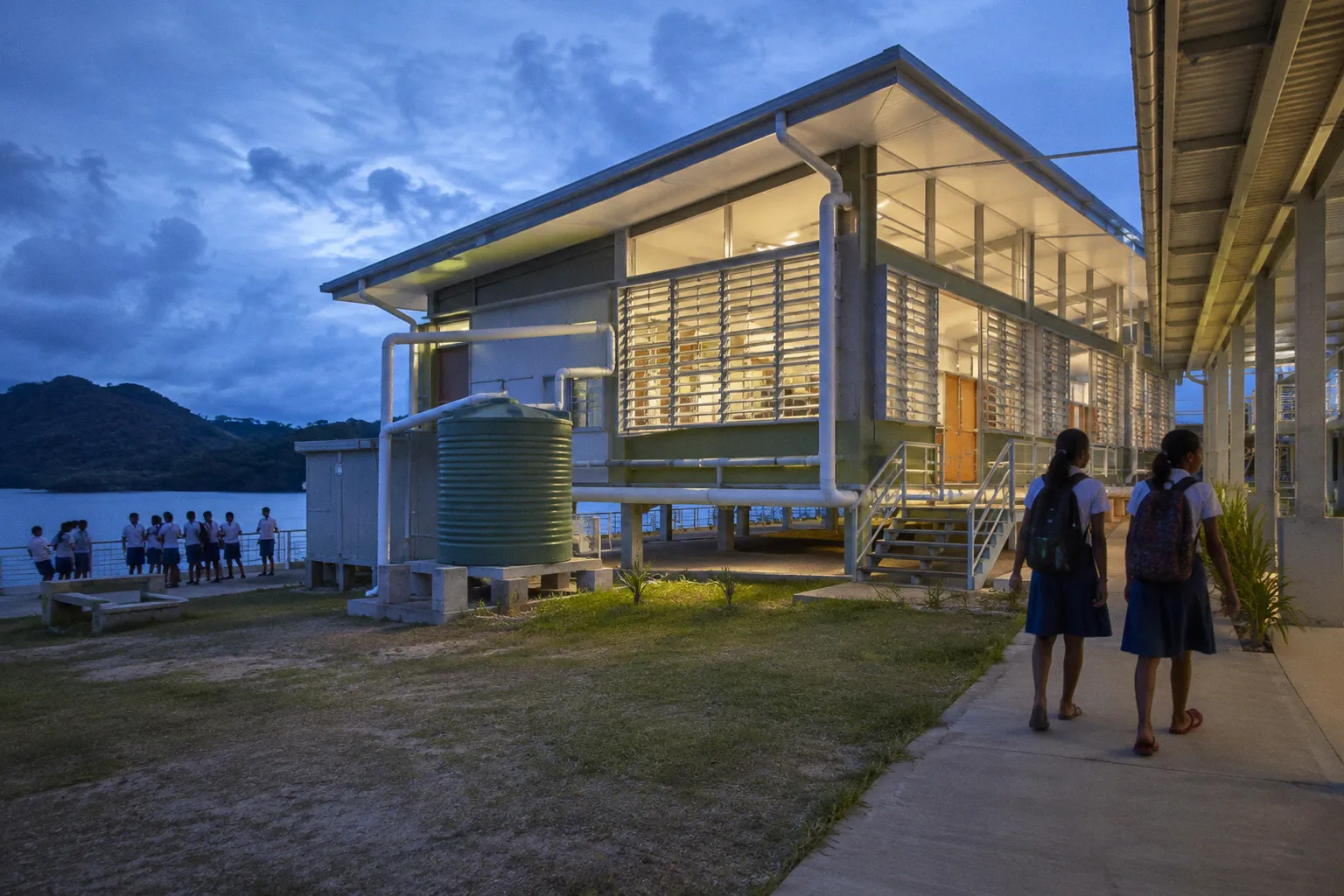
We're not riding that route, but the spec sheet they're funding is the one we should be running through every rural rebuild we anchor. Climate-resilient water, renewable power, maintenance budgets baked in from day one — that is the difference between a school that survives its fifth monsoon and a slab that doesn't make it past the second.
What's actually in the package
The programme, called Pacific Climate Resilient Education Systems, runs five years across Fiji, the Federated States of Micronesia, Kiribati, and Solomon Islands. Those are the classrooms that take a beating every cyclone and flood season, get patched, then get hit again. The new money funds climate-resilient WASH facilities, renewable energy systems, connectivity upgrades, and — this is the line item most rebuilds skip — long-term maintenance planning. Headline numbers floating in the announcement: around 15,000 children, 2,000 teachers and administrators, and 25,000 community members pulled into disaster risk reduction and maintenance activity over the programme window. Implementation runs through the host Ministries of Education alongside UNICEF, national disaster management offices, and climate authorities. The agreement was signed in Koror by Marjeta Jager, Deputy Director-General for International Partnerships at the European Commission, and Roshni Basu, UNICEF Pacific's Deputy Representative.
What that means for our builds
Here is the friction point we keep hitting on the dirt road. We pour the slab, hang the doors, ride out. Then the next monsoon rolls through, the roof leaks, and nobody budgeted a maintenance crew. The Pacific CRES setup tries to break that loop by treating maintenance as core infrastructure, not an afterthought you pray somebody picks up later. If you are scoping a rural rebuild anywhere in the monsoon belt — Indian subcontinent included — run the same checklist before the first brick goes down. Water source redundancy. Sanitation that survives flooding. Power that does not depend on a single grid line for two weeks at a stretch. A maintenance line item that survives the next budget cycle. Renewable is not a buzzword when the diesel truck cannot reach the village. UNICEF's Pacific office framed the programme as a long-term fix rather than a short-term patch, and that framing is the one we should be carrying into our own project plans. Stop chasing ribbon-cuttings; chase the spec that keeps the building standing.
What else moved on the wire
Pennsylvania's governor signed a 2026-27 budget that adds $678 million to public school funding on top of roughly $3 billion in cumulative increases since taking office, with $11.85 billion total going into the state's students this year. Northern Ireland's education minister pushed three post-primary capital projects into the design and planning phase. The UN-hosted GHES II process launched a higher education consensus statement calling for collective action. None of those routes cross our maps, but the throughline holds: infrastructure money, maintenance money, and the political will to keep both flowing past the ribbon-cutting. Spec it before you build it. Water. Power. Sanitation. Maintenance line. If the plan does not carry all four in writing, the next storm writes the post-mortem.