Community diaper bank setup: a pre-launch checklist
Nearly one in two families in the United States struggles to afford enough diapers to keep their children clean, dry, and healthy — a statistic that, once you sit with it, rearranges your understanding of what "basic need" actually means.
Diapers are not covered by federal food assistance programs like SNAP or WIC, which means that for millions of households, the monthly cost of keeping an infant in clean diapers falls entirely outside any safety net we've collectively agreed to fund. And yet the conversation around diaper need remains strangely peripheral in mainstream welfare discourse, overshadowed by flashier causes and more photogenic campaigns. I've spent enough time at the intersection of community organizing and grassroots welfare work to know that the most transformative projects often begin with the least glamorous inventory — in this case, stacks of size 4s and 5s in a borrowed church basement, sorted by volunteers on a Tuesday evening.
What follows is not a theoretical framework. It's the practical architecture of getting a community diaper bank from the idea stage to the point where families walk through your door and leave with what they need. Every section here reflects a real operational decision you'll face, and each one matters more than it might first appear.
Legal Foundations and Fiscal Sponsorship Requirements
Before you collect a single diaper, you need to answer a structural question: how will this operation exist in the eyes of the law and the donor community? The most common path for grassroots diaper banks is obtaining 501(c)(3) tax-exempt status, which allows you to accept tax-deductible donations and opens the door to institutional partnerships. But the application process for independent 501(c)(3) status is neither quick nor inexpensive — it requires articles of incorporation, bylaws, an Employer Identification Number, and a filing fee, and the IRS review can take several months.
For many first-time organizers, the smarter entry point is a fiscal sponsorship arrangement. A fiscal sponsor is an existing 501(c)(3) organization that agrees to serve as your legal and financial umbrella while you build the operational muscle of the diaper bank under their exempt status. This is not a formality or a rubber stamp — it's a genuine partnership that typically involves a written agreement outlining how funds are managed, what reporting you'll provide, and what autonomy you retain over programming decisions. The advantage is speed: you can begin fundraising and collecting donations almost immediately, without waiting for the IRS to process your standalone application.
If your ambition is to eventually join the National Diaper Bank Network — which now comprises more than 300 member basic needs banks across the country — you'll need to demonstrate either independent 501(c)(3) status or an active fiscal sponsorship, pay membership dues, and sign a member agreement. The network provides access to bulk purchasing partnerships, advocacy resources, and a peer community of organizers who've already navigated the terrain you're entering. It's worth building toward, even if it's not your day-one priority.
The legal structure isn't bureaucracy for its own sake — it's the foundation that tells donors, partners, and families that this operation is real, accountable, and here to stay.
Securing Clean Storage and Logistics Infrastructure
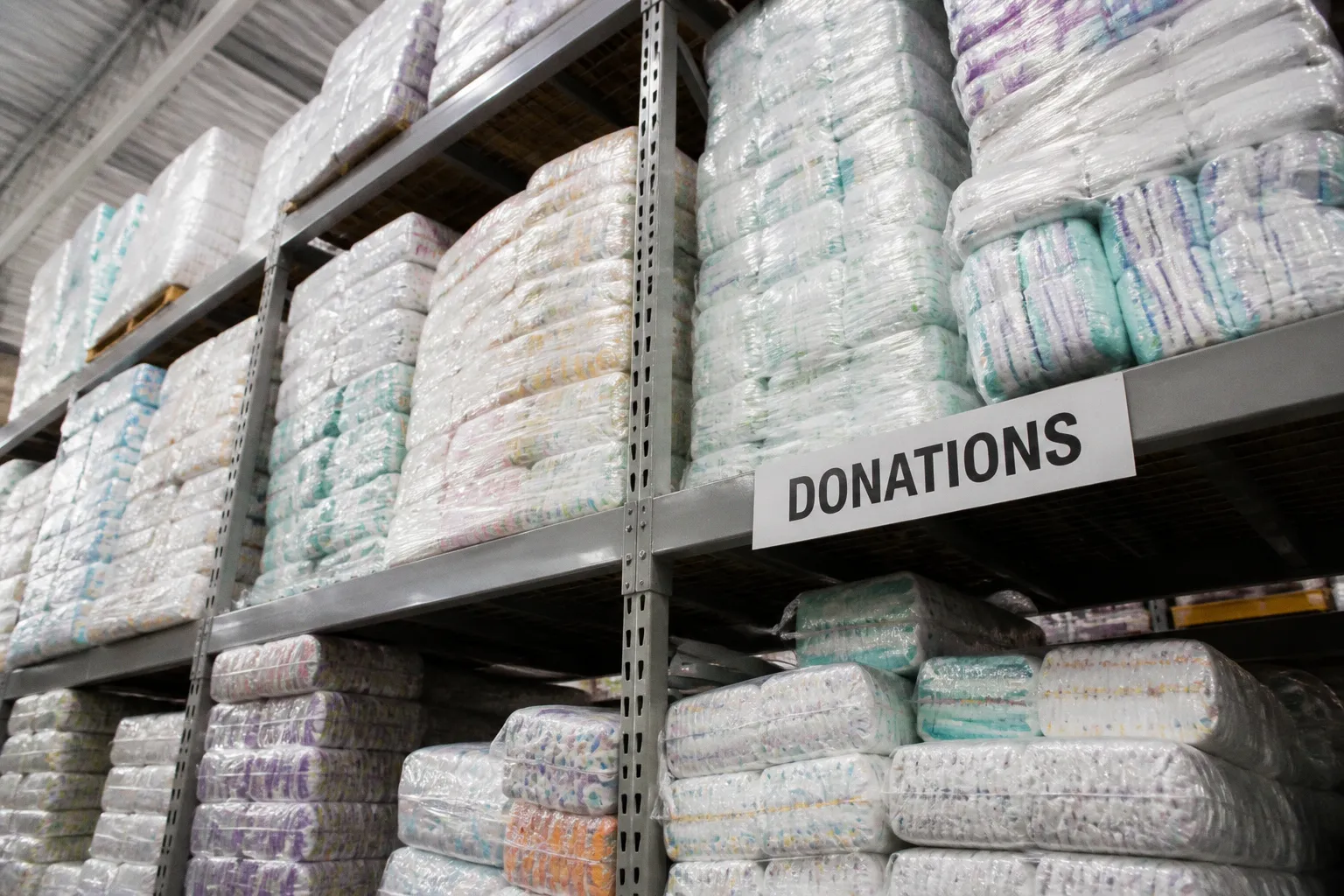
Diapers are bulky. This is a logistical reality that catches many first-time organizers off guard. A single case of diapers occupies roughly the same footprint as a medium moving box, and when you're aiming to serve dozens or hundreds of families per month, the volume adds up with startling speed. You need a dedicated, clean, dry, and climate-appropriate storage space — and "climate-appropriate" matters more than you might think, because damp or excessively hot conditions can degrade packaging and compromise the product before it ever reaches a family.
The most common solutions I've seen work well include donated space in houses of worship, community centers, or even unused rooms in partner organizations' offices. The key criteria are straightforward: the space must be accessible enough for regular volunteer shifts, secure enough to prevent theft or tampering, and large enough to accommodate both incoming donations and outgoing distribution kits without creating a bottleneck. Some organizers invest in industrial shelving early; others start with donated bookcases and plastic bins. Both approaches work, but labeling and organization from the outset will save you enormous headaches later.
Transportation is the other half of this equation. How will diapers move from donation drop-off points to your storage facility, and from storage to your distribution sites? If you're operating on a shoestring — and most diaper banks do initially — you're looking at volunteer vehicles, borrowed vans, and the occasional coordination with local businesses willing to lend a truck for a few hours. Map these routes before your first drive, not during it.
Strategic Diaper Drive Planning and Inventory Management
Community diaper drives are the lifeblood of most diaper banks, but a successful drive is more than a social media post and a collection bin. Organizers consistently recommend planning drives over a timeframe of one week to one month, which gives donors enough time to participate without letting the momentum dissipate. Shorter drives create urgency; longer ones allow for workplace campaigns and faith-community coordination. The sweet spot depends on your community's rhythm.
Here's where inventory strategy becomes critical: not all diaper sizes are created equal in terms of demand. Sizes 4 through 6 are consistently the highest-need items across diaper bank programs nationwide, because infants and toddlers in those size ranges tend to wear diapers for longer periods, and families with older babies are often deeper into financial strain as parental leave benefits and early savings have been exhausted. When you publicize your drive, be specific about what you need. A call for "diapers" will yield a mountain of newborn sizes from well-meaning donors whose own children have long since outgrown them. A call for "sizes 4, 5, and 6 — the sizes families actually run out of first" yields what your families need.
| Planning Element | Recommended Approach | Why It Matters |
|---|---|---|
| Drive duration | 1–4 weeks | Balances urgency with donor participation windows |
| Priority sizes | Sizes 4, 5, 6 | Highest sustained demand across family demographics |
| Collection points | Multiple, geographically spread | Reduces donor friction, increases participation |
| Timing | Late September (Diaper Need Awareness Week) | National visibility amplifies local messaging |
| Monetary donations | Always accept alongside physical goods | Allows bulk purchasing at lower per-unit cost |
Monetary donations deserve special attention. Cash allows you to purchase diapers in bulk at significantly lower per-unit costs than retail, and it lets you fill gaps in specific sizes that physical drives don't cover. Make it easy for people to give money, not just product.
Partnering with Local Agencies for Effective Distribution
A diaper bank that operates in isolation — disconnected from the agencies and organizations already serving families in need — will struggle to reach the people who need it most. This is where the work shifts from logistics into relationship-building, and it's the part I find most essential to get right.
Start by mapping the landscape of local organizations that already have trusted relationships with low-income families: WIC offices, Head Start programs, homeless shelters, domestic violence services, pediatric clinics, food banks, and faith-based outreach ministries. These organizations don't just refer families to you — they provide context. They know which neighborhoods are underserved, which populations face language barriers, and which families are navigating overlapping crises that make even a modest diaper expense unmanageable.
The goal is integration, not duplication. If a food bank already distributes hygiene kits on Thursdays, perhaps your diapers join that distribution rather than creating a competing event on a different day. If a domestic violence shelter serves families who can't easily travel to a public distribution site, perhaps you arrange discreet delivery. Each partnership should be shaped by dialogue with the partner organization about what serves their clients best, not by a one-size-fits-all model you impose from the outside.
Stewardship means building the diaper bank around the lives of the families it serves — not asking families to rearrange their lives around your schedule.
Distribution models vary. Some diaper banks operate as open pantries where families self-select from available inventory. Others pre-pack kits by size and distribute them at scheduled events. Still others deliver directly to partner agencies who handle the last-mile connection to families. Each model has trade-offs in terms of dignity, efficiency, and resource requirements. The right choice depends on your community's geography, your volunteer capacity, and — most importantly — the expressed preferences of the families themselves. Ask them. The answer might surprise you.
Mobilizing Volunteer Networks for Sorting and Packing
More than half of all diaper bank programs in the United States rely entirely on volunteer labor to sort, pack, and distribute diapers. This is both a strength and a vulnerability. Volunteers bring energy, community connection, and a sense of shared ownership that paid staff alone cannot replicate. But volunteer-dependent operations are only as reliable as their systems for recruitment, training, and retention.
The sorting and packing process itself is straightforward but physically demanding. Donated diapers arrive mixed — different brands, different sizes, some loose, some in open packages. Volunteers need to sort by size, count inventory, repackage into distribution-ready bundles, and flag any damaged or expired product. A well-organized packing shift for a team of eight to ten volunteers can process several hundred diapers in a couple of hours, but only if the workspace is laid out logically and the process is clearly explained before anyone picks up the first pack.
Recruit with specificity. "We need volunteers" is easy to ignore. "We need six people next Saturday from 10 a.m. to 1 p.m. to help us sort 2,000 diapers so forty families can pick up supplies next week" is a call to action that connects effort to outcome. People want to know their time matters. Show them how it does.
Retention is the long game. Volunteers who feel like interchangeable labor won't return. Volunteers who understand the families they're serving, who see the distribution day photos, who hear that a mother was able to send her child to daycare because she had enough diapers that week — those volunteers come back and bring others with them. Build feedback loops between the sorting room and the distribution site. Close the distance between the work and its purpose.
Timing Your Launch Around National Momentum
One strategic consideration that's easy to overlook: National Diaper Need Awareness Week takes place annually at the end of September. This is a period of heightened media attention, corporate giving campaigns, and public engagement around diaper need — and it's an ideal window to launch a new diaper bank or run your first major drive. The national conversation creates a tailwind that local organizers can ride, amplifying your message far beyond what your own channels could achieve in isolation.
The diaper bank movement itself has deep roots. It originated in Tucson, Arizona, in 1994, when a local organizer recognized that families were making impossible choices between diapers and other essentials — and that no existing assistance program addressed the gap. The National Diaper Bank Network was formally established in 2011 to coordinate and support the growing number of community-level efforts. You're not starting from nothing. You're joining a lineage of organizers who saw the same need you see and built something to meet it.
What This Work Actually Requires
I want to be honest about something that operational checklists tend to gloss over: starting a diaper bank requires sustained attention to a problem that is neither glamorous nor politically fashionable. There are no viral moments in sorting diapers by size. There is no TED talk in negotiating storage space at a community center. The work is granular, repetitive, and deeply necessary.
What it asks of you, as an organizer, is a particular kind of agency — the willingness to see a gap in the welfare infrastructure and fill it with whatever tools you have, while remaining in genuine dialogue with the families and partner organizations whose lives your decisions will affect. The legal structure, the storage logistics, the drive planning, the partnerships, the volunteer networks — these are not separate tasks to be checked off a list. They are interconnected systems, and the quality of each one depends on the strength of the others.
If you're reading this because you've already seen the need in your community — a parent rationing diapers, a daycare turning away a child, a family choosing between formula and clean changes — then you already have the most important ingredient: the conviction that this is worth doing. The rest is stewardship. And stewardship, at its best, is just the practice of showing up for your neighbors with intention, consistency, and care.