L'Hemisfèric tickets: navigating booking options for visitors
The first thing worth understanding about L'Hemisfèric tickets is that you are not buying admission to a building. You are buying a seat for one specific showing, on one specific date, at one specific time.
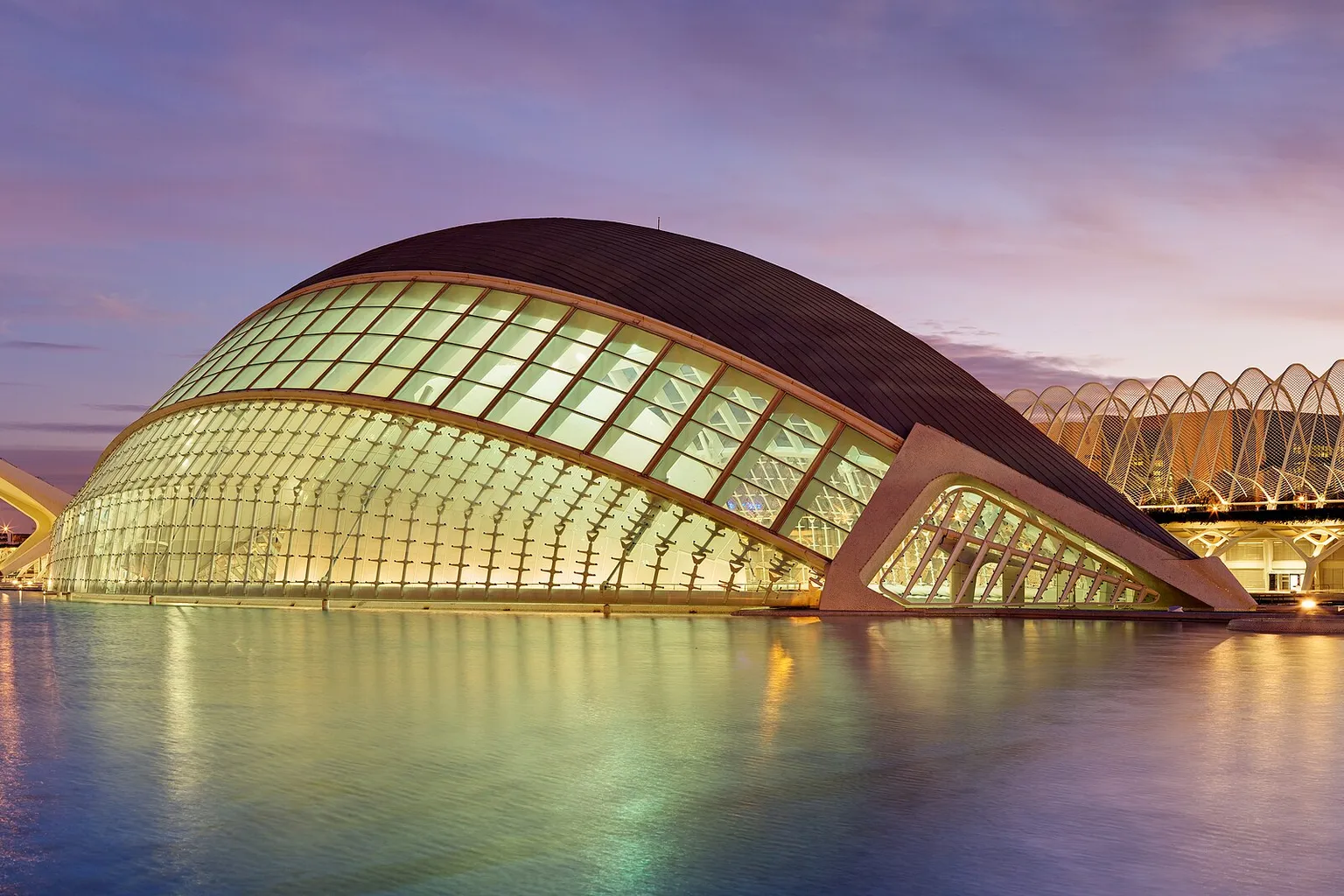
That distinction shapes everything else: which booking channel makes sense, which ticket tier fits your group, whether a combined City of Arts and Sciences pass earns its keep, and how early you need to be at the entrance.
Tickets and prices
L'Hemisfèric
| Option | Type | Duration | Rating | From | |
|---|---|---|---|---|---|
| Entry ticket · 1-hour 3D filmGetYourGuide | other | 1 hr | ★ 4.1476 reviews | from€9 | Check availability |
| Combo ticket · Aquarium, science museum & 3D theaterGetYourGuide | combo ticket | — | ★ 4.43,407 reviews | from€46 | Check availability |
| Combo ticket · Science museum & 3D theaterGetYourGuide | combo ticket | — | ★ 4.4110 reviews | from€14 | Check availability |
| Combo ticket · Aquarium & 3D theaterGetYourGuide | combo ticket | — | ★ 4.4215 reviews | from€39 | Check availability |
| Official ticket · Science museumOfficial | official ticket | — | — | from€7.20 | Check availability |
At the box officeAdult€6.90Official website — tickets.cac.es
Walk in expecting the rhythm of an art museum and you may find yourself standing outside the projection hall with a perfectly valid receipt but no usable slot for the screening you wanted. L'Hemisfèric is not a venue where visitors drift in, look around, and decide what to do next. The session is the centre of the visit.
L'Hemisfèric opened in 1998 as the inaugural building of Santiago Calatrava's City of Arts and Sciences complex on the former bed of the Túria river. Its programme has changed over the years, but the basic arrangement remains consistent: one audience, one film, one shared stretch of looking upward into a large concave screen before everyone leaves and the next session begins.
A typical projection runs for approximately forty-five to fifty minutes. The venue treats each showing as a closed session, and latecomers are not admitted once the house lights have gone down. Booking is therefore a small commitment rather than a casual add-on. Choose the screening that fits the rest of your day, then arrange the rest of the day around it.
Understanding the single-session booking model
A standard L'Hemisfèric ticket covers one projection session. Whether you book through the official City of Arts and Sciences website or through a third-party reseller, the booking process normally requires you to settle three details before payment: the date, the time slot, and the title of the show.
The programme changes during the year. Planetarium sessions, large-format documentaries, and 3D features rotate through the schedule, so the selection available during one season may not resemble the programme offered several months later. There is no general admission ticket that lets you choose any film on any day, and there is no automatic re-entry if you leave the auditorium during the screening. A return to the next showing requires a separate valid booking.
That is the point at which many first-time visitors misread the venue. The Museu de les Ciències next door follows a different logic: you can enter during opening hours, move through its galleries at your own pace, and stay for as long as the ticket conditions allow. L'Hemisfèric works more like a cinema or a scheduled performance. The time on the ticket is not a suggestion. It is the appointment.
The ticket in your hand is for a single performance, not for the building. Plan the day around the showing, not the other way around.
The difference matters even when you hold a combined pass for the complex. A pass may cover access to several attractions, but it does not remove the need to select a session for L'Hemisfèric. You still need a showing time, and popular sessions can become difficult to fit into the rest of your itinerary if you leave the choice until the last minute.
The practical sequence is simple:
1. Look at the available L'Hemisfèric sessions first, especially if a particular film or language option matters to your group.
2. Choose the time that leaves a realistic buffer before and after the projection.
3. Book the Museu and Oceanogràfic around that fixed point rather than trying to force the screening into an already crowded schedule.
4. Keep the booking confirmation accessible on the day, along with any documentation needed for a reduced ticket.
Reversing that order can leave you with an awkward early-morning or late-afternoon slot. Midday screenings often fit family itineraries more comfortably, but they are also the sessions many visitors try to secure first.
What availability really tells you
L'Hemisfèric ticket availability is not only a question of whether a date appears in the calendar. You also need to check how many sessions are offered that day, which titles are running, and whether the available times work with the rest of your visit. A date with several screenings gives you more flexibility than a date with one attractive title at an inconvenient hour.
The programme can also matter more than the time. A visitor looking specifically for a planetarium-style presentation or a film with a particular language arrangement should not select the first available slot and investigate the content later. Read the title and session description before completing payment. The most convenient time is not necessarily the right booking if the programme is the central reason for visiting.
This is also where online booking has a practical advantage. Checking the calendar before arriving lets you compare sessions without standing at a ticket counter while the rest of the group waits. It gives you a clearer view of the day's shape and makes it easier to notice when a combined attraction pass would create an unrealistic timetable.
Navigating ticket tiers and discount eligibility
The exact prices and eligibility rules can change, but the structure is relatively easy to understand. Most visitors fall into one of four broad categories: standard adult admission, a reduced rate, free admission for very young children under the venue's applicable conditions, or a discount linked to a Valencia Tourist Card.
The standard adult rate is the reference price shown at the ticket office and on most booking platforms. Reduced admission generally applies to children in the stated child age bracket, older visitors, and people with disabilities. The boundaries and documentation requirements should be checked at the time of purchase rather than inferred from a travel forum or an old screenshot.
Children under four may enter free under the venue's conditions, typically without occupying a separate seat in the same way as an older child. That arrangement is particularly relevant for families because a dome projection lasting approximately forty-five to fifty minutes can be a long time for a very young child to remain still. The free-entry rule does not necessarily mean that every practical detail is identical to a standard child booking, so read the conditions attached to the session before payment.
Visitors using a Valencia Tourist Card may receive a percentage discount on individual purchases at participating attractions. Whether that discount is worthwhile depends on the rest of the trip. If the card will also be used for public transport and other paid attractions, the calculation may work in its favour. If the only planned activity is one Hemisfèric screening, the card should not be treated as an automatic saving.
| Category | Who may qualify | What to check |
|---|---|---|
| Standard adult | Visitors outside the reduced categories | The selected session, date, and ticket conditions |
| Reduced admission | Children, older visitors, and visitors with disabilities under the venue's stated rules | Age limits and any supporting document required at entry |
| Free admission | Very young children under the applicable conditions | Whether the child needs a separate booking or sits with an accompanying adult |
| Valencia Tourist Card holder | Visitors presenting a valid card where the discount applies | Whether the discount is available for the chosen booking channel and product |
The table is a useful orientation, not a substitute for the current terms. Discount categories are only helpful when the booking system and the entrance staff can match them to the visitor using the ticket. If someone in your party qualifies for a reduced rate, keep the relevant identification or proof close at hand even if you are not expecting it to be requested.
For a mixed-age group, booking everyone in one transaction is usually the least confusing option. It keeps the date and session together, reduces the risk of assigning one traveller to the wrong time, and makes it easier to see which ticket type has been applied to each person. Separate transactions can make sense when different members of the group are arriving independently, but they also create more opportunities for mismatched times and incomplete confirmations.
A reduced ticket is not useful if the person cannot demonstrate eligibility at the entrance. Conversely, there is no advantage in choosing a standard adult ticket for everyone simply to avoid reading the conditions. Check the categories before payment, and make a note of which member of the group is attached to each concession.
Maximizing value with combined City of Arts passes
The City of Arts and Sciences is a cluster of attractions rather than a single building. For visitors intending to see more than one of them, a combined pass can be more useful than purchasing each admission separately. Depending on the product, the pass may include L'Hemisfèric, the Museu de les Ciències, and the Oceanogràfic, with validity arranged across one, two, or three consecutive days.
The important point is that a combined ticket changes the financial calculation, not the scheduling logic. You still need to choose an L'Hemisfèric session. You still need to arrive on time. You still need to allow enough space in the itinerary to walk between buildings and deal with entry procedures. The pass gives you broader access; it does not turn a scheduled projection into an open-ended museum visit.
Whether it offers good value depends on how many attractions you genuinely plan to use. If L'Hemisfèric is the only destination on your list, an individual session ticket is usually the cleaner choice. If you also expect to visit the science museum or the aquarium, the combined option may make more sense, particularly when the Oceanogràfic is part of the plan.
There is no advantage in buying a broader pass merely because it appears comprehensive. The pass is useful when it reflects the shape of your day. An aquarium visit can take substantial time, while the science museum rewards a slower, more flexible pace. Adding a scheduled projection to both is possible, but only if the timetable leaves room for movement, breaks, food, and the inevitable pauses that come with travelling as a group.
For families with different interests, the pass can provide a different kind of value. One child may be more interested in marine life, another in the planetarium or large-format film, while adults may prefer the museum's interactive exhibits. The combined arrangement allows the group to divide attention across the complex rather than treating every attraction as a single shared block.
A sensible comparison looks like this:
- Choose an individual L'Hemisfèric ticket when the screening is the main purpose of the visit or when the rest of the complex is not part of your plan.
- Consider a combined pass when you are certain that at least one other major attraction will be visited.
- Use the multi-day validity strategically when available, especially if trying to cover the aquarium, museum, and Hemisfèric in one day would make the schedule uncomfortably tight.
- Book the screening slot early even if the pass itself gives you access to several venues. The pass does not guarantee that every session will remain available.
The most common mistake is to think of the combined pass as permission to improvise. It is better understood as a way to spread the cost and the visit across the complex while keeping the Hemisfèric appointment fixed.
When a combined ticket becomes a scheduling problem
The attractions do not all demand the same kind of attention. A short screening can look easy to fit between two longer visits, but the transition itself takes time. Visitors need to leave one venue, find the next entrance, use facilities, collect food or water, and regroup after separating inside a large complex.
For that reason, the best time to visit L'Hemisfèric is not necessarily the first or last session offered. A screening in the middle of the day can anchor the itinerary, but only if the activities before and after it are close enough in practice. A late session may leave more room for the aquarium or museum earlier, yet it can also create pressure if the group has evening transport or dinner plans.
If you have several days available, using the pass across separate days can be more comfortable than treating every attraction as a challenge to complete in one visit. The value of a multi-day product is not only financial. It can remove the pressure to rush through exhibitions merely because the pass includes them.
Logistics for a seamless screening experience
L'Hemisfèric is one of the buildings within Valencia's City of Arts and Sciences complex. The site is extensive, and the building's distinctive architecture does not eliminate the practical need to confirm your route, entrance, and arrival point before the day of the screening.
It is possible to arrive by car, but parking and weekend traffic can add uncertainty to a schedule that already depends on a fixed start time. Public transport is often the calmer option for visitors staying in central Valencia, with routes serving the complex and a walk required for the final approach. Whichever method you choose, allow for the last part of the journey rather than calculating only the time needed to reach the general area.
Give yourself time to find the correct entrance. The architecture is memorable, but the scale of the complex can make the last part of the journey less straightforward than it looks on a map. A visitor who arrives at the site ten minutes before the show may still need to cross a plaza, orient themselves, find the entrance, and deal with the ticket check. The useful margin is the time before you reach the building, not merely the time before the film begins.
Aim to be at the auditorium entrance at least ten minutes before the published start time. More time is sensible if you are travelling with children, using reduced tickets, or combining several attractions. Once the screening begins, late admission is generally not permitted. This is partly a matter of consideration for the audience and partly a consequence of the room itself: the dome, the darkened interior, and the seating layout make a mid-show entrance disruptive.
The screening lasts approximately forty-five to fifty minutes, so factor that duration into every onward booking. A session that starts at one time does not mean that you will be walking away from the building immediately when the listed start time is reached. Allow for the full projection, the departure of the audience, and the walk to the next attraction.
On arrival, visitors may receive or collect an audio headset for the presentation. The available narration languages should be checked for the specific programme and booking conditions, but the venue commonly provides several language options, including Spanish, Valencian, English, and French. Do not assume that every film uses the same audio arrangement simply because a previous visitor describes it that way. The title of the show and its format can affect what is available.
A little arrival time protects the part of the visit that cannot be recovered: the fixed start of the screening.
The same principle applies to food and transport. A quick meal immediately before the projection can become stressful if the restaurant is on the opposite side of the complex. A plan to catch a timed bus or reserve a later attraction should include more than the nominal film length. Scheduled venues reward spare capacity; they punish optimistic arithmetic.
Building the day around the session
A reliable itinerary usually has one fixed point and several flexible areas around it. L'Hemisfèric should be the fixed point. The museum galleries, a walk through the complex, a meal, and some shopping or photography can be arranged before or after it, with enough space to absorb delays.
The exact amount of buffer depends on the group. Travelling alone with a digital ticket is different from travelling with young children, a person who needs accessible routes, or several people using different ticket categories. A schedule that feels generous on paper may become tight once everyone has to stop at the same entrance and produce the relevant documents.
Weather also deserves a place in the calculation. Much of the movement between buildings takes place outdoors, and heat can slow down a group even when the distance looks modest. A sunny day may make the complex enjoyable to walk through, but it can also make a tightly packed itinerary more tiring than expected. Water, shade, and a realistic pace are practical parts of the ticket plan, not distractions from it.
Essential rules for entry and auditorium seating
Seats inside the auditorium are generally unnumbered. You choose a place after entering, so the order in which the audience arrives can influence the available seating. The front-centre area often attracts visitors who want a direct view into the dome. Families with small children may prefer the back rows or an aisle for a simpler exit, while visitors who are sensitive to steep or immersive visuals may feel more comfortable choosing a position with an easier view of the surrounding room.
There is no reason to treat the first row as automatically superior. The screen is large, and the geometry of a dome projection can feel different from a conventional cinema. A seat that looks attractive on a diagram may not be the most comfortable choice for someone prone to motion sickness or discomfort when looking upward for a long period.
If your group has specific seating needs, arrive early enough to make a considered choice. Staff may direct visitors through the auditorium or reserve certain areas for operational reasons, and the final arrangement can depend on the session. The key point is that a general L'Hemisfèric ticket does not normally give you a numbered seat selected during checkout.
Children, accessibility, and comfort
Families should consider more than whether a young child can enter free of charge. The dark auditorium, the duration of the projection, the sound level, and the immersive image can all affect how comfortable the experience feels. A child who is happy in a conventional cinema may still find a dome presentation unfamiliar.
Choose the most practical seating position available rather than pursuing the most dramatic view. An aisle or rear position can make it easier to leave quietly if a child becomes restless. It can also reduce the pressure on the rest of the group if someone needs a short break.
Visitors with mobility requirements or other access needs should review the current venue information before booking and contact the relevant service if the online description does not answer a specific question. A ticket confirms admission to the session, but it may not answer every question about routes, companion arrangements, or auditorium access. Sorting out those details before payment is less stressful than trying to resolve them at the door.
The rules for 3D sessions deserve particular attention. Do not assume that every booking channel describes the glasses, accessories, or collection procedure in the same way. Information about how 3D glasses are supplied may not be consistent across every product, and the available research does not establish a universal policy for all bookings. The safest approach is to read the terms attached to the exact session and ticket you are purchasing.
If the booking page is unclear, check the venue's current instructions before payment or ask the reseller to confirm what is included. This is especially important when a third-party package combines the screening with transport, a guide, or another attraction. The product title may be broad, while the conditions contain the details that determine what happens at the door.
The same caution applies to changes, refunds, and cancellations. A ticket purchased through the official site and a ticket supplied by a reseller may be governed by different procedures. Save the confirmation, note the name of the booking channel, and check the conditions before assuming that a missed session can be transferred to another time.
If you are combining L'Hemisfèric with the Oceanogràfic on the same day, leave a generous gap between the end of the projection and any timed aquarium entry. The buildings are on different sides of the complex, and the walk along the landscaped promenade can take longer than expected, particularly in hot weather or with a group that includes young children. A schedule that looks efficient on paper can become unpleasant once it includes toilets, water, photographs, and the simple process of getting everyone moving in the same direction.
Choosing the right booking route
The official City of Arts and Sciences website is usually the most direct place to see the venue's own session availability, programme information, ticket categories, and current conditions. It is the natural starting point when the screening itself is the priority. You can compare dates and titles before committing to a time, and the ticket conditions are connected to the venue's own booking process.
A third-party platform can still be useful when it forms part of a wider travel purchase or when you are comparing a package that includes other attractions. The trade-off is that the reseller's terms may apply to changes, refunds, customer support, and the presentation of the ticket at entry. A lower headline price does not automatically mean a better booking if the product is less flexible or leaves out an item you expected to be included.
Before choosing a booking channel, compare the details rather than only the price:
- Is the ticket for a named date and session, or does it require a later reservation?
- Is the film or presentation clearly identified?
- Are adult, child, reduced, and free-entry categories described?
- Does the product include only L'Hemisfèric, or also the museum or Oceanogràfic?
- Are changes and cancellations explained in plain terms?
- Will you receive an instant confirmation that can be shown at the entrance?
- If the session is 3D or uses a particular audio arrangement, is that detail stated?
The official channel is often the least complicated choice for a straightforward individual visit. A reseller can be reasonable when the package genuinely matches the rest of the itinerary, but read the conditions attached to that specific product. Two tickets that look similar in a search result can have different rules once you open the full description.
Keep the confirmation available offline if possible. Mobile coverage is not the part of the experience worth testing at the entrance, and a saved document is easier to find when a group is waiting behind you. If the booking includes reduced admission, keep the supporting documentation with the ticket rather than leaving it in another bag.
Making the final choice
The best way to book tickets for L'Hemisfèric is to begin with the session rather than the pass, discount, or attraction bundle. Check the programme, identify the date that fits your trip, and decide whether the available time can coexist with the museum or Oceanogràfic. Only then compare ticket categories and combined options.
For a simple visit, an individual ticket is usually the clearest route: one date, one showing, one audience. For a broader City of Arts and Sciences itinerary, a combined pass may offer better value, but it still requires the same discipline around the fixed screening time. The pass expands what you can visit; it does not make the timetable less real.
Ticket availability can change as the date approaches, particularly when a specific film, language arrangement, or family-friendly time is important. Booking too early without checking the terms can be unhelpful, but leaving the screening until the final stage of a tightly planned day is worse. The practical middle ground is to confirm the programme and conditions, select the session that anchors the itinerary, and then build the rest around it.
L'Hemisfèric works best when treated as a scheduled experience rather than a background stop. Once that is clear, the booking choices become easier: select the right session, choose the ticket category you can document, use a combined pass only when the rest of the complex is genuinely part of the plan, and arrive with enough time to enter without rushing. The dome may be the visual centre of the visit, but the success of the visit is decided before the lights go down.
Practical info
Currency: EUR
Driving: on the right
Emergency number: 112
FAQ
Can I enter L'Hemisfèric at any time during the day?
Do I need to book a session if I have a combined City of Arts and Sciences pass?
Are seats in the auditorium assigned?
Are there discounts available for L'Hemisfèric tickets?
What happens if I arrive late for my scheduled screening?
Photo: Diliff / CC BY 2.5 — Wikimedia Commons