Grassroots aid models: which path suits your community?
In the first six weeks following the February 2022 escalation in Ukraine, an estimated 1,700 newly formed local aid groups activated across the country.
That mobilization outpaced the roughly 150 pre-existing national NGOs and church-based organizations already operating inside the territory by a factor of more than ten. The disparity is not anecdotal; it is a measurable indicator of where response capacity actually sits when centralized systems are slow to deploy. Conventional humanitarian architecture typically requires 72 to 96 hours to establish a field presence, while a neighborhood committee with private vehicles, a shared spreadsheet, and a messaging app can move food, medicine, and shelter within a single afternoon. For community leaders weighing which grassroots aid distribution method deserves investment, the decision is rarely ideological. It is a question of resource allocation, sustainable yield, and which bottleneck each model is engineered to remove.
Compare car rental deals in United Kingdom
See available offersPartner link — DiscoverCars comparisonThis analysis compares the three principal grassroots aid distribution methods in active circulation - physical resource hubs, crisis-mobilized networks, and direct financial transfers - and overlays the digital and volunteer-logistics layer that makes any of them operational. Each carries distinct cost structures, scalability ceilings, and impact metrics. None is universally optimal. The objective is to match distribution architecture to community conditions.
Mapping the Decentralized Landscape
Grassroots aid distribution methods fall into three functional archetypes, with a coordination layer that operates across all three. The archetypes are not mutually exclusive; mature community welfare campaigns frequently combine two of them, and effective implementation always depends on the coordination layer beneath them.
| Parameter | Physical resource hubs (community fridges, local pantries) | Crisis-mobilized networks (ERRs, Ukraine local groups) | Direct financial transfers (UCTs) |
|---|---|---|---|
| Primary resource distributed | Food, hygiene items, small goods | Multi-sector: food, medicine, shelter, evacuation | Cash |
| Cost per recipient | Low (donation-driven, volunteer-stocked) | Variable; often zero cash cost, high volunteer hours | Moderate to high ($100–$1,000+ per transfer) |
| Recipients' agency | Limited; takes what is stocked | High; needs-matched via local coordinators | Highest; recipient allocates per own priorities |
| Speed of deployment | Days (physical setup) | Hours to days | Weeks (requires payment rails, ID verification) |
| Scalability ceiling | Refrigeration capital, spoilage rate, route density | Volunteer burnout, security risk in active conflict | Digital payment infrastructure, market density |
| Primary bottleneck solved | Stigma barrier, 24/7 access | Last-mile reach when formal agencies are absent | Supply-chain overhead, paternalistic targeting |
The table is descriptive, not prescriptive. Each row corresponds to a decision variable a partnership director or campaign lead must weigh: what is being distributed, at what unit cost, with what recipient agency, on what timeline, and against which operational friction.
Physical Resource Hubs: Community Fridges as Distribution Nodes
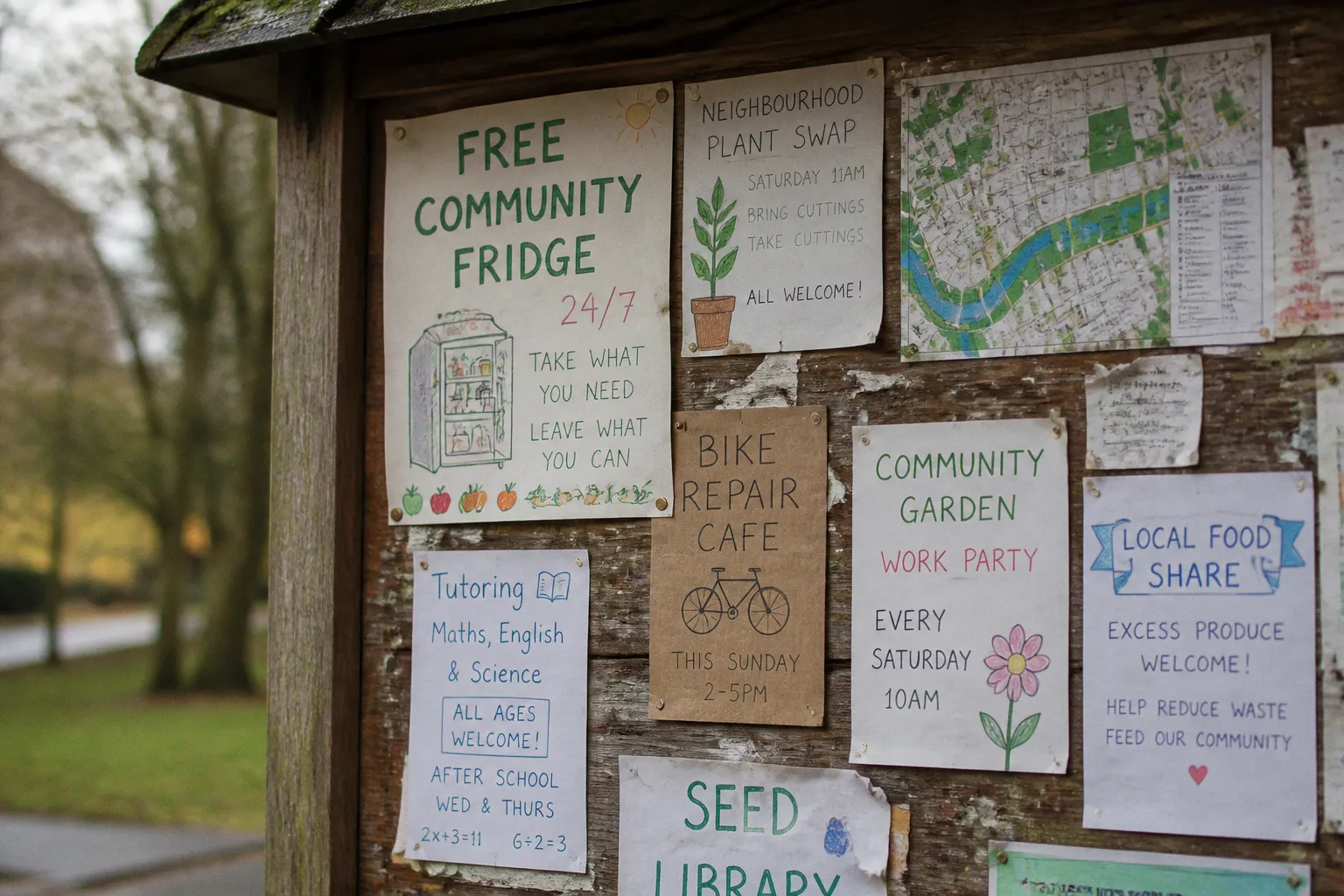
Community fridges - colloquially "freedges" - are the most visible form of grassroots resource hub. Operationally, they function as zero-paperwork, 24/7 nodes where any community member can deposit or withdraw food without registration, intake interviews, or eligibility screening. The model removes two structural frictions that suppress utilization of formal food assistance: the documentation barrier and the stigma barrier. A household that would not walk into a charity-run pantry will take yogurt from an unmarked refrigerator on a public sidewalk.
The performance data on this model is concrete. The Love Fridge in Chicago had distributed more than 10,000 pounds of food by November 2021, operating on a volunteer rotation and donated refrigeration units. The 19th Ward Mutual Aid network reported serving 4,953 families - an estimated 17,323 individuals - through June 2021. These are not pilot figures; they are sustained operational totals from volunteer-run infrastructure.
For a rural deployment, the model requires adaptation. A freedge in a dense urban walkshed captures foot traffic that a remote village cannot replicate. The equivalent architecture in a low-density area is the scheduled mobile pantry: a refrigerated van, a defined route, and a predictable cadence. Volunteer biker networks, where they exist, can substitute for vans on the last mile where road access fails, carrying smaller payloads more frequently. The relevant impact metric is not pounds distributed but households reached per operational hour, weighted by the cost of the routing layer required to maintain the cadence.
Community fridges remove the documentation and stigma barriers that suppress formal food assistance utilization; their bottleneck is refrigeration capital and route density, not beneficiary demand.
Crisis-Mobilized Networks: ERRs and Ukraine's Local Aid Wave
When centralized coordination collapses or fails to reach a geography, the crisis-mobilized network becomes the primary distribution channel. Two contemporary cases illustrate the architecture.
Sudan's Emergency Response Rooms (ERRs) emerged from neighborhood resistance committees and evolved into decentralized distribution networks operating soup kitchens, community clinics, and medicine delivery routes in areas where international agencies lacked access. The ERRs function as nodes of mutual accountability rather than as branches of a central command: each room decides its own priorities, sources its own supply lines, and reports to its own community. Coordination across rooms is informal and digital, not institutional.
In Ukraine, the parallel is the proliferation of approximately 1,700 local aid groups during the first six weeks of conflict. These operated alongside roughly 150 pre-existing national NGOs and church-based organizations, but the local groups handled the bulk of immediate humanitarian distribution because they were already on the ground. The structural lesson is unambiguous: pre-existing community infrastructure is the principal predictor of crisis response capacity. Organizations that have not built local trust before a crisis cannot purchase it during one.
For a partnership director evaluating this model, the relevant metrics are pre-crisis presence density and volunteer retention rate. Impact measurement in active conflict is necessarily approximate; what can be measured is whether the network existed before the crisis and whether it remained operational through it.
Direct Financial Empowerment: Unconditional Cash Transfers
Unconditional Cash Transfers (UCTs) distribute the resource that most directly transfers decision-making to the recipient: cash. Programs such as GiveDirectly route funds directly to households, typically via mobile money, allowing recipients to allocate the transfer against their own prioritized needs rather than against a donor's category list.
The unit economics are well documented. Cash transfers remove the warehousing, sorting, and distribution overhead that consumes 20–40 percent of in-kind aid budgets, depending on the geography. Recipients spend disproportionately on food, medicine, and shelter improvements - outcomes that track closely with what external needs assessments would have recommended, validating the recipient-allocation approach. The GiveDirectly model has logged tens of millions in transfers across multiple countries, and the impact evidence base is one of the more robust in the sector.
The model has three structural prerequisites that limit its applicability:
1. Digital payment rails. Mobile money or banking penetration at the household level is required. Rural communities without it cannot receive the transfer at scale, and a transfer that cannot be delivered is a planning line, not an outcome.
2. Functional local markets. Cash without commerce converts to nothing. In displacement camps, war zones, or collapsed supply chains, the cash has no yield and the recipient loses agency rather than gaining it.
3. Recipient identification. Targeting, even when nominally "universal," requires a registration mechanism. This reintroduces the documentation friction that physical hubs eliminate, and it imposes an administrative cost that volunteer networks often cannot absorb.
For community welfare campaigns in well-connected, market-dense geographies, UCTs are the highest-leverage method on the matrix. For rural school-rebuilding campaigns specifically - where the problem is the absence of supply at the site, not the absence of purchasing power at the household - UCT is rarely the right distribution primitive. It works when the recipient has unmet demand and a functioning market; it fails when the binding constraint is logistics, not income.
The Coordination Layer: Digital Logistics and Volunteer Capacity
No grassroots aid distribution method scales without the coordination layer. The layer has two components: digital infrastructure and volunteer logistics, and both are binding constraints more often than the distribution model itself.
Digital infrastructure during the COVID-19 pandemic became the most thoroughly tested piece of grassroots coordination architecture of the past decade. In China, community group buying (CGB) transitioned from a commercial e-commerce channel to a mutual aid distribution system, with local group leaders coordinating bulk orders, establishing neighborhood supply channels, and distributing daily necessities through WeChat groups. The model required no new technology; it required no new digital infrastructure beyond what residents were already using for personal messaging. Comparable deployments have run on Facebook groups, Slack workspaces, WhatsApp broadcasts, and Telegram channels across multiple continents.
Volunteer logistics is the harder problem to scale. Grassroots associations typically operate with less bureaucracy, more internal democracy, and fewer economic resources than traditional NGOs; they rely on volunteer time, informal transport networks, and the personal vehicles of members. The "Mobilizing Mutual Aid" toolkit published in July 2025 frames resource exchange projects as a cost-free solution to transportation insecurity - a constraint that disproportionately affects low-income communities whose access is bounded by their immediate walkshed. The 0-to-21 Transportation Disadvantage Index quantifies this exposure and identifies the geographies where volunteer routing infrastructure produces the highest marginal impact.
For an Indian rural school-rebuilding campaign, the volunteer logistics layer is the binding constraint. Without a routing layer - biker convoys, depot nodes, scheduled supply runs - the aid does not move from the district warehouse to the schoolhouse. Volunteer biker networks in this context are not a stylistic choice; they are the operational prerequisite for last-mile delivery in geographies where four-wheeled transport cannot reach on a predictable schedule, and they convert donated goods into delivered goods at a unit cost that formal logistics contractors cannot match.
The coordination layer is where most grassroots aid models actually fail or succeed; distribution architecture without volunteer routing infrastructure is a planning document, not a delivery system.
Sustainability Boundaries and the Path Forward
Grassroots aid distribution methods are not a substitute for systemic welfare reform. They are a complementary distribution channel with specific strengths and specific failure modes. Three boundaries define where the model breaks.
First, volunteer burnout. Grassroots networks depend on unpaid labor, and the rate at which volunteer time becomes a binding constraint rises non-linearly with the duration of an operation. The post-COVID attrition rate among mutual aid groups formed during 2020 is not well documented in the public record, which is itself a data gap that funders and researchers should treat as a priority for the next evaluation cycle.
Second, regulatory grey zones. Many grassroots aid operations function in a legal ambiguity between informal mutual aid and formal charitable activity. This ambiguity is sometimes protective (low administrative overhead) and sometimes constraining (inability to receive institutional grant funding, exposure to liability risk, no clear tax treatment for in-kind donations).
Third, infrastructure dependency. Digital coordination is only as reliable as the underlying connectivity. Physical resource hubs are only as reliable as the power supply and the cold chain. The mobile pantry or biker-route model is only as reliable as the fuel access and mechanical condition of the volunteer fleet. These dependencies are typically external to the aid organization and outside its direct control, which makes them uninsurable through standard operational planning.
For funders and policymakers, the operative conclusion is that grassroots models are most cost-effective when integrated as a last-mile delivery layer beneath formal procurement and program design, rather than treated as a parallel infrastructure competing for the same donor rupee. A grant to a school-rebuilding campaign that combines centralized bulk procurement with decentralized volunteer routing captures both the unit economics of formal supply chains and the last-mile reach of grassroots networks. That is the allocation choice that maximizes impact per dollar and the allocation choice that current funding architecture - which tends to fund either one or the other - systematically fails to make.
The route forward is straightforward in concept and difficult in execution: treat grassroots aid distribution methods as a portfolio, allocate capital against the specific bottleneck each one resolves, and fund the volunteer routing layer as critical infrastructure rather than as soft overhead. Communities that adopt this allocation discipline will out-deliver communities that do not, and the impact metrics will show it within a single operating cycle.