Delivering Literacy: How Mobile Libraries Bridge the Education Gap in Rural Ghana
The Borgen Project filed a dispatch on a logistics problem we recognize down to the rut pattern: getting printed material into the hands of kids who sit hours from the nearest reading room.
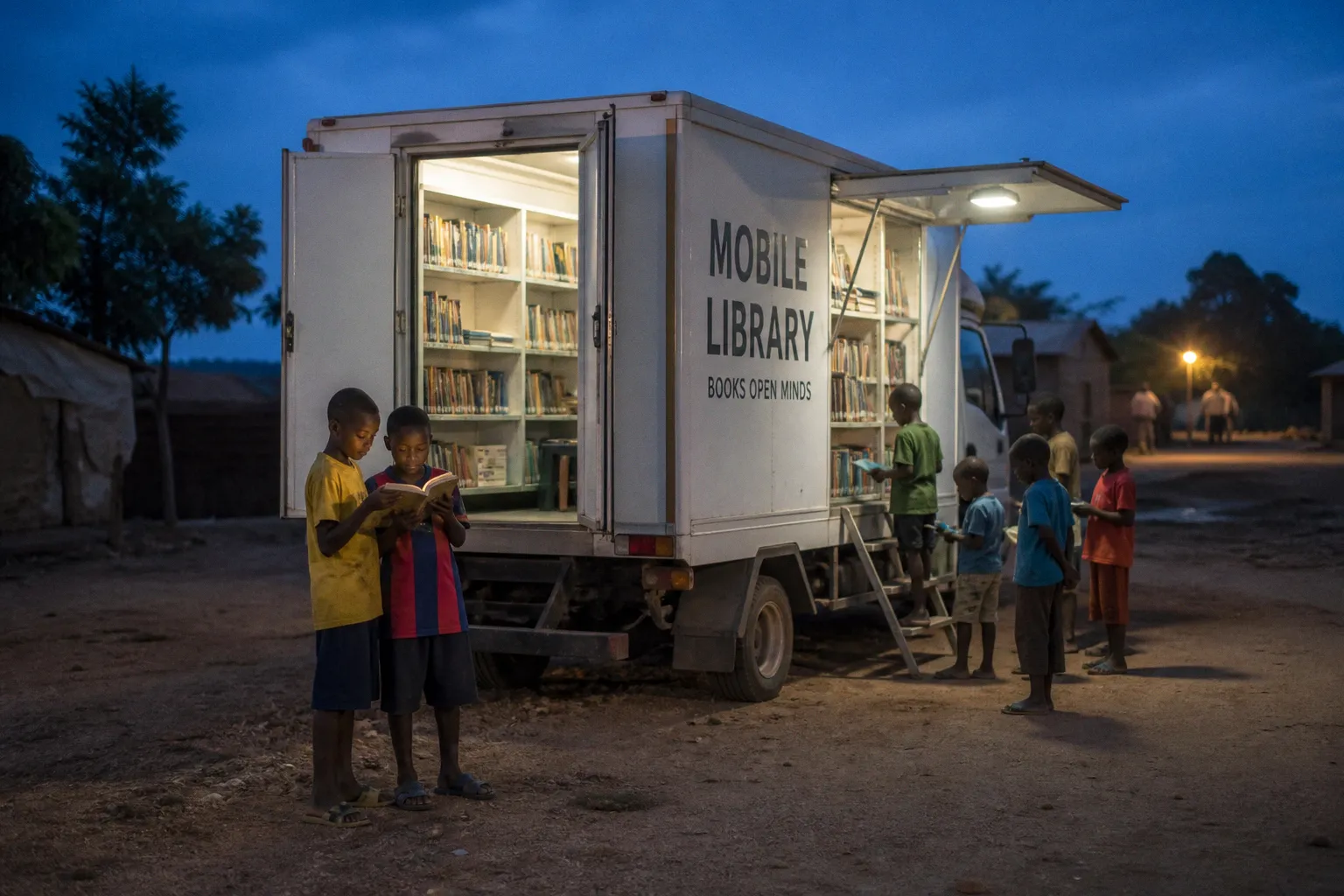
Their piece, "Mobile Libraries in Ghana and Education to Rural Communities," treats the library as a moving asset rather than a building. That is the correct framing for anyone running routes to forgotten classrooms.
The Ghana route on the map
By the Borgen Project's account, mobile libraries serve rural Ghanaian communities where fixed school infrastructure is thin or absent. A library vehicle — or, in leaner setups, a motorcycle convoy with strapped-down crates — runs a scheduled circuit, dropping reading material at villages that would otherwise go without. The article snippet does not give us the operator name, vehicle class, or book count; we can flag the model as a concept, but the specifics have to be verified against the original reporting before any field team copies the blueprint.
Why it maps onto our two-wheel work
Our Indian biker networks have been running the same mechanical logic for years. You anchor a fixed asset to a moving schedule — a blackboard strapped to a Royal Enfield, primers in a sidecar, a tarp over a stack of donated readers — and the dirt road stops being the showstopper. The school building can wait. The content cannot.
Mobile libraries solve three problems a permanent school cannot, in districts where the state has not yet arrived:
- Capital drag. No foundation pour, no roof truss, no contractor middleman. Reading material lands this quarter, not next fiscal year.
- Reach. A vehicle on a loop covers ten villages for the cost of one classroom. The marginal kilometre is cheap.
- Maintenance. There is no leaking roof to patch. There is a schedule to keep, and a schedule is fixable with a clipboard and a fuel receipt.
For volunteer biker networks mapping new rural school rebuilds, this is a planning question worth raising before the first brick is ordered. Does this community need a fixed reading room, or does it need a reliable mobile route? The answer shifts the entire budget line.
Field checklist before we lift the model
If a chapter is weighing a mobile-library extension alongside an existing school-rebuild haul, anchor the plan to these points:
- Operator. Who owns the route — local NGO, district education office, or a hybrid. Get the org chart in writing.
- Vehicle math. What hauls the load, the fuel cost per kilometre, and whose signature is on the fuel bill.
- Schedule discipline. A mobile library that misses its drop date is worse than no library at all. Pin the cadence, post it, enforce it.
- Book sourcing. Local print keeps money in the district and keeps titles relevant. Donated imports work for filler, not for the core reading list.
- Exit plan. Grants expire. Who keeps the route running when the launch money runs out? If there is no answer, do not start.
A mobile library is not a school. It is a delivery mechanism for content while the structure is being fought over, funded, and built. Run it like a route, not like a photo opportunity.